Section 5: Field Safety Planning and Preparation
The following sections outline the essential steps, considerations, and tools needed to identify, evaluate, and manage risks when planning and conducting field research.
Field Research Hazard and Risk Assessment Process
The first step in creating a field safety plan is to identify possible hazards that people may encounter when working in the field, travelling to the field, or during any overnight stays. A hazard and risk assessment identifies specific hazards, assesses the risks of those hazards, establishes proper work procedures to mitigate the risk. The assessment is then used to determine appropriate training for team members to avoid and mitigate risks as well respond appropriately if an accident happens.
This guide contains general information related to a broad range of hazards a field team may encounter. For site-specific hazards, expert consultation may be helpful; contact Environmental Health & Safety for assistance as necessary. A template for a field safety plan, including hazard and risk assessment, is available for the University of Nevada, Reno community using your NetID login.
Risk and Hazard Assessment
Some risks may be inherent in specific fieldwork being performed (e.g. altitude, climbing tower ladders, etc.), and these risks are an unavoidable condition of performing the work. Inherent risks should be identified and resources to mitigate risk should be made available to personnel exposed to the risk. Enhanced risks can also occur, and these are often avoidable (e.g. climbing towers with lightning present). Assessing the risks associated with field work will inform, via the field safety plan, how to accept and mitigate inherent risks while avoiding enhanced risk activities.
Field Trip Leaders are responsible for conducting a comprehensive risk and hazard assessment for each field-based activity to determine whether members of the University of Nevada, Reno community can safely participate in the proposed activity.
This assessment must:
- Identify hazards and associated risks for participants
- Prepare hazard mitigation procedures if possible
- Specify the risks and hazards to be addressed in the Field Safety Plan
- Establish criteria for participation by defining “go/no-go” criteria and benchmarks for continuing or withdrawing from the field environment
Components of the Field Research Hazard and Risk Assessment Process are provided in the following sections to assist your efforts. Hazard mitigation and control measures follow the risk and hazard assessment.
Identifying Hazards in the Field
Before starting any experiment or project, determine:
- What hazards are inherent to the field environment?
- What hazards are associated with transportation?
- What hazards are related to materials, equipment, or work activities?
- What could go wrong, and how could it happen?
- What are the worst likely consequences?
- What contributing factors may exist?
To assist this determination, you may want to perform a hazard analysis. Hazard analysis involves listing hazards from most serious to least serious along with their respective control measures.
Document the answers consistently in the risk assessment form. Good hazard descriptions should specify:
- Location – Where it could occur
- Exposure – Who or what could be affected
- Trigger – What might cause or precipitate an incident
- Consequence – The likely outcome
- Contributing Factors – Any other elements that could increase risk
Assigning Risk
First, assess severity:
- If exposure to a hazard occurs, how serious would the outcome be?
- Focus on the most probable severe outcome, not the absolute worst imaginable.
Then, assess likelihood:
- Assume a system or process failure occurs. How likely is injury given the current controls?
- Use accident data and lessons learned to inform your judgment.
You may want to use a risk matrix, which compares the potential amount of harm, or severity, of a hazard to its likelihood to occur in order to assign a risk rating. The risk matrix example figure shows a table format with the consequences as column headings (insignificant, minor, moderate, major and catastrophic), and the likelihood as row headings (almost certain, likely, possible, unlikely and rare). The cells in the body of the table are assigned a risk rating (low: 1-6, medium: 7-15, high: 16-22 and catastrophic: 23-25).
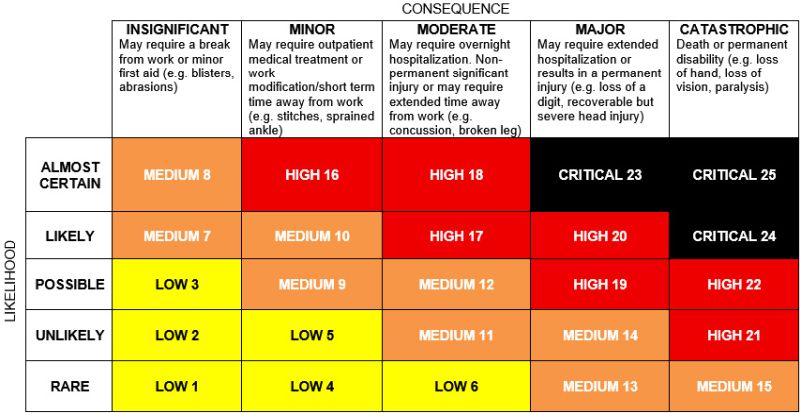
It can be argued that risk matrices are subjective and oversimplified for complex safety decisions, but their utility lies in their at-a-glance estimates of risk for purposes of risk reduction. If you chose to employ a risk matrix, a quick web search will provide instructions and examples of these common tools.
No matter how you choose to quantify or estimate the degree of risk associated with your field activities, document your findings in your Hazard and Risk Assessment. The PI or trip leader and field team must determine whether the risk level is acceptable before proceeding. If not, return to the control selection phase and revise the risk assessment.
Hazard Control Measure Selection
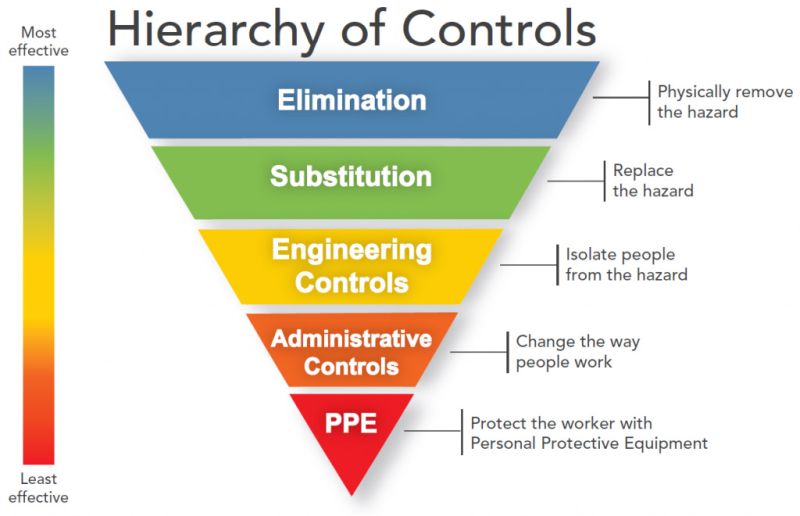
Consider the Hierarchy of Controls with efforts to reduce the likelihood of harm from identified hazards. The Hierarchy of Controls is used in the safety industry to rank control measures from most effective at the top (Elimination) to least effective at the bottom (Personal Protective Equipment). Choosing controls higher in the hierarchy is preferred, and a combination of controls may be best when possible. For example, not working in areas known to have rattlesnakes (Elimination) is a better option to avoid being bitten than wearing snakebite-proof gloves as personal protective equipment (PPE). Likewise, working with gopher snakes instead of rattlesnakes (Substitution) avoids the hazard of working with a venomous snake. In both cases, snakebite-proof gloves could serve as a final measure of protection when working with any type of snake.
The Hierarchy of Controls image is depicted as an upside-down pyramid shape showing the most to least effective safety controls which are in the order Elimination, Substitution, Engineering Controls, Administrative Controls and finally Personal Protective Equipment. Image attribution: NIOSHVector version, Michael Pittman, CC0, via Wikimedia Commons.
Not all controls are available for particular hazards, and the best options are generally chosen by the field supervisor and listed in the field safety plan. Elimination and substitution are self-evident. The following sections provide detail to help better understand the other areas of the hierarchy of controls.
Engineering Controls
Engineering controls are physical means to separate the worker from hazardous conditions that may cause injury or illness. Some examples used in fieldwork might include the following:
- Fencing, locks, and enclosures to keep workers and others away from hazards
- Air-handling equipment such as pressurized cabins in equipment working in areas where there are hazardous dusts
- Bringing samples back to a lab where work with chemicals can be performed in a fume hood
- Guards and de-energizing devices for tools and equipment to protect workers from hazardous machinery or energy sources
Administrative Controls
Administrative controls encourage safe work practices or discourage unsafe work practices through policies and procedures. These controls change or influence the way people work to encourage safety. Some examples of administrative controls used in fieldwork might include the following:
- Performing analyses as presented in a standard operating procedure (SOP) that calls for performing steps in a specific order, potentially with the use of specific PPE
- Using checklists and guides to help remember important steps
- Developing a field safety plan, performing a job hazard analysis, and performing safety briefings
Personal Protective Equipment
Personal protective equipment (PPE) is equipment, clothing, or accessories designed to minimize or prevent exposure to hazards. It’s important to realize that personal protective equipment is the least effective means of workplace hazard control; it protects workers from hazards but does not prevent access to the hazard. Some examples of PPE used in fieldwork might include the following:
- ANSI Z89.1 approved hard hats
- ASTM F2413 approved safety-toe footwear
- ANSI Z87.1 approved safety glasses
- Fall protection devices
- Climate-appropriate clothing
- Ear protection adequate for the work being performed
- Gloves appropriate to the work or substances in use
- High visibility clothing and vests
The employer is mandated to provide all required PPE for employees, but employee-owned equipment may be permissible. If employees are allowed to provide some of their own PPE, the employer is still responsible for ensuring that it is adequate for the work being performed as well as being properly maintained.
In some cases, employees may opt for additional PPE, which may be considered optional for the work being performed. For example, some people may take extra precautions to avoid sun exposure, or they may choose voluntarily to wear a dust mask or respirator for work where it may not be required.
Documenting and Updating Control Measures
The greater the severity of a credible worst-case scenario, the more robust the controls must be. Document existing controls and evaluate their effectiveness by asking:
“How likely is it that this scenario will occur with these controls in place?”
Review your assessment with your PI, supervisor, and experienced peers. Update controls based on past incidents, near misses, or lessons learned. If introducing new locations, procedures, or equipment, ensure everyone understands the new risks and the reasons for the changes.
Preparing the Risk and Hazard Assessment
You may consult this Field Safety Manual Development Guide for information about content to include in the Risk & Hazard Assessment component of your Field Safety Plan. You should also review institutional policies (e.g. Biosafety Manual and Exposure Control Plan) as applicable, and related departmental and government entity policies for required standards. Compliance with these standards ensures adherence to University of Nevada, Reno and state or federal regulations.
Testing Your Process
Where possible, perform a dry run in which work is performed under the following controlled conditions:
- Use a similar environment
- Work with less hazardous materials
- Scale down the process
After any trial, record observations and recommended changes in the hazard and risk assessment. Update your Field Safety Plan following any accidents, incidents, or near-misses.
Maintaining and Updating the Risk Assessment
When beginning fieldwork:
- Apply the controls identified
- Continuously evaluate their effectiveness during the activity
- Update the risk assessment whenever there is a change in location, scale, materials, equipment, or conditions
Share updated versions with your PI and team. Regular review ensures that assessments remain accurate, hazards are identified promptly, and controls continue to reduce risks effectively.
Field Safety Plan
Leaders of the field activity are responsible for preparing a Field Safety Plan that includes the following:
Research Details
- Research plan summarizing the fieldwork, working conditions, and proposed work timeline
- Weather to expect, what to be aware of if conditions change, and how weather may be monitored.
- Required personal protective equipment and safety items
Travel Routes
- Clear definition of each field site to be visited
- Include site maps and/or GPS coordinates when available
- Maps and site plans should be available in both offline (printed or downloaded) and online formats
- Routes to, from, and between all field sites
- Travel contingency plans for weather or unforeseen events
- Worst-case scenario exfiltration plans (primary and secondary evacuation routes)
Emergency Contact Information
- Local emergency numbers (e.g., police/sheriff departments, first responders)
- Contact details for relevant state and federal agencies (e.g., National Forest Service, National Park Service, State Park Headquarters)
- Departmental contacts to report emergencies
- BCN Risk Management for reporting all accidents and injuries occurring at work
- NSHE Worker’s Compensation office to report and handle workplace injuries
- Environmental Health and Safety for reporting, questions, and advice
Hazard and Risk Assessment
- Identification and likelihood of potential field hazards
- Hazard control measures
- Establishment of go/no-go criteria, expected no-go wait times, and benchmarks for continuing or withdrawing from the field
Equipment Requirements (Field Kit)
- List of required protective equipment
- List of required emergency and first aid equipment
Standard Operating Procedures (SOPs)
- Step-by-step instructions for how to perform certain tasks or procedures for planned field activities
- Focus on tasks that may be hazardous, where critical steps may be easily forgotten, or where a specific order may be important to field research data
- Bear in mind that these are administrative control measures; adequate detail in SOPs is helpful
Participant Information
- List of all field participants
- Emergency contact information for each participant
- Being mindful of HIPPA and privacy, consider adding a reminder that people who have allergies or medical conditions that they would like to share with the field team leader or all attendees should inform those who need to know
Field Safety Kit List
Field researchers must assemble a field kit with materials appropriate to the location and nature of planned activities.
- A complete list of kit items must be included in the Field Safety Plan
- Kit contents must be checked for completeness, functionality, and compliance before each trip