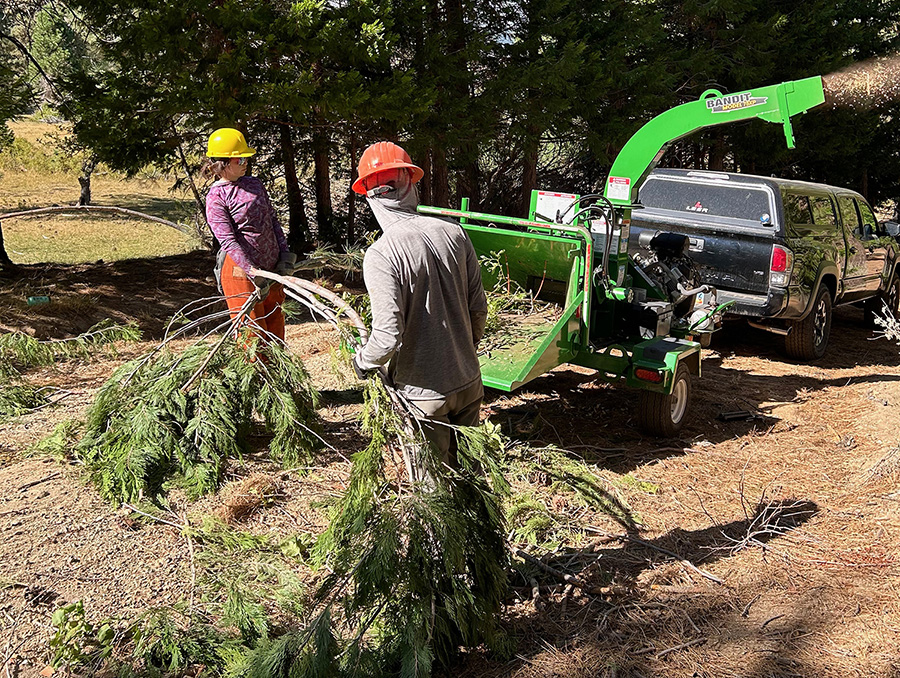
During National Wildfire Awareness Month, researchers, land managers and community partners are advancing a shared goal at the Little Valley Research Station and the Whittell Forest & Wildlife Area: reducing wildfire risk while restoring forests that can better withstand future fire.
That work recently received a major boost through a $3.55 million federal award from the U.S. Department of the Interior, funded through the Southern Nevada Public Lands Management Act. The six‑year project – Little Valley Wildland-Urban Interface Wildfire Mitigation & Fire‑Adapted Forest Restoration – runs from 2026 through 2031. It is led by University of Nevada, Reno researcher and Associate Professor Sarah Bisbing and forester Hunter Noble in the Department of Natural Resources & Environmental Science, part of the University’s College of Agriculture, Biotechnology & Natural Resources. Bisbing is director of the Whittell Forest & Wildlife Area, and Noble is the forest manager.
The project targets wildfire risk along the Sierra Front, where growing communities border fire‑prone forests. Research and restoration efforts will focus on reducing hazardous fuels, restoring fire-adapted forest structure and monitoring treatment effects on forest health and vegetation recovery.
What distinguishes the work at the Little Valley Research Station and the Whittell Forest & Wildlife Area is collaboration. The sites support active partnerships between University researchers and fire agencies, land managers and local communities working on the same landscape.
“The strength of this work is knowing it needs to happen and getting it done before the next fire arrives,” said Bisbing, who also conducts research as part of the College’s Experiment Station.
Interdisciplinary projects at the site have addressed forest fuels, post‑fire soil health, watershed impacts, drinking water quality, pollinator systems and climate‑driven change. That research, supported by more than $15 million in active and recent funding, is designed to inform forest and fire management.
“Fire doesn't wait, and neither can we.” - Sarah Bisbing, associate professor, Natural Resources & Environmental Science; director, Whittell Forest & Wildlife Area
Public engagement is also part of the model. The Fire & Fuels Education Seminar Series, hosted this spring at the Little Valley Research Station, brought researchers, land managers and residents together to discuss what works on the ground in restoring fire-adapted forests and reducing wildfire risk. The series featured speakers from academia, fire districts, nonprofit organizations and state and federal agencies, creating a space for shared learning and dialogue.
“Science only matters if it’s accessible and usable,” Noble said. “These seminars connect research directly to the people making decisions and living with fire risk.”
This collaborative approach is expanding through the launch of the Nevada Forest and Woodland Restoration Institute, a new effort led by plant ecologist and Assistant Professor Robert Shriver, a colleague of Bisbing and Noble in the Department of Natural Resources & Environmental Science who also conducts research as part of the Experiment Station. The institute is designed to accelerate applied restoration science, support cross‑boundary collaboration and translate research into practical guidance for land managers and communities across Nevada.
The institute also positions Nevada for inclusion in the Southwest Ecological Restoration Institutes (SWERI) network, a multi‑state initiative authorized by Congress to support science‑based forest and woodland restoration across the Interior West. SWERI works closely with land managers and stakeholders to deliver actionable research, monitoring and collaborative support at landscape scale.
“Nevada’s forests and woodlands face urgent challenges from wildfire and climate stress,” Shriver said. “This institute exists to turn that urgency into action on the ground.”
As wildfire seasons grow longer and more intense, National Wildfire Awareness Month underscores the importance of preparation and mitigation. At the Little Valley Research Station and the Whittell Forest & Wildlife Area, that work is grounded in collaboration, long‑term data and shared responsibility for Nevada’s forested landscapes.
This project was funded due to the Southern Nevada Public Land Management Act, which authorized the sale of BLM-administered federal lands within a designated boundary in the Las Vegas Valley and required proceeds to be used on projects to fund federal, state and local projects that benefit communities and public lands.


