
Thank you to the team at the University Libraries @One Center for producing and editing this episode.
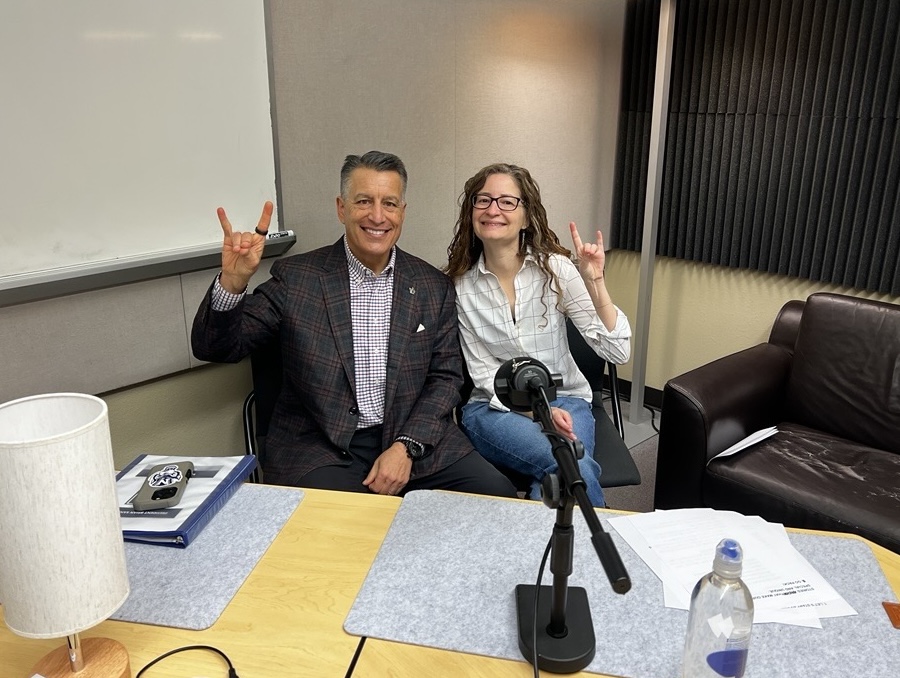
In honor of Earth Day, University of Nevada, Reno President Brian Sandoval speaks with Dr. Beth Leger, a foundation professor and the director of the University’s Museum of Natural History.
During the episode, Leger shares her passion for researching desert plants and what inspired her career path as a researcher. She also shares with listeners the importance of starting the state’s first native seed bank and how collecting native seeds will benefit generations to come. Additionally, she discusses the creation of the Museum of Natural History on campus, which sees thousands of visitors each year.
Sagebrushers is available on Spotify, Apple Podcasts and other major podcast platforms, with new episodes every month.

Sagebrushers season 5 episode 2: Director of the Museum of Natural History
In this episode of Sagebrushers, University of Nevada, Reno President Brian Sandoval speaks with Dr. Beth Leger, a foundation professor and the director of the University’s Museum of Natural History.
President Brian Sandoval: Welcome back, Wolf Pack Family to Sagebrushers. I'm your host, Brian Sandoval, a proud graduate and president of the University of Nevada. Today, we are recording in the @One podcast studio of the Matthewson-IGT Knowledge Center. Our guest today is quite intimately familiar with sagebrush. In fact, in addition to her role as the director of the Museum of Natural History. Dr. Beth Leger is an expert in the desert shrubs of Nevada's landscapes. Dr. Leger received her bachelor's degree in biology at Lewis and Clark College, then went on to earn her doctoral degree in ecology at UC Davis. She started working here 20 years ago. Dr. Leger is a foundation professor, was named the University's 2025 outstanding researcher in STEM, has received mentorship awards and even has a plant named for her by a colleague. Welcome, Dr. Leger. Thank you so much for being here.
Elizabeth Leger: Yay, thank you so much for having me.
Sandoval: I am really looking forward to this conversation. So, let's start by exploring some of your research. Your work deeply connects you with the landscape in Nevada. What got you excited to study plants here at the University of Nevada?
Leger: Yeah. Well, our desert plants are the most amazing individuals. They have to deal with cold, heat, cold, then heat. We have spring like 12 times every year and then it gets cold again. And these plants cannot get up and move. They have to live their whole lives out there in Nevada and just take whatever it throws at them. And the amazing thing is they've been doing this for millions of years without our help, and they are experts at living in these harsh conditions. And it's just so fascinating to go and see the diversity in the desert.
One of the things I love so much about the desert is how much it changes year to year. I always make fun of my colleagues who study trees because trees look the same every day of the year, practically. Maybe they're a little more green or a little less green, but they don't change as much as the desert. The desert, one year you can go out and it's a blanket of little wildflowers. Then the next year, there's absolutely nothing. Then there's just so much change that happens in this very subtle way. You do have to get down on your hands and knees to see some of these plants, but they are spectacularly cool, and they deal with harsh conditions.
Sandoval: When did you know? I mean, when did you know when you were an undergrad, when you were a kid and you got interested in that and it evolved?
Leger: It was actually when we were at Davis. My husband and I were grad students at Davis, and I was studying the California poppy, which is the most enormous, luxurious plant. It's got a huge flower, and it's very gaudy, and everyone thinks it's beautiful. So, it's a very obvious thing to study. Then my husband had an opportunity to come to Nevada and do a resurvey of some butterflies that had been surveyed in the 70s. And so he and I just went on a road trip across Northern Nevada, totally unprepared for the fact that nobody ... We didn't see anyone for five days practically driving across Northern Nevada and just realizing that you could just pull over anywhere and see this amazing wild nature, stop and camp and keep going. That whole experience of sort of traversing Northern Nevada when we were grad students really planted the seed of wanting to live here.
Sandoval: No pun intended.
Leger: I actually did not intend that. When this job came open, we were actually living in New York and Matt saw it and he poked me and he said, “I think this is your job.” And I was like, “Yes, you're totally right.” This is just the desert itself was the thing that sort of seduced us into this place and this place.
Sandoval: And so, you were a plant person even from childhood?
Leger: My dad was a huge gardener, and I just loved being outside with him. I just remember putting seeds in the ground with him, and he would let me walk on the soil to sort of tamp it down. He would always say, "You can give the plants a drink." So I got to water them. It was very calm and just bonding time with my dad. And I would watch the plants change over time where we grew up. I do think that some people are just sort of more inherently attracted to the slower, more quiet things. I see that even in my students, the students who go on to study plants, they know about their childhood weeds, and they used to play with them and look at the seeds. I do think that it was sort of instilled early on.
Sandoval: So in the mountain west, we've had a lot of wildfires.
Leger: Yes.
Sandoval: Unfortunately. How is your work related to wildfire or other landscape disturbances?
Leger: Yeah. So, we do love lighting the desert on fire. That's something that humans are really good at. And we had this unfortunate introduction of a bunch of alien annual grasses like cheatgrass that are very, very flammable. This combination of European settlement with this very inflammable grass has led to this condition where we have these huge wildfires that are beyond the scope and scale of what used to be happening here. And so one of the things we try to do as humans is put back the plants that we want after those wildfires. So, there's a huge operation in Nevada. It's actually home to the biggest ongoing seeding project possibly in the world. We get so many seeds after these fires. It's huge and it's a huge operation. One of the things that I realized when I first came here 20 years ago, though, is that those seeds that we're planting in Nevada are not from Nevada.
They're mostly collected from northern places, wetter places grown on farms and then brought back to Nevada. And they don't know how to deal with Nevada's five to seven to eight-inch precipitation a year. And so we're taking things from Montana where they used to get 20 inches of precipitation a year, planting them in Tonopah, and that doesn't work very well. So early on my research was figuring out what helps the plants of Nevada live here. What characteristics do they have that help them grow? And Nevada's covered with plants. When you drive out there, we clearly have our own resource of plants that live here and they are better adapted to Nevada's soil and climate. So working on figuring out why and how and who.
Sandoval: So, this evolved into something what I believe is really cool, but the Nevada Native Seed Bank. What is the seed bank and why did you start it?
Leger: The Nevada Native Seed Bank is one of my favorite things. It is designed to collect Nevada seeds and bring them here and store them for restoration use. We provide them to farmers who are interested in growing them out and we store them for future generations. So, seeds are unique in that we can keep those particular individuals alive for tens, fifties, maybe hundreds of years. So, the future generations are going to thank us for taking Nevada's plants and putting them in this seed bank. So, we both clean seeds, which means people always think that means soap and water. That's not what that means. People go out and they collect wild seeds and they bring them back and they're covered with all these different parts and sticks and flower material. And so basically we have a whole bunch of undergraduates who are super awesome employees doing the work of rubbing them, separating the seeds from the chaff, blowing that off. We have a whole bunch of specialized equipment. Sometimes we just have to use our hands if it's really delicate seed. And so we turn them from these sort of like grocery bags of stuff into these sort of more like Ziploc bags of clean seeds. And then those can go into long-term storage or they can be given to farmers to grow out. So it's been a really awesome thing. It took about 10 years to create this resource. And this year is the first year that we are processing about a hundred collections from Nevada that were done all across the state, and they were brought here. And so we have you and our undergraduates processing Nevada seeds for storage in Nevada for the first time ever. So it's pretty great.
Sandoval: It is great. And so, are we talking sagebrush?
Leger: Yup.
Sandoval: And trees?
Leger: Yup, grasses and forbs, flowering plants, all kinds of things. We've processed almost 200 different species at this point. There are 3,651 plant species in Nevada. So we don't have one of everything at this point, but that we could aspire to that.
Sandoval: And for the listeners, so they can envision. You said something about bags, but I mean, what's the quantity of seeds?
Leger: Well, we take all different sizes, but it is funny. One of our units of measurements is grocery bag. If someone calls us and they have a collection, we say, “how many grocery bags?” And they say, “six grocery bags.” That's sort of the scale that we process here. We can do very small things. For Nevada's rare plants, you don't want to over harvest. So we can very carefully and delicately process really small collections. We can do larger collections if they're sort of a more agriculturally grown collection. So we do everything from the teaspoon to the truckload here.
Sandoval: And is this common? I mean, do other states have native seed banks?
Leger: Yes, and that's the good thing about Nevada, we don't have to reinvent this wheel. We can go around the world literally and look at the absolute top standard. Our seed bank manager and creator, Shannon Swim, she went to Kew Gardens in England and looked at their seed bank. It's the Millennium Seed Bank. It's the world's most premier facility. She went there, she saw what they do, she was trained under them, and then she was able to come back here to UNR and recreate that sort of flow here. So yes, we're not first, so we get to benefit from all these other expertise around the nation and the world.
Sandoval: But in Nevada, we're the only, correct?
Leger: We are the only. Yup, and California has one. They've had one for a hundred years. So we are a little bit late to the game, but what's the saying? The best day to plant a tree 20 years ago, next best day today, right? So we're doing it today.
Sandoval: No, I like that. So let's shift gears a little bit and move to the Museum of Natural History, which you started along with Dr. Chris Feldman back in 2013. So, can you tell the audience about the collections and the goals of the museum?
Leger: Yes. So that is another very fun part of my job here. I absolutely love it. The collections that we have at UNR date back to before Nevada was even a state. We have collections from the 1850s that people were—they collected plants and animals and were holding them. And then when the University was formed, they were put into a repository here. So they've been building for over a hundred years. And when I came here in 2006, my friend Chris Feldman was taking care of the collections. They had been moved off the main campus out to this Stead Terawatt facility. One Halloween, he invited me to go out there with him to see these collections. And I was like, sure, I'll go with you and look at them. And when I saw them, I was like, I cannot believe this stuff is not available to the public and it's not available to researchers. You know that facility is quite hard to get into. And at that same time is when the Knowledge Center was being built, and they took the life sciences and all the other libraries and moved them into this building. And that opened up that suite in Fleischmann Agriculture on the top floor. So, all these things were sort of happening at the same time. I got to see these collections, just had this real feeling like, this needs to be shared. These are spectacular. We cannot just have these in the dark.
And then this space opened up. So the deans of College of Science and College of Agriculture at that time, it was Ron Pardini and Jeff Thompson was the dean of the College of Science. We all got together and we proposed to the University that we turned that life sciences library into a museum. And amazingly, the University agreed. It was Jannet Vreeland at that time who agreed. She funded a renovation of the space and we got to make an awesome classroom that's super, super cool. And so we got to move all of UNR's collections for the first time from these little satellite areas all into one place on campus. And we just threw open the doors to undergraduates and graduate students, to the public, to classes and we have been sharing it ever since.
Sandoval: So you get about 4,000 visitors a year?
Leger: Yep. I think last year was over 5,000. We kind of exhausted our outreach coordinator, Cynthia Scholl. We have two to four visits a week up in the museum. It's so fun.
Sandoval: No, that's incredible. So, what keeps it running? What's the funding?
Leger: Yes, well, I was going to say love and fumes. A lot of it is, again, we get donations from individuals. We've been supported by the Charles Stout Foundation since the beginning. Colleges of Agriculture and College of Science help us with our staffing. And again, multiple private gifts have helped. Another huge resource that we have here at UNR is our graduate student population. They are incredible. They are the workforce behind our big events. We give them free creative reign to design outreach activities and they just put so much work into it and they do these creative things. So when people from the public come on the Saturday, they will interact with UNR's wonderful graduate student population who are so delightful and so creative. And they're in the midst of their training and their thinking and their creativity and they don't have to go to a million meetings. You know what I mean? They're the most wonderful ambassadors for the museum and the public.
Sandoval: So, obviously it's an amazing museum, but there's real research going on.
Leger: Absolutely.
Sandoval: So, talk a little bit about that research.
Leger: Yeah. So one of my favorite two projects I love that came out of the museum recently, one I did with undergraduates where, again, observing the plants of the Great Basin and thinking about how they're changing with the introduction of cheat grass and the fires that we have. I've started making these observations that I think the native plants are getting smaller over time. I think that when resources are limited, these plants cannot grow to the size they used to, that they're just getting smaller. But it was sort of an observation that wasn't really proven. So I had some undergraduates go through our plant collection, which is spectacular, and literally just like measure how tall they were over time. We did that for, I want to say, six or seven different species. And lo and behold, five of them were getting smaller over time, which is what I thought.
And then one of them was getting way bigger. And this one, it's Mentzelia albicaulis. It loves fire. It loves disturbance, and it loves Nevada's current situation. And you can pick that signal up in our plant collection because it's huge. It's big and getting bigger. So there are these clues in there about what plants ... or how plants are changing over time and which plants might be sort of winners, right, in the years to come. So that's one example. I can give you another one if you want.
Sandoval: Sure.
Leger: So another super fun one, we had a postdoc here, Nazy Balmaki, who's now a faculty at Texas A&M. And she did this work looking at pollen stuck to the legs of butterflies in our collection over time. So she washed pollen off the butterfly legs with alcohol and then identified all the species of plants that these butterflies have been interacting with and looked at change over time and was able to see that the contemporary collections have less complicated interactions with plants, whereas the butterflies from, you know, 50, 75 years ago have more complicated pollen mixtures on their legs.
So there's really a snapshot of what Nevada used to look like, that you really cannot get anywhere else. People have done DNA analyses from these. For mining, you can actually look at heavy metal concentrations in plants and find areas of potential mining interest and chemical changes. Yeah, it's just an absolute treasure trove.
Sandoval: It's just fascinating. So we're getting short on time, but I'm going to have one more fun question. We all love living in Northern Nevada and wanted to ask you what your favorite part of Northern Nevada is besides the sagebrush.
Leger: Well, my favorite part of my job is, as you can tell from this interview, I feel like I've gotten to live three different careers in one. And that's the thing I love about Nevada is how much opportunity there is. We all get to wear a lot of different hats, and that is just something that's very unique to this place. As a resident of Nevada, I love the plants and the wild animals around us. We live within the McCarran Loop, but we have bears and coyotes and a bobcat just wandering through our canyon. I watch the flowers every year, and I keep track of when I see the first flower of the year. It's right in my backyard, and it's a wild plant. I didn't plant it. I just love how close we are to nature, and I think it's easy to forget in Reno how lucky we are to be mere steps away from wild nature.
Sandoval: No, and I couldn't say it any better because we are very blessed to live where we live. So I'm really grateful for spending time with you, but unfortunately, that's all the time we have today. So join us next time for another episode of Sagebrushers as we continue to tell the stories that make our university special and unique. Dr. Ledger, thank you.
Leger: Thank you so much.
Sandoval: All right. Thank you again and go Pack.
Leger: Go Pack.


