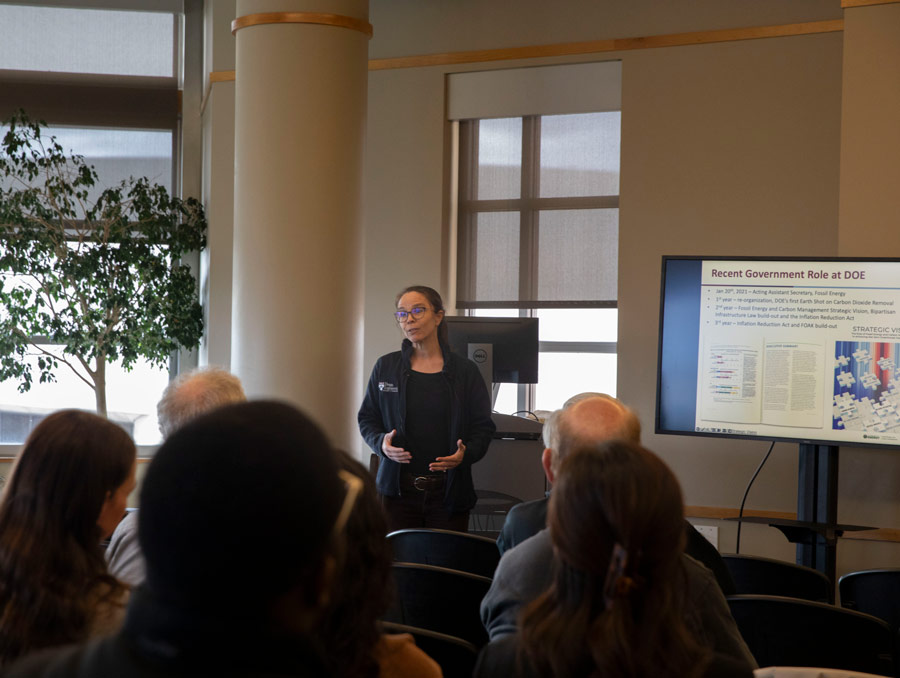
Last month, the fourth season of the Energy Solutions Forum concluded with Jennifer Wilcox, who spoke to the audience about carbon removal policy and science. Wilcox is the Presidential Distinguished Professor of Chemical Engineering and Energy Policy at the University of Pennsylvania (U Penn) and has appointments in the School of Engineering and Applied Science and in the Kleinman Center for Energy Policy.
Wilcox’s work spans industry, academia and government. She is the Chief Scientist at Isometric, a company developing science-based carbon removal protocols and digital monitoring systems for the industrial economy. She previously served as the Principal Deputy Assistant Secretary for the U.S. Department of Energy’s Office of Fossil Energy and Carbon Management, where she helped guide the national carbon management strategy and implementation efforts under the Bipartisan Infrastructure Law and Inflation Reduction Act. Wilcox is a Senior Fellow at the World Resources Institute, where she helps advance carbon removal policy solutions. She also wrote the free, open-source Carbon Dioxide Removal Primer and has been recognized as one of the TIME 100 most influential climate leaders in business.
In her research lab at U Penn, Wilcox studies scalability of carbon dioxide capture and storage. Her experience across academia, industry and government positioned her to discuss both scientific and policy challenges associated with scaling carbon management technologies.
Wilcox said that one of the biggest challenges facing these technologies is planning long-term deployment strategies amid shifting federal priorities and policy uncertainty. However, state and local governments are enthusiastic about carbon capture and sequestration technologies and have continued to develop and invest in them.
Wilcox didn’t start out studying carbon capture. She was researching combustion science and mercury emissions from coal-fired power plants when she heard an NPR interview that shifted her perspective.
“I realized that I had the skill set and the background to shift and pivot into that field, because I recognized, although mercury is also an important pollutant, that carbon dioxide is more important,” Wilcox said. “At that moment, I made a decision to pivot all my research and all my work to focusing on carbon.”
While the transition may have appeared dramatic, Wilcox explained that the core principles of chemical engineering translated naturally to carbon capture and removal technologies. Her work has since expanded to include broader greenhouse gas mitigation and industrial decarbonization challenges.
The reason for Wilcox’s turn toward carbon removal, a conversation heard coincidentally on public radio, is something the founder of the Energy Solutions Forum, Mick Hitchcock, hopes to replicate with the series. By establishing a forum dedicated to climate and energy challenges, Hitchcock hopes these conversations can spark new collaborations, research directions and technological innovation.
The Energy Solutions Forum returns in the fall with speakers on sustainable concrete production, solar panel recycling and nuclear power.


