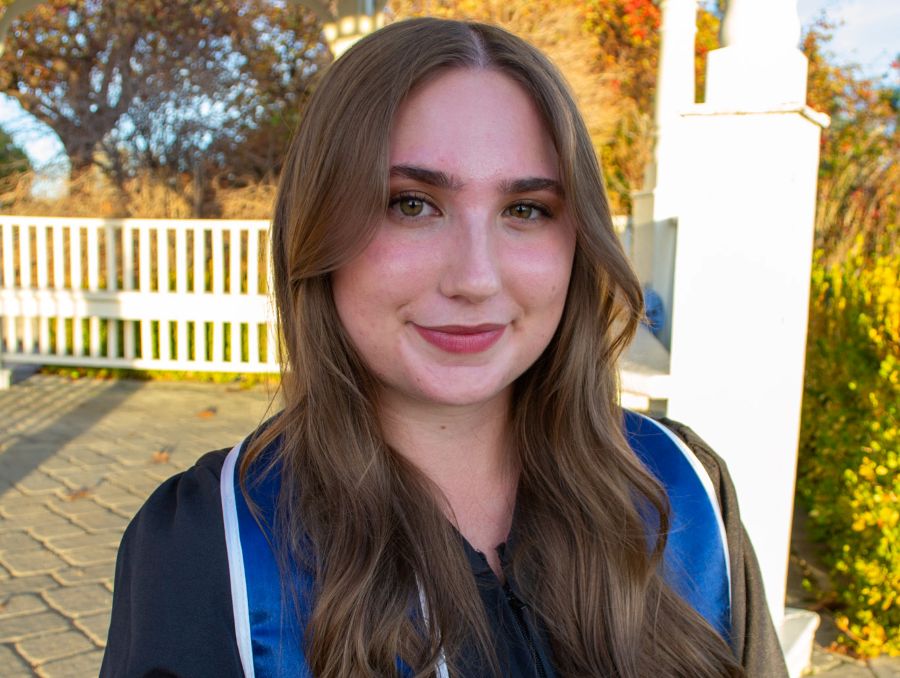
Not every researcher sets out to study something close to home. But sometimes, the work has a way of finding you. For University of Nevada, Reno alumna, Isabella Durda, research has had a personal and meaningful connection to her everyday life.
When she first started studying at the University her freshman year, Durda didn't know if research was something that she was interested in. It wasn't until she applied for the Pack Research Experience Program (PREP) award that she realized it was.
“I had never done research; I didn't even know I was really interested, but I just saw the PREP program, and I didn't have anything to lose,” Durda said. “I ended up getting my first-choice lab.”
She was placed with Associate Professor of Psychology Sarah Haigh, Ph.D. focusing on physiological responses to sensory stimuli.
“We know that certain patterns are uncomfortable and can cause discomfort among individuals,” Durda said. “It was more so those patterns combined with certain color combinations. Do certain color combinations affect the discomfort or the cognitive performance more so than others?”
Durda went on to continue through PREP for a second semester and later received a Nevada Undergraduate Research Award (NURA) to continue her work with Haigh in the College of Science. As she continued, Durda’s research expanded to show the differences in the discomfort between non-headache groups and migraine groups.
For Durda, the research hit closer to home than she expected. As someone who experiences severe migraines and is highly visually sensitive, she found herself connected to the work she was doing every day. At one point, she decided to run herself through the experiment. She lasted two minutes.
"When you're doing research and it aligns with something that you experience in your life, it makes it a lot more meaningful," Durda said. "I can really empathize with the people going through it."
After she graduated in December 2025, Durda was able to take the project she had been a part of since the beginning and turn it into a manuscript. On April 24, 2026, "Discomfort and reading speed: Effects of migraine" was published in Perception, a peer-reviewed journal through Sage. Her name is listed alongside Haigh as co-author.
"It's hard to put into words how rewarding that is," Durda said. "It's very cool to have this little chapter of my life encapsulated in the paper."
Durda credits Haigh with playing a significant role in shaping who she became as a researcher. She describes her mentor as honest, kind and never afraid to give direct feedback even when it was hard to hear early on.
"She never made me feel stupid for not knowing things, but at the same time, she wasn't afraid to be honest," Durda said. "I think it made me such a good researcher later."
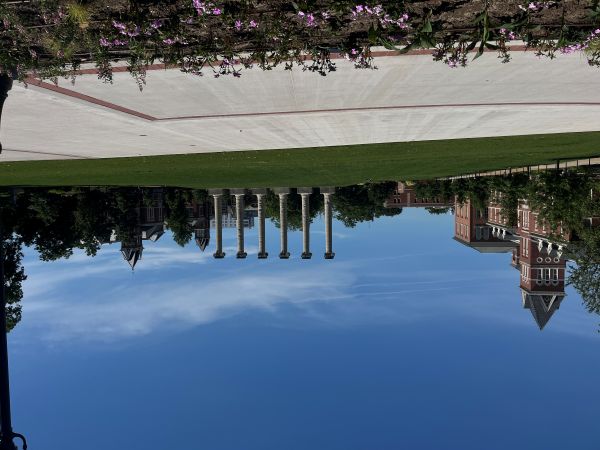
Now Durda is taking everything she learned at the University of Nevada, Reno to the University of Missouri, where she is pursuing a doctoral degree in occupational therapy. She has already landed a position as a research assistant in the occupational therapy department, and says she feels confident going in because of the foundation she built in Reno.
For students still on the fence about pursuing research, Durda's advice is straightforward: just try it.
"Don't be afraid to be wrong; don't be afraid to look stupid,” she said. “It is always better to clarify or ask a dumb question than wish you had asked it. Those are things I realized quickly, and I think it served me incredibly well, and I think it will continue to do so as I move into my next adventure.”


