On the first morning of the 2025 Nevada Aphasia Camp, participants gathered in a circle inside a yurt at the Sierra Nevada Journeys Grizzly Creek campus. Campers — people with aphasia, care partners, speech-language pathology (SLP) students and facilitators — sat as equals.
The session opened with a guided meditation led by Mary Kramer, accompanied by guitarist Kjell Phillips, creating a calm space without pressure to speak.
The main exercise was simple but profound: each camper wrote “I Am” statements on a whiteboard. For people with aphasia, it was a chance to affirm identity beyond their diagnosis.
One by one, participants shared: “I am strong. I am resilient. I am hopeful.” Some spoke their words, others had a partner read, but all expressed resilience, humor, gratitude and hope.
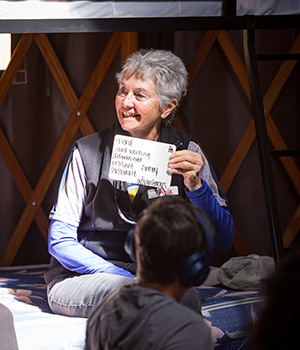
By the end, the circle of strangers had become a community, setting the tone for the weekend as a place where every voice — however expressed — was valued.
“The meditative connection session was really beautiful because everyone was so vulnerable and generous in sharing part of themselves,” Maria Ballesteros, M.S., CFY-SLP, a Class of 2026 SLP master’s student, said. “You have to be really strong to do that. I felt blessed to be in that space, to witness people’s stories. It was beautiful, and I felt really lucky.”
The roots of Nevada Aphasia Camp
Last year marked the third annual Nevada Aphasia Camp, co-founded by community leaders Zack and Sara Holm, Angie DiPrinzio and Estelle Sanders, along with Tami Brancamp, Ph.D., CCC-SLP, associate professor at the University of Nevada, Reno School of Medicine (UNR Med) Department of Speech Pathology and Audiology.
“This camp was founded in partnership with people who have aphasia,” Brancamp explained. “At the Aphasia Center of Nevada, we let our members drive the programs. A couple of them loved outdoor activities and wanted a camp experience. I’m more of a glamper myself,” she laughed, “but this was the compromise. Camp provides opportunities for stroke survivors to reclaim independence and joy in the things they used to love.”
The camp grew out of the connections made through the Aphasia Center of Nevada — and now, it’s a place where people return each year to strengthen bonds and create new friendships.
Zack Holm, who had a stroke 10 years ago, has been there since the beginning. “At first, I had no speech at all. Now it’s a little better — not perfect, but better. This is my third year at camp, and it feels like a family. Every year, the friendships grow, and we all get a little stronger together.”
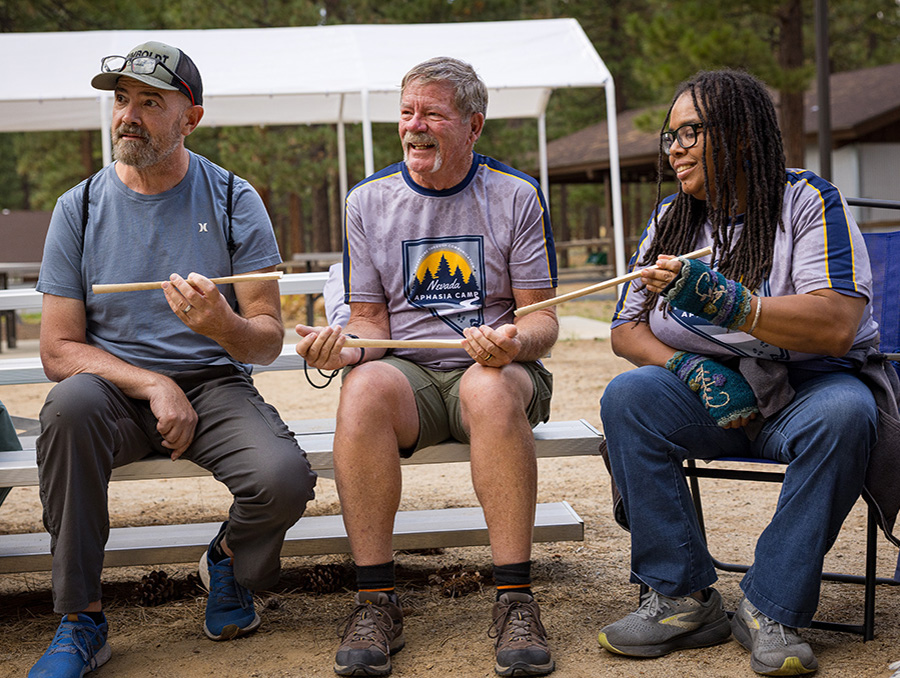
This year, 34 participants filled the camp to capacity: 13 individuals living with aphasia, eight care partners, seven student leaders (six master’s students in speech-language pathology and one medical student pursuing neurology), and dedicated volunteers. Their motto: adventure through communication.
“Each year we look forward to seeing old friends and meeting some new ones too,” Sara Holm said. “Zack loves working with the UNR Med master’s students and always tells people how fired up and energized they are and how much that transfers to him when he gets to work with them in therapy and at camp.”
Sara also praised the staff who make the experience so meaningful. “I think the Sierra Nevada Journeys facilities are hard to beat, and the staff we’ve gotten to work with are caring, quick learners and super fun,” she said. “I love seeing some of our friends with aphasia really thrive and shine when they’re given a little — guided and incredibly supported — independence in the Aphasia Camp setting and structure.”
What is aphasia?
Aphasia is a language disorder, often caused by a stroke, traumatic brain injury or brain tumor. It can affect a person’s ability to understand and use language, including speaking, reading, writing and, in some cases, mathematical skills. More than two million Americans live with aphasia, yet nearly 85% of the public has never heard of it.
“Most of us know someone, or know of someone, who has suffered a stroke,” Michael ‘Doc’ Vaugh, said. “However, about one-third of all stroke victims additionally suffer from aphasia. Here lies a real lack of awareness by the general public about this disability.”
That lack of awareness can deepen isolation. People with aphasia are often mistaken for having a cognitive disability or avoided because conversation requires patience. At camp, that stigma falls away. Every mode of communication is welcome: spoken, written, gestured or expressed.
Stories of strength and determination
Every camper brought a unique journey to the 2025 Aphasia Camp.
Angie DiPrinzio
Before her stroke in 2008, Aphasia Camp co-founder Angie DiPrinzio worked at a construction company and as a part-time fitness trainer. When the stroke left her unable to speak for nearly two years, the path forward looked daunting. Her early days were filled with frustration: not being able to find words, struggling with movement, and facing uncertainty about the future.
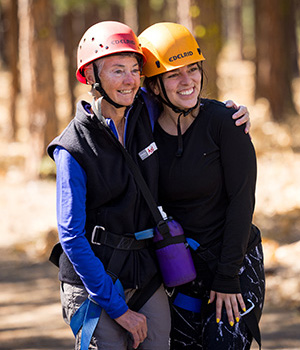
Seventeen years later, DiPrinzio has worked hard to reclaim independence. She walks with a brace, rides a trike through her neighborhood, and participates in adaptive fitness classes. Her personal motto, “Yes I Can,” has become more than just a phrase — it’s the way she approaches each challenge.
“I want to do more than survive; I want to thrive,” she said. At camp, DiPrinzio was quick to share encouragement with others, cheering them on and offering the kind of empathy that only comes from lived experience.
“Angie is the most determined person I know,” said Brancamp. “When I am struggling, I often think of Angie — and then I push myself to do the hard thing.”
That determination has left a mark on others, including Jessica Giron, M.S., CCC-SLP, a SLP graduate who first attended camp as a student in 2024 and returned as a volunteer last year. “What I love about camp is the connection and community. It’s an honor to help someone communicate again, even in small ways. Everyone deserves to be heard.”
Giron recalled one moment with DiPrinzio that still brings her to tears: “We worked for weeks on building a full sentence, and one day she said, ‘Estelle goes to the supermarket every day to get vegetables.’ It may sound simple, but it was a huge breakthrough. We hugged, and I cried. Moments like that are why I come back.”
Michael ‘Doc’ Vaughn
Known affectionately as “Doc,” Michael Vaughn spent his career immersed in language and culture. In 2019, however, an accident with an out-of-control skier followed by a stroke left him with aphasia, creating communication challenges that were often difficult for others to understand.
“I have two undergraduate degrees, a master’s and a Ph.D. I speak four languages and play a number of musical instruments,” Vaughn said. “But aphasia has turned my life of communicating, writing, listening and speaking upside down. It can be very difficult to have meaningful discussions with people who don’t understand — or aren’t willing to understand — and it can take me time to respond,” he explained, often describing the daily frustration of being misinterpreted or underestimated because of his speech.
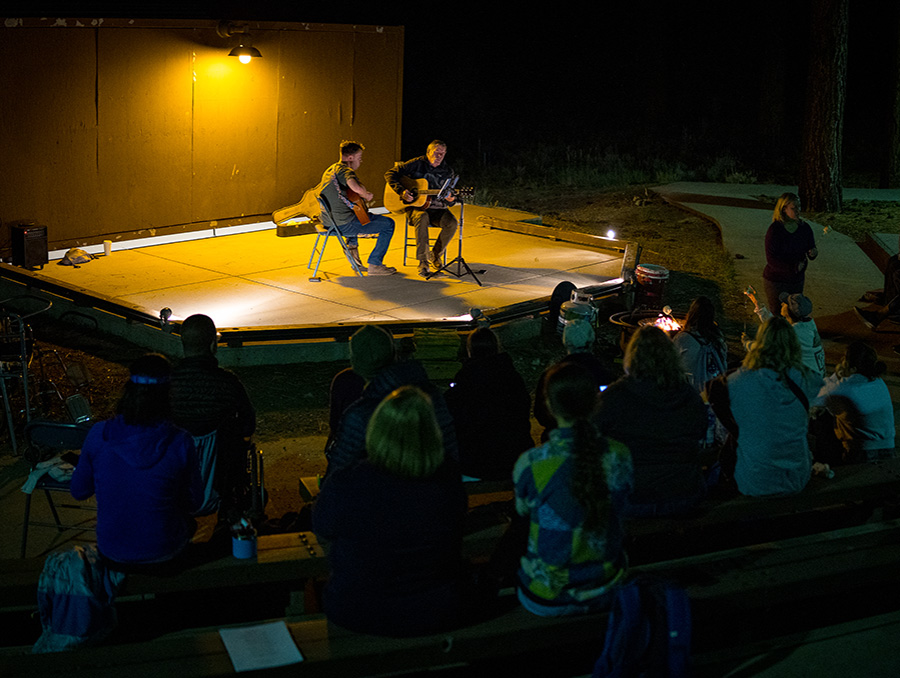
Camp, he says, is one of the few places where that weight lifts. This year, he surprised the group by picking up his guitar and playing in front of others for the first time since his stroke. For Vaughn, music has always been a form of language, and that performance became a breakthrough moment not just for him but for everyone listening.
Reflecting on the experience, he said, “I can’t say enough about it — the faculty, especially Dr. Brancamp and the grad students helping us — it’s fun to be with them, and I look forward to coming again, and I want to see so many more get to experience this.”
Julie Hardt
A world-class swimmer and accomplished coach, Julie Hardt is no stranger to discipline and perseverance.
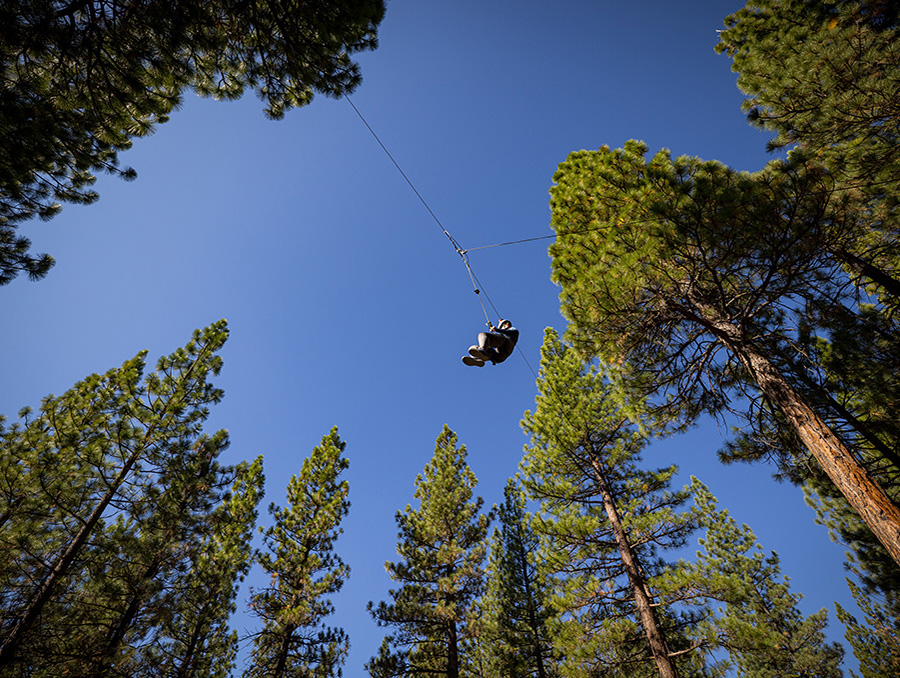
An American record holder in swimming, with a Ph.D. in sport psychology and, most recently, an assistant coach at the 2024 Paralympic Games, Hardt’s life shifted after a brain tumor left her with anomic aphasia, a form that makes it difficult to find certain words.
For her, the challenge hasn’t been just finding words — but navigating how others perceive her. "At camp, I don’t have to explain or apologize. I’ll get there eventually,” she said, “even if I’m slower than normal. I’m still me.”
Demetrius Moreno and Janu Orrick
In 2022, Demetrius Moreno suffered a major stroke that altered the course of his life. In the years since, he has focused relentlessly on recovery — relearning speech, regaining movement and adjusting to a new way of life.
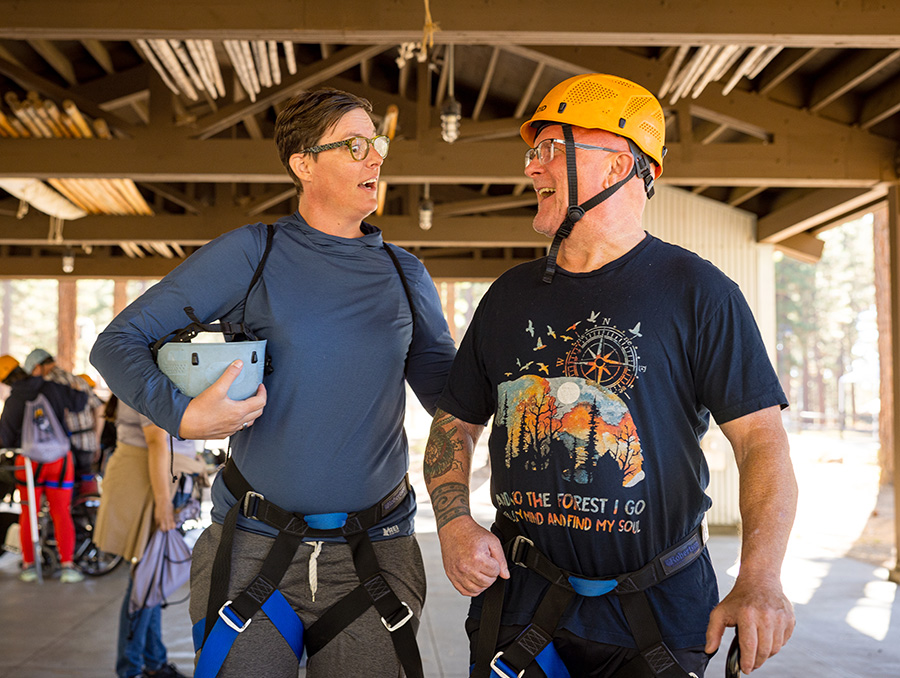
This year was Moreno’s first time at Nevada Aphasia Camp. For him, simply being there was a victory. “At first, we were told he would never walk or talk again,” Janu Orrick, Demetrius’ care partner, said. “It took a month before he could swallow, but I knew he would prove them wrong. Today, Demetrius works tirelessly every day on walking, talking and regaining movement. His determination and spirit inspire everyone who knows him.”
Together, they’ve even created AphasiaPals.com, a platform to connect others with communication partners.
Ricky and Audrey Ahumada
Audrey Ahumada attended camp this year with her husband, Ricky, who had a stroke nearly 10 years ago, resulting in aphasia.
“Ricky has experienced things he never thought he could do, and it has really brought out his confidence and independence,” Audrey said. “Seeing him push himself and succeed was incredibly fulfilling — not just for him, but for me, too. It showed me he can do hard things.”
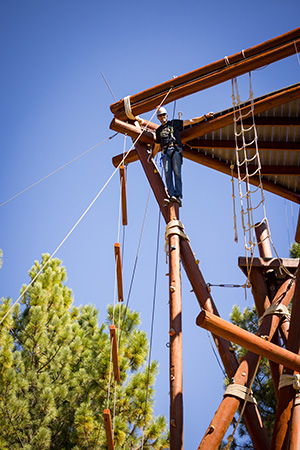
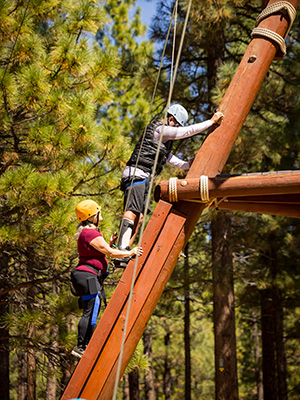
This year, with Audrey by his side, Ricky climbed the Alpine Tower, cheered on by the entire camp. Together, they faced the fear and challenge of the climb, proving that determination, courage and support can transform even the most daunting obstacles into triumphs.
Lessons beyond the classroom
For the speech-language pathology students — and the first medical student camper — the weekend at Nevada Aphasia Camp was transformative.
“In class, we learn about aphasia,” said Chloe Yocom, M.S., CFY-SLP, a Class of 2026 SLP master’s student, “but here we see how it truly affects lives.”
The immersive environment allowed students to experience firsthand what textbooks could never capture: the patience, creativity and empathy required to truly communicate.
“During my time here already, I’ve heard the most amazing stories and seen so much resilience from these people,” Yocom said.
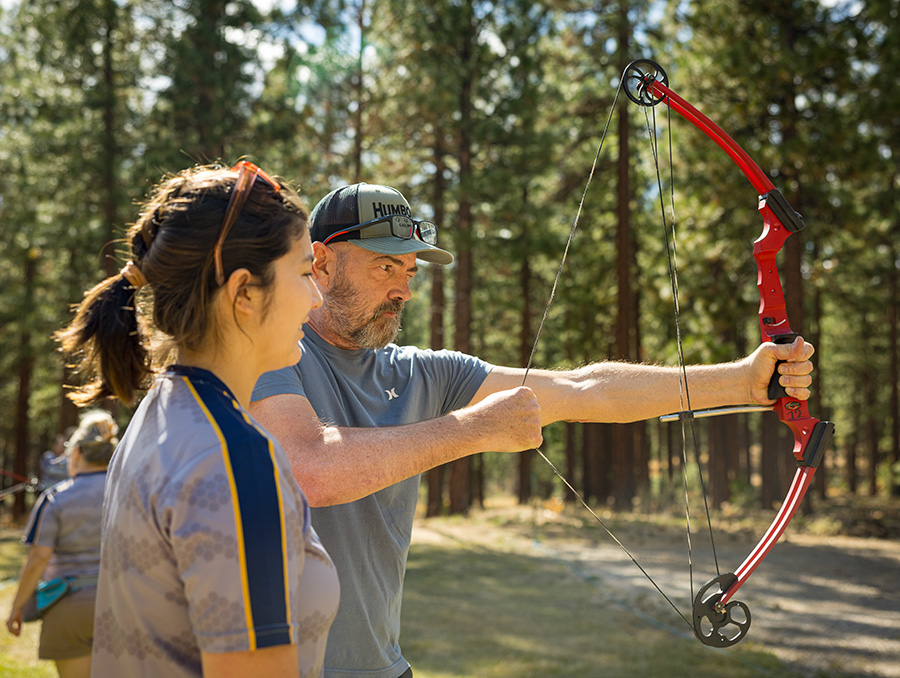
For Marie Hashitani, M.D., a Class of 2026 medical student who recently matched into the neurology residency program at UC Davis, the camp provided a perspective that extended far beyond the clinical setting.
“In clinic, we often see patients in very acute or controlled settings,” she said. “At camp, I got to know them as whole people — their families, their stories, their resilience.”
Hashitani reflected on how the weekend reshaped her understanding of recovery and connection. “Aphasia Camp shows not only how patients overcome huge hurdles, but also how families adapt and engage with their communities. Healing isn’t just medical — it’s about the mind, the soul and redefining relationships with oneself and others.”
She added, “This experience taught me the importance of multidisciplinary care. It takes many different types of professionals to help people reach their fullest potential.”
Ballesteros echoed those thoughts, emphasizing the human bonds that made the camp so special. “I loved connecting with people with aphasia. Seeing their growth and progress — not just through speech-language services, but through the opportunity to connect with each other — was inspiring.”
For all the students, the experience left a lasting mark — not only on their future careers, but on their understanding of resilience, humanity and the power of communication.
Finding power, together
By the final day, campers left with new friendships, renewed courage, and the confidence of knowing they are not alone. Students left with a deeper commitment to the people they will serve. Care partners left with hope.
“Anyone with aphasia would benefit from being here,” Vaughn said.
“Being here has changed the way I see everything,” added Phillips. “We’re breaking down barriers and showing what’s possible.”
Nevada Aphasia Camp has become more than an annual gathering. It’s a family and a reminder that communication is bigger than words.
About Aphasia Center of Nevada
The Aphasia Center of Nevada is a community resource dedicated to supporting individuals living with aphasia and their care partners through programs that promote connection, communication and engagement. Offerings include communication groups, book clubs, monthly gatherings, game nights and the annual Aphasia Camp.
The Center’s mission is to empower individuals with aphasia and their care partners to reengage in meaningful life participation by increasing awareness of aphasia and providing education, support and opportunities that enhance quality of life while reducing loneliness and social isolation. Gifts to the Aphasia Center help ensure these programs remain free or low-cost and accessible to those who need them.


