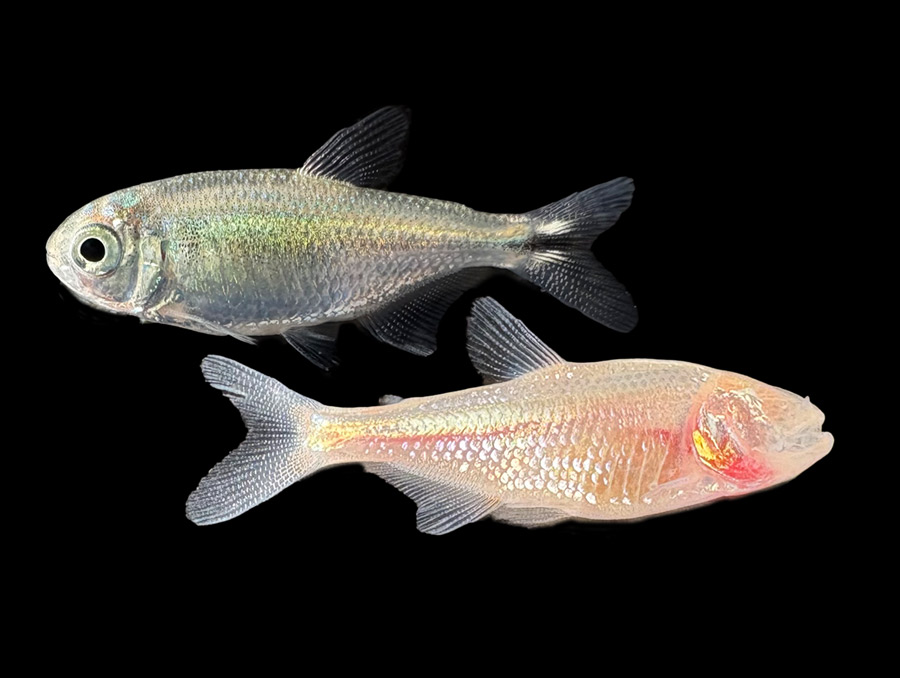
Near the rivers of northeastern Mexico, tetra fish swim blindly inside the Pachón cave. It’s not because it’s too dark for the fish to see, but because the fish have no eyes. The cavefish consume compounds that are known to be linked to eye health, but new research published this week in the journal Current Biology shows a surprising twist in how the fish, and their sighted relatives, metabolize those compounds.
The eyeless tetras weren’t always in the dark. At some point, sighted ancestors of the fish became trapped in the cave and quickly evolved to lose their eyes, while their surface-dwelling cousins retained theirs. This occurred multiple times in rivers throughout the region, leading to multiple populations of eyeless cavefish that have become a favorite animal model among evolutionary scientists. Misty Riddle, an assistant professor in the Department of Biology at the University of Nevada, Reno, is one of those scientists. She’s studied cavefish evolution for over a decade and led recent experiments exploring metabolism of carotenoid pigments, which are known for making carrots orange and supporting healthy eyesight. Carotenoids also support other functions in the body and are important to the immune system.
“They're not eating carrots, but one thing that we found that was surprising to us is that [the cavefish] are eating carotenoids,” Riddle said.
Usually, carotenoids are processed in one of two ways: some are converted into vitamin A, while others are broken down by an enzyme called beta-carotene oxygenase 2, or Bco2 for short. The recent publication found that metabolism of carotenoids is disrupted due to a faulty fish version of the gene, bco2a, in the Pachón cavefish. The faulty gene means that Bco2a protein doesn’t do its job of cleaving carotenoids, and more pro-vitamin A carotenoids may be left to be turned into vitamin A. Riddle said there are molecular networks that exist in many animals to break down and remove excess amounts of vitamin A due to the risk of toxicity.
“We don't yet know how those pathways may have also been changed in cavefish,” Riddle said. “We're starting to look at the whole network.”
This work, in some ways, started over a decade ago. When she was a postdoctoral scholar working with the Mexican tetra, Riddle noticed that the fat tissues in the cavefish were bright yellow, while the surface fish had white fat tissues. She realized it might be due to the fish’s diet but wasn’t sure what the genetic basis was for this striking color difference. Riddle set out to answer a general question about how metabolic pathways that process nutrients evolve as animals adapt to different environments.
Interestingly, the striking yellow color of many pet fish is supported by a carotenoid-rich fish food, “because it makes your fish a pretty color,” Riddle said.
The fish in the lab were fed this commercial fish food, and Riddle wondered if that’s why the cavefish were accumulating so many carotenoids. A graduate student in the Riddle lab, David Peréz Guerra, caught wild cave-dwelling and surface-dwelling tetra in Mexico. (Riddle noted that, perhaps unsurprisingly, the eyeless fish were much easier to catch.)
“What he found is the same striking accumulation of carotenoids in the fish in their natural habitat,” Riddle said. “It was really clear in the data, both the river fish and the cavefish were consuming the same types of carotenoids, but only cavefish were retaining them.”
In hybrids between cavefish and surface fish that resulted in offspring with eyes but still retained the faulty Bco2a gene, the scientists found that there was no correlation between eye presence and accumulation of carotenoids, meaning that the fish aren’t accumulating more carotenoids because they don’t have eyes and aren’t using vitamin A.
“That dramatic carotenoid accumulation doesn't seem to be an obligatory consequence of eye loss,” Riddle said.
Riddle points to another population of cavefish in the Molino Cave, which are also eyeless but don’t have the Bco2a mutation and don’t have yellow fat tissues as further evidence that carotenoid accumulation doesn’t necessarily occur because of a lack of eyes.
The cavefish withstand large amounts of vitamin A and may use excess carotenoids to their advantage in reproduction. Additional carotenoids in eggs may protect the fish against remarkably low-oxygen conditions found in the caves, which could cause harmful oxidative stress to the young fish. Interestingly, the cavefish also tolerate carotenoid-poor diets, whereas surface fish exhibit signs of vitamin A deficiency and immune dysfunction.
Riddle is now testing whether disabling Bco2a in surface fish can re-create the carotenoid-hoarding seen in cavefish. At the same time, her lab is working to restore Bco2a function in cavefish, to see how its loss may have helped these animals survive in caves. The findings are leading to new questions about metabolic evolution in extreme environments.


