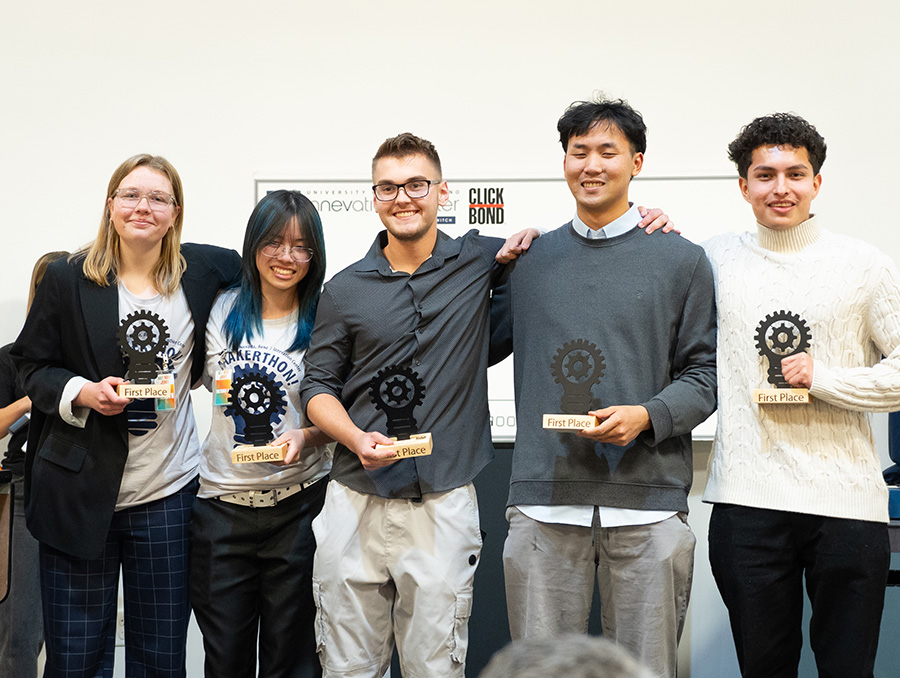
The University of Nevada, Reno Innevation Center held its sixth annual Makerthon competition, presented in collaboration with Click Bond, Inc., April 24-26, 2026. Six student teams competed in the 48-hour event, building prototypes from scratch to address one of Northern Nevada's most urgent challenges: extreme heat.
"It was absolutely incredible to see how much work the teams put in throughout the weekend," Liz Brown, Makerspace manager at the Innevation Center, said. "Seeing their rough napkin-sketch ideas come toward really surprisingly polished prototypes within 48 hours was so impressive. It was a great thing to see them engage with the prompt, learn more about their community and how they can support it."
Using the Makerspace's tools, machinery and software, teams of college and high school students had 48 hours to develop, test, build and then pitch a prototype to a panel of judges. For the first time, final pitches were delivered at The Discovery, next door to the Innevation Center.
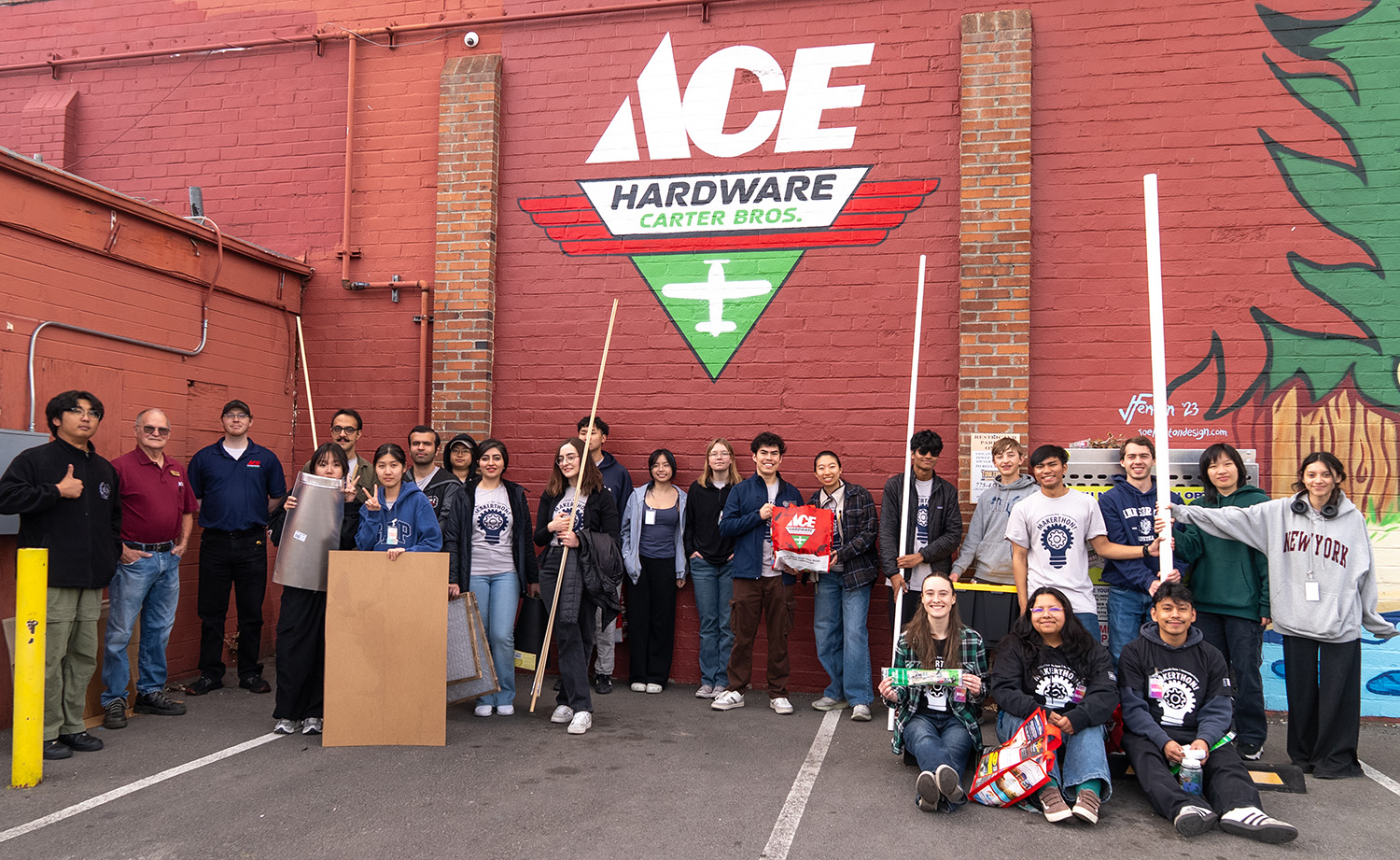 Student competitors had one hour and $100 as a team to shop for supplies at Carter Bros Ace Hardware in Midtown Reno.
The competition prompt challenged students to confront a documented local problem:
“Nevada cities are getting hotter every year, and extreme heat creates health risks, infrastructure challenges, and reduced quality of life – especially for vulnerable populations. According to Climate Central and 2024 studies by the Desert Research Institute (DRI), Reno is the fastest-warming city in the U.S. Reno’s temperature rose 7.6 degrees F between 1970 and 2023, far exceeding the national average warming of 2.6 degrees F. The city’s rapid expansion and high-altitude desert environment contribute significantly to this rapid heat increase.
The challenge: Design a physical product that helps individuals or communities stay safer and more comfortable during extreme heat. Your solution could address personal cooling, outdoor infrastructure, public spaces, transportation, or heat mitigation.”
This year's judges panel included Daniel Smith, founder of the Makerthon competition and now with the Economic Development Authority of Western Nevada; Brock Young, occupational health and safety manager at the University of Nevada, Reno; Nathan Digangi, economic development director with the Downtown Reno Partnership; John Wertz, director of product development engineering with event sponsor Click Bond, Inc.; business engineer and entrepreneur Brooke Westlake, founder and owner of WICE; and Juan Henao, researcher at the Desert Research Institute.
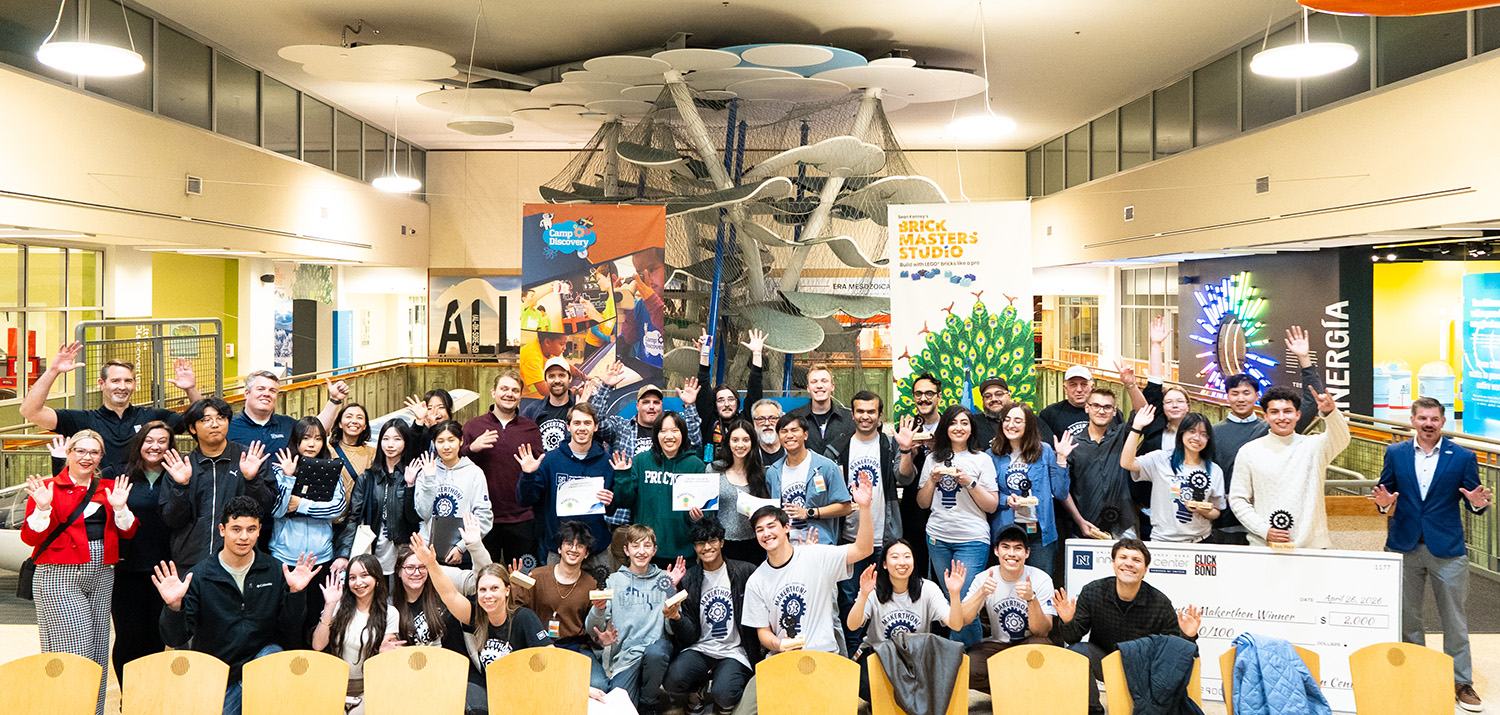
"Seeing that they had no idea what the prompt was going to be, these students were not experts in this field 48 hours ago," Brown said. "They spent a lot of time digging into all the different problems. We really encouraged them to touch on personal issues and personal connections to the products they were developing, which really helps their pitch and commitment to the product."
Students were given basic starting supplies and access to the Makerspace scrap pile. Each team was also provided $100 to spend at the Midtown Ace Hardware, Carter Bros., for additional supplies for their prototype.
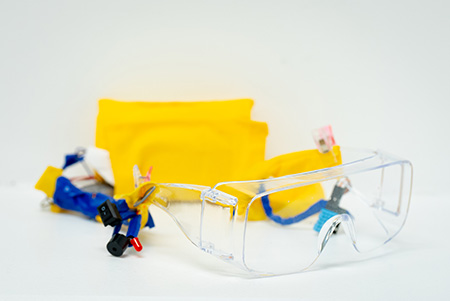
Team Niet Beef Jerky took first place and the $2,000 prize for their Core Temp Cord – a wearable device that continuously records a construction worker's core temperature and sends an alert before they approach heat stroke thresholds.
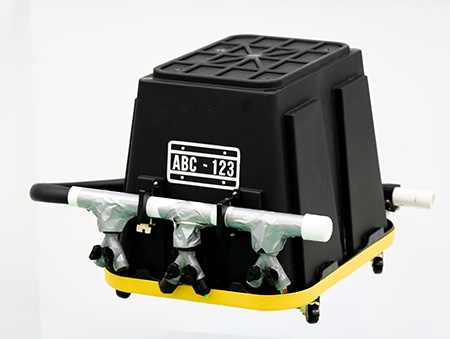
Second place and $1,000 went to team Electrum, whose members came from Reno High School, Sage Ridge School and Truckee Meadows Community College. Their prototype used a light-sensitive, color-detecting system to spray a reflective coating on asphalt, reducing heat absorption through independent valves that could identify and avoid existing paint lines on roads.
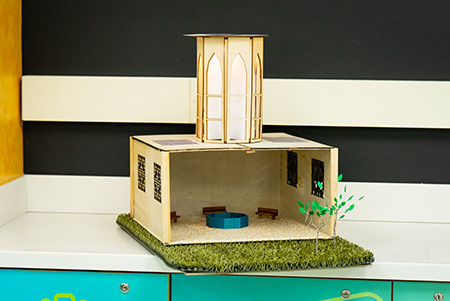
Third place, with $500, went to team Last Minute Legends for The Ventus, their hybrid windcatcher cooling system concept – designed and aimed at providing pedestrians and those in outdoor public spaces to cool down with a low-energy infrastructure.
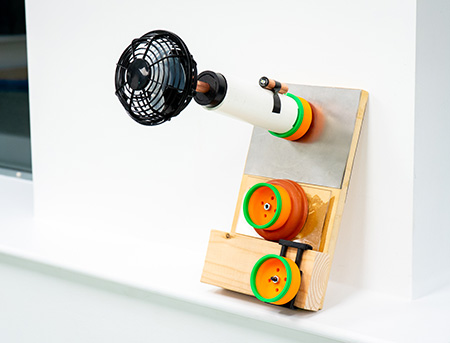
For the second year, a Fan Favorite was selected by public online vote. That honor went to team Fulcrum for Gecko Guster, a portable, multi-surface compact fan with a magnetic ball-and-socket joint, an interchangeable suction mount and a built-in light.
“It is always impressive to see what these students are able to accomplish in just 48 hours,” Smith said. “But what really impressed me this year was the quality of ideas and presentations. The teams really took it to the next level this year.”
Follow the Innevation Center on Instagram, @UNRInnevationCenter, and find this year's competition on the 2026 highlight reel.


