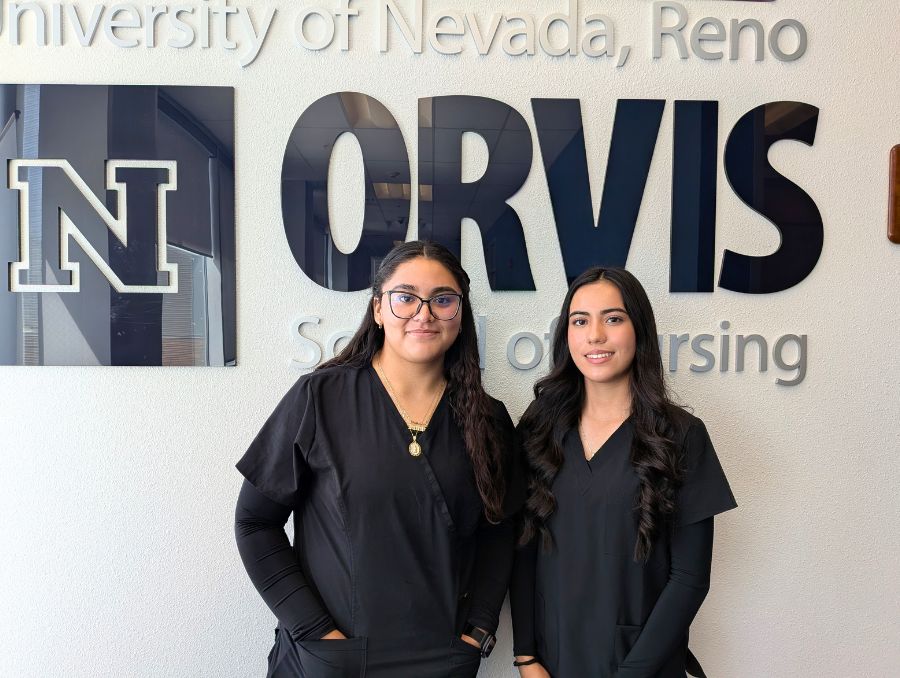
Fatima Gonzalez Lopez and Jaqueline Barba Gomez are early in their college journeys, but they are already building the skills and confidence needed for a future in nursing.
As first-year pre-nursing students at the University of Nevada, Reno, they are working toward their Healthcare Simulation Technology Specialist (HSTS) Microcredential, an introduction to simulation-based healthcare training that has already led to employment. Both are now student workers in the Orvis School of Nursing Simulation Lab, where they help prepare clinical learning environments and support student training.
“Working as a student employee in the simulation program has been a really valuable experience,” Gonzalez Lopez said. “Seeing how everything is set up and used has helped me understand how important preparation and attention to detail are in healthcare.”
Both students' interest in nursing is shaped by lived experience. Gonzalez Lopez wants to support families who face barriers to care.
“Growing up, I saw my parents struggle with healthcare and all the barriers they had to go through just to get a simple checkup,” Gonzales Lopez explains. “That stayed with me. I know it won’t be easy, but I want to be able to support people who go through the same struggles my parents did and make them feel cared for, understood and not alone.”
Barba Gomez’s path was influenced by her father’s stroke and the care he received from nurses.
“To be honest, it was not until my senior year in high school that I knew that I wanted to pursue nursing,” Barba Gomez said. “My father got a stroke, and that changed mine and my family’s life completely.”
Upward Bound helped both first-generation students see higher education as possible and connected them with opportunities like the (HSTS) Microcredential.
“Upward Bound meant a lot to me because it was the first time I felt like college was actually possible,” Gonzalez Lopez said.
“Upward Bound really changed my life because if it were not for the program, I would have never had the opportunity to attend college,” Barba Gomez added.
Through the HSTS program and their work in the Simulation Lab, they are gaining early exposure to the realities of healthcare. They assist with organizing supplies, preparing simulation stations and supporting hands-on learning experiences for nursing students.
“Being part of the Wolf Pack means being part of a supportive community that encourages me to grow and succeed," Gonzales Lopez said. “I’m very thankful to Haley and Andy for giving me the opportunity to be involved in the simulation program, and I don’t take that opportunity for granted. I always try to give 110% in everything I do.”
Haley McNeil, MSN, R.N., CHSE, director of simulation, remarked, “Fatima and Jaqueline have been exceptional additions to our simulation team. They are motivated, dependable, thoughtful and always willing to learn. What has stood out most is how engaged they are in supporting positive learning experiences for students and faculty.
“One of the most exciting parts of working with them has been seeing how the Healthcare Simulation Technology Specialist (HSTS) microcredential helped prepare them for this role. Coming in with foundational knowledge about simulation environments, equipment and best practices has been tremendously helpful to our team and allowed them to contribute meaningfully from the beginning. The skills they are developing through this work, including communication, teamwork, adaptability and attention to detail, will also serve them well throughout their future nursing careers.”
Moments like practicing suturing and working behind the scenes have made the nursing profession feel more tangible, while also building their confidence as they prepare to apply to nursing school.
“Practicing suturing was a really interesting experience because it was one of the first times I felt like I was actually doing something related to nursing,” Gonzalez Lopez said.
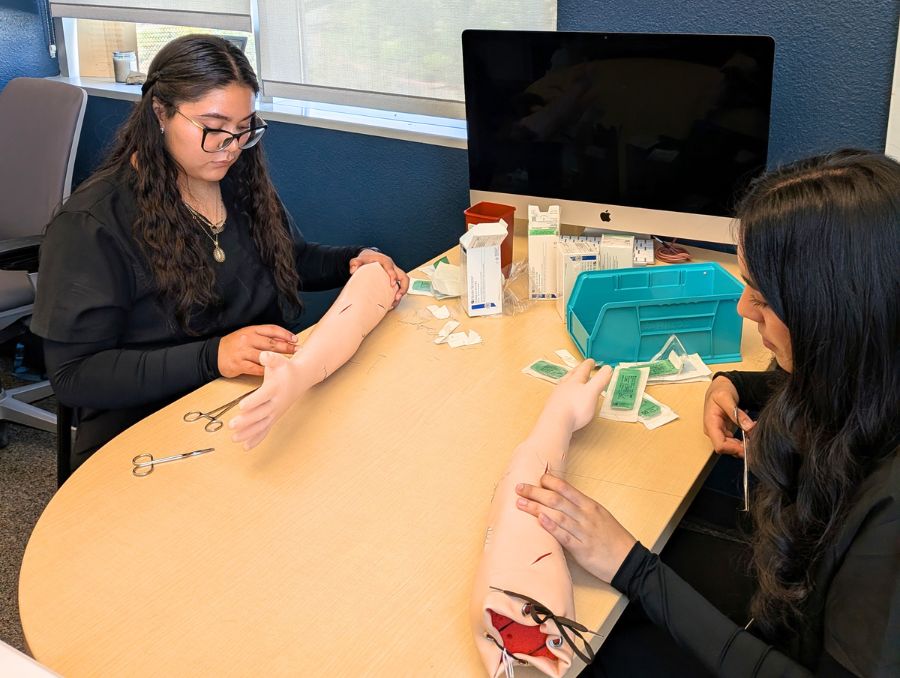 Fatima Gonzalez Lopez and Jaqueline Barba Gomez practicing suturing.
The microcredential has helped both students feel more prepared for what comes next.
“The program allowed me to understand what nursing students go through,” Barba Gomez said.
“Overall, it gave me a stronger sense of confidence and helped me take my first step toward a career in nursing,” Gonzalez Lopez said.
Looking ahead, both students are focused on making a meaningful impact in their communities by providing compassionate, accessible care.
“I want to make people feel cared for and understood, especially those who come from backgrounds like mine,” Gonzalez Lopez said.
Through early experience and a clear sense of purpose, Gonzalez Lopez and Barba Gomez are already laying the foundation for their futures in nursing while showing how microcredentials can create real pathways to opportunity.


