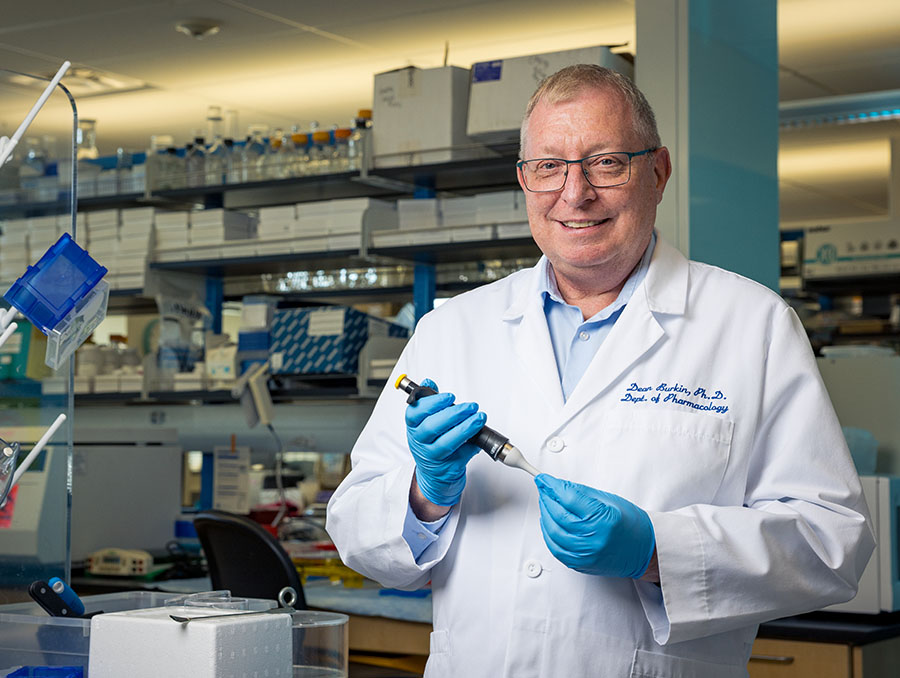
When Dean Burkin, Ph.D., first began studying Duchenne muscular dystrophy (DMD), the goal was straightforward and urgent: understand why muscles fail in this devastating disease and find a way to slow or stop it. More than two decades later, that work has evolved into a globally recognized research program that is not only uncovering new ways to protect muscle tissue but also opening unexpected doors in cancer and cardiovascular research.
This year, that sustained impact was honored with the “Foundation Established Innovator Award,” recognizing Burkin’s contributions as both a scientist and mentor at the University of Nevada, Reno School of Medicine (UNR Med).
“The Foundation Established Career Innovator Award recognizes years of hard work by my research team in developing novel integrin-based therapies for the treatment of muscular dystrophy,” Burkin said.
Since joining the University in 2003, Burkin has studied DMD, a severe and fatal neuromuscular disorder with limited treatment options. Individuals with DMD often lose the ability to walk during their teenage years and frequently face premature death in their 20s or 30s.
His work focuses on understanding how DMD damages the body and finding new ways to slow or prevent the disease. Burkin’s research team discovered that a protein called α7β1 integrin may be able to help support and protect muscles when dystrophin – a key muscle protein – is non-functional or missing in patients with DMD.
Burkin explained that dystrophin normally acts like a type of “molecular glue” that helps keep muscles strong during movement. Without it, muscles become damaged over time. His team found that increasing the levels of the α7β1 integrin protein may help muscles stay more stable and reduce progression of the disease.
“Using high-throughput drug screening, we have identified a small molecule, S969, that increases α7β1 integrin in muscle," Burkin said. "Our studies indicate S969 can prevent muscle disease in models of DMD.”
The discovery has the potential to significantly impact future treatments for patients with DMD and may eventually move into clinical application.
“The next steps in our research are focused on advancing our therapeutic candidate toward clinical studies,” Burkin said. “This includes manufacturing S969 to FDA standards, testing the manufactured drug, and designing a clinical trial using S969 for the treatment of DMD.”
In addition to its implications for muscular dystrophy, Burkin’s research has also uncovered promising applications in other disease areas. His team recently identified patients with mutations in the α7 integrin gene linked to muscle weakness and heart failure, opening new avenues for cardiovascular research.
“Understanding the role this integrin plays in cardiac muscle function may open new opportunities to develop our integrin therapies for the treatment of cardiovascular disease,” Burkin said.
“Dr. Burkin is exactly the type of established faculty innovator this award is meant to recognize,” Lucia Notterpek, Ph.D., said.
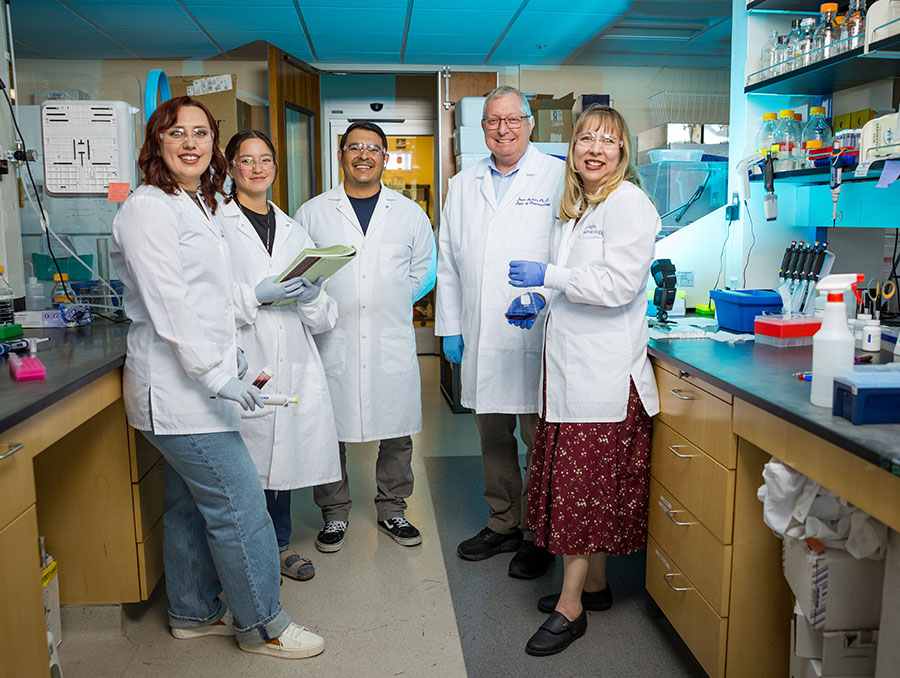
Burkin’s contributions extend far beyond the laboratory. Throughout his career at UNR Med, he has mentored Ph.D. students, medical students, master’s students and undergraduate researchers, helping prepare future leaders in biomedical research and clinical practice.
“He demonstrates that academic excellence and entrepreneurship can be mutually reinforcing when pursued responsibly, with clear arcs from discovery to translation," Lucia Notterpek, Ph.D., senior associate dean of research, said. "Just as importantly, he is building translational capacity within the University by embedding trainees in rigorous, real-world innovative workflows.”
Alongside his research and mentorship, Burkin also plays an important role in medical and graduate education, teaching foundational subjects such as genetics, ethics and the body’s major organ systems, including the gastrointestinal, endocrine, reproductive and musculoskeletal systems.
“Dr. Burkin is an amazing advisor who leads by example and fosters an incredible lab environment,” Hailey Hermann, Ph.D., a post-doctoral scholar in the Burkin Lab, said. “You can hear his laughter echoing through the hallways, and his passion for research is truly contagious.”
That same commitment to learning and discovery also shapes how he approaches his work as a scientist. For Burkin, collaboration and persistence remain central to success in academic research.
“My advice to junior faculty is to stay focused, persevere, and develop productive collaborations,” Burkin said. “Academic research can be demanding, but it is also a meaningful opportunity to generate new knowledge, make impactful discoveries, and contribute in ways that can change the world for the better. Also, remember to take time to spend with your family and enjoy life.”