In the arid valleys of the American West, winter snowpack from surrounding mountains forms a vital resource, serving as a natural reservoir of frozen water that melts each spring to feed rivers, lakes and irrigation systems. But as winters grow warmer and mountain storms shift from snow to rain, the presence and volume of that snowpack is becoming less predictable, creating new challenges for farmers and other water users.
At the University of Nevada, Reno, a multi-year, interdisciplinary initiative called SNOWPACS – Synthesizing kNowledge to Optimize Water Policy under Changing Snowpack – is investigating options for helping farmers and other water users navigate water availability changes and challenges in snow-fed river basins. Funded by the USDA National Institute for Food and Agriculture, the project focuses on understanding and predicting how changes in snowpack and water availability affect agricultural production and food security and how water policy can be shaped to help communities adapt.
The project team is examining these questions through case studies set in two Western river basins: the Walker River Basin of Nevada and California, and the South Platte River Basin of Colorado. Each of these basins is home to communities that are impacted by changing snowpack conditions.
“What’s happening currently as we move forward through the century due to climate change is that the snowmelt is going to arrive earlier, and there’s a mismatch between when the snow water is available and when it’s needed for downstream agriculture,” said SNOWPACS Program Director Michael Taylor, who is an associate professor of economics in the University’s College of Business and an agricultural and resource economics specialist with University of Nevada, Reno Extension.
An interdisciplinary effort, the SNOWPACS project incorporates expertise in hydrology, climate science, economics and policy. In the Walker River Basin, project hydrologists began by modeling possible future changes in snowpack and seasonal water availability. The SNOWPACS team then met with farmers, conservation groups, water managers, tribal leaders and other water users to discuss how their operations and needs would be affected by the changes described in the models, and what new and unexpected challenges might result.
By understanding how much water will be available each year and the diverse needs and perspectives of the water users that depend on it, the SNOWPACS project team is learning about the challenges that will shape future water policy.
“We’ve spoken with water users from across the Walker Basin, from the headwaters to the lake, and asked them about the challenges they were facing in terms of water management, in the context of a changing climate,” said Loretta Singletary, SNOWPACS co-project director and Extension’s interdisciplinary outreach liaison and professor of economics at the University. “Collaborative research is really the backbone of the project and is the reason why it is so important to identify and engage our community partners, who inform our research agenda and help to disseminate and potentially put our research findings into practice.”
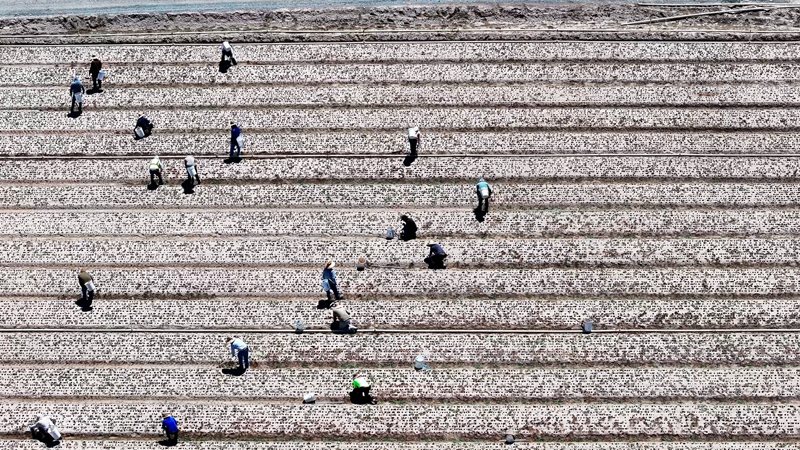 Farm workers harvest onions at Peri & Sons farm in Yerington, Nevada, during fall 2024. Credit: Vanesa de la Cruz Pavas.
Understanding Water Markets
In addition to learning about the current and future needs of water users in the region, the project team is also studying the ways in which water is transferred between water users, through systems known as water markets. Water markets involve buying, selling and leasing water rights – the legal right of an individual or organization to use a certain amount of water each year based on the claim date or seniority of their water rights.
This voluntary exchange of water rights through water market mechanisms helps agricultural producers and other water users support one another when there is less water available, such as during particularly dry years. Farmers, for example, may choose to permanently sell or lease a portion of their water rights to other farmers or other water users for fixed periods.
Agricultural communities across the West have supported one another and maintained healthy connections for generations through various types of water-sharing arrangements. But transferring water rights from one place to another and changing how that water is used, permanently or temporarily, can be challenging. While permanent water rights sales are common, these transfers can lead to buy-and-dry outcomes, which can harm rural communities that rely on agricultural activities.
In the West, water rights were historically claimed by those first landowners who provided evidence of putting the water to use, resulting in a hierarchy of “senior” and “junior” water right holders who access water in a “first in time, first in line” basis, per the Doctrine of Prior Appropriation.
Today, senior and junior water right holders remain in a game of “tug-of-water.” As cities continue to grow, there’s a higher demand for water for nonagricultural uses. But agricultural communities rely on water to feed farmlands and fuel the local economy.
Additionally, water is needed for healthy ecosystems. Snowpack melts and flows into Walker Lake, which sits at the downstream end of the Walker River Basin. Less predictable snowmelt affects how much water feeds into the lake in a given year.
“Walker Lake has shrunk over time due to less and less water being sent down to the lake; more water is being diverted for agriculture upstream,” said Elizabeth Koebele, co-project director at SNOWPACS and associate professor of political science in the University’s College of Liberal Arts.
Beyond agriculture, water markets are essential for restoring Walker Lake’s ecosystem, and supporting various native birds, plants and fish. Agai Pah, or Walker Lake, is culturally important to the Walker River Paiute Tribe, the Agai Dicutta (Trout Eaters), who have stewarded the lake’s waters and surrounding lands for thousands of years. The Walker Basin Conservancy is leading efforts to promote temporary leasing in an effort to restore Walker Lake’s water levels.
Navigating Choppy Waters: Economic and Environmental Costs
Much of the work of the SNOWPACS team has been devoted to understanding complex historical relationships and the diversity of water needs in the region. Through many conversations, the pros, cons and challenges of different water market options have emerged.
Removing water from historically irrigated lands can have long-lasting negative effects and can increase the chances of invasive weeds and dust hazards. These put permanent loss of agricultural lands at risk, as well as increase water costs and result in less agricultural production.
When implementing new or experimental types of water exchanges, there are legal and logistical barriers to consider as well. Most water transactions in Nevada are handled by the Nevada Division of Water Resources, and approval requires assuring the exchange does no harm to other existing water rights holders.
“Information costs and transactional costs, like the time and money that is required to enter a water trade, which might involve moving water to where it’s been historically allocated, changes the place of use and the purpose of that use. And that requires approval,” said Singletary.
The future of agricultural lands depends heavily on consistent timing and quantity of spring snowmelt. Less spring snowmelt means less water; less water means fewer crops. As seen in the South Platte River Basin, local businesses can be forced to close shop, creating a ripple effect in the economy, leading to lower property values and even ghost towns.
The Future of the “Current”
As the project comes to a close, the team has many results to share. They have published research in journals such as Water Policy, Colorado Water, Environmental Research Letters, and through videos for general audiences. A new research paper highlighting Colorado’s South Platte River Basin is under review and discusses alternative ways of designing water markets based on population growth, food security and production, and changing values around water exchange. The project team hopes that agricultural communities throughout the West will be able to learn from information gathered during the SNOWPACS project about water markets and climate adaptation strategies.
Projects such as SNOWPACS spark new conversations around limited water resources, promote equitable water sharing, and balance human needs with ecosystem health and conservation. Water markets are just one of many ways of mitigating potential risks from climate change, which has brought a lot of uncertainty for water rights holders and managers, bringing a need to look ahead at how to best adapt to changing patterns of snowmelt and water flow.
“The work that we’ve done has really tried to delve into the nuances and call attention to the fact that we really need to be focused on local-scale issues when we’re thinking about adaptation,” said postdoctoral researcher Bea Gordon.
The work of the SNOWPACS project provided Gordon, as well as other postdoctoral researchers and University graduate students, with practical experience navigating the complex challenges and interactions between climate, water, agriculture and society.
“I think one of the reasons this project has been successful is that we’ve had really wonderful graduate students and post-docs who have not only led a lot of the work, but have also been trained during the course of this project and are now going out and being professionals who have an interest and a focus and experience in doing interdisciplinary work focused on water and agriculture,” said Taylor. “I think that’s going to be an important legacy of the project.”
Learn more
The video "Water Markets of the Walker Basin" was produced through a partnership between the Hitchcock Project for Visualizing Science in the Reynolds School of Journalism and University of Nevada, Reno Extension.
The Hitchcock Project for Visualizing Science is an initiative within the Reynolds School of Journalism to prepare students, professionals and scientists to present science in visual, creative forms. Through curriculum, workshops and experiential learning opportunities, students learn to communicate science effectively and combat misinformation while building and enhancing their skills for science storytelling. For more details, visit the Hitchcock Project website.
The SNOWPACS project examines water systems and climate impacts in the Walker Basin region of Nevada and the Platte River Basin of Colorado. A video overview of the SNOWPACS project is available on YouTube.


