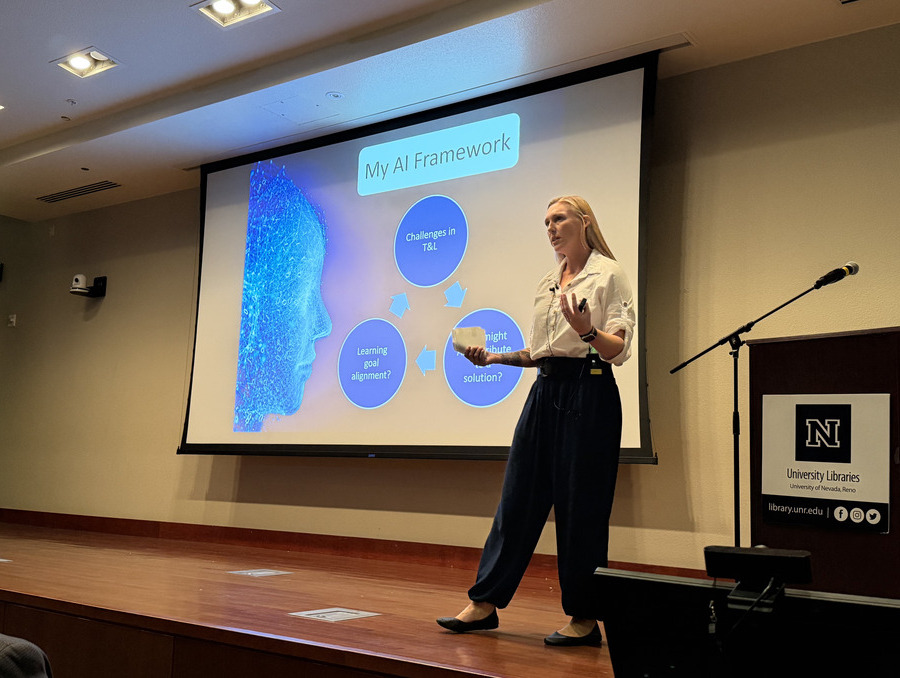
In classrooms, offices, and panel discussions across campus, faculty are asking questions about AI: ethical implications, how to incorporate it into learning and what role the technology should play in higher education. What has changed over the past year isn’t that those questions have been answered. It’s that more people are willing to engage with them.
Early conversations at the University around AI were marked by hesitation. Questions about academic integrity, uncertainty about expectations and concern about what might be lost were discussed openly by faculty at a recent Pack AI Symposium Series.
 Director of Advancement in Teaching Excellence Sarah Cummings has contributed to emerging frameworks that emphasize intentional, learning-centered use of AI in higher education.
“I think the conversations are becoming more progressive and more positive,” Sarah Cummings, director of advancement in teaching excellence at the University, said during a recent conversation. “There is an increasing curiosity now, with more nuance and depth.”
“It’s not about AI-first. It’s about teaching. It’s about learning goals. Then you ask whether AI supports that."
Cummings works with faculty to help them meet their teaching goals in ways that fit their courses, disciplines and students. Through her participation in national conversations on AI pedagogy and curriculum with the American Association of Colleges and Universities, Cummings has contributed to emerging frameworks that emphasize intentional, learning-centered use of AI in higher education. And if her work in AI is more recent, her expertise in teaching isn’t: Cummings has been at the University of Nevada, Reno for nearly two decades, and has won numerous accolades, including the Paul and Judy Bible University Teaching Excellence Award, F. Donald Tibbitts Distinguished Teacher Award and the NSHE Regents' Teaching Award.
Cummings's work with Pack AI, the University’s institutional effort to approach artificial intelligence in a way that is both innovative and responsible, focuses on helping faculty and students understand how AI can support teaching, learning and research, while maintaining clear expectations around ethical, transparent and discipline-specific use.
"Pack AI isn’t about prescribing a single approach. It’s about equipping faculty with the resources they need to explore, adapt and lead in their own classrooms." – Executive Vice President and Provost Jeff Thompson
“Pack AI isn’t about prescribing a single approach. It’s about equipping faculty with the resources they need to explore, adapt and lead in their own classrooms," said Executive Vice President and Provost Jeff Thompson. “What’s been especially encouraging is the level of engagement and curiosity from faculty across disciplines.”
That shift has been shaped in part by initiatives like the University’s Pack AI Symposium Series, where faculty from across disciplines are sharing how they’re experimenting with these tools in real time: not as experts with polished solutions, but as instructors trying to make thoughtful decisions in evolving conditions.
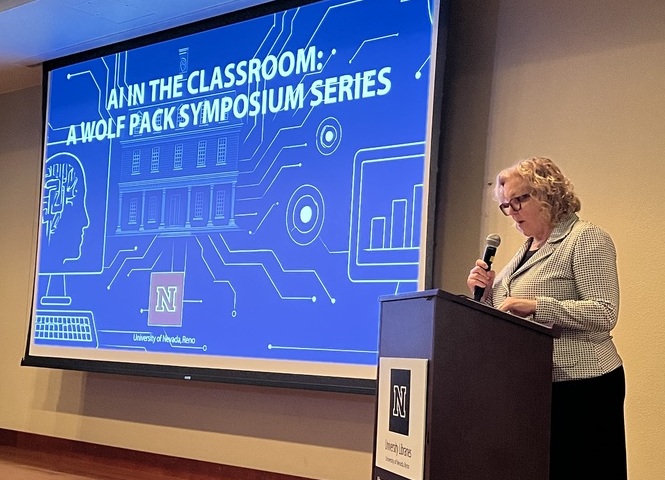 Dean of Libraries Catherine Cardwell spoke at the fall Pack AI Symposium Series.
The series brings together perspectives from engineering, the humanities, Libraries and the social sciences, creating space for faculty to examine how AI is influencing their teaching, assignments and expectations of student work.
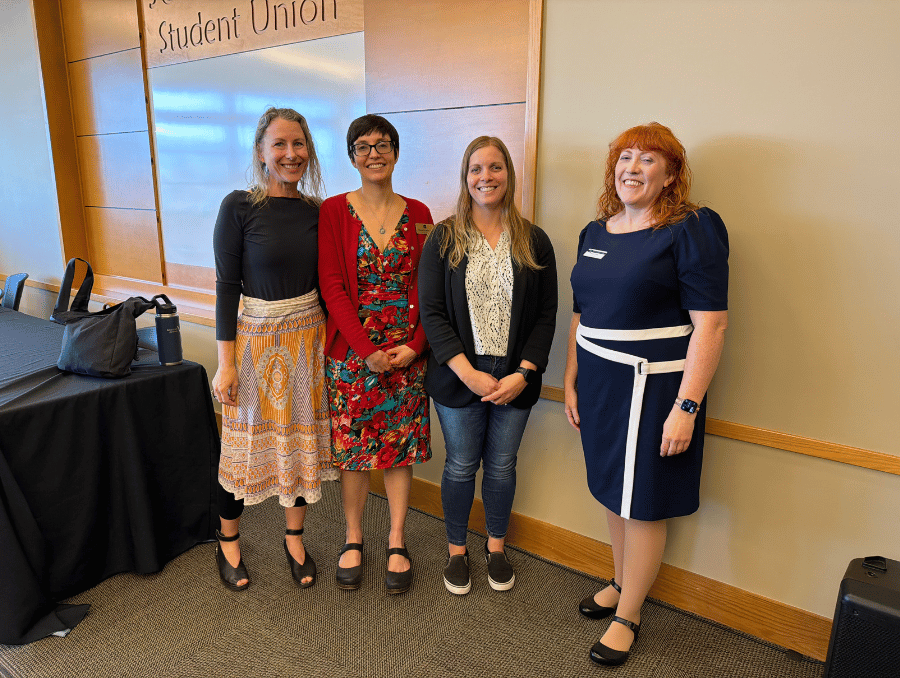 Academic faculty members Jodie Barker, Elena Azadbakht, Brittany Avila, and Candice Bauer spoke at the March Pack AI Symposium.
Panelists reflect that range: Candice Bauer, assistant dean for assessment, compliance and evaluation and associate teaching professor in the College of Engineering, approaches AI through accreditation, faculty development and instructional standards; Jodie Barker, associate professor of French, brings a perspective grounded in translation and literature, where questions of meaning and authorship are central. Elena Azadbakht, health sciences librarian, focuses on research practices and information literacy in a rapidly shifting digital environment; and Brittany Avila, lecturer and academic advisor in psychology, connects AI use to cognitive development and evidence-based teaching.
Conversations at various campus forums and gatherings often move between the practical and the philosophical, grounded in what is happening in classrooms. It’s clear that faculty are thinking about how to help students develop reasoning and judgement around AI: when to use it, when not to and how to take responsibility for their choices.
Start with learning, not the tool
If there is a throughline emerging from those conversations, it’s this: AI is not the starting point.
Instead, faculty are grounding their decisions in a more familiar question: what do students need to know and be able to do?
“It’s not about AI-first,” Cummings said. “It’s about teaching. It’s about learning goals. Then you ask whether AI supports that. It’s a conversation. It’s become more thoughtful, more constructive and more focused on learning.”
That framing has become a way to bring together a wide range of perspectives, including those who are skeptical, cautious or still figuring out where they stand. In practice, that means AI isn’t being adopted wholesale or rejected outright. It’s being used in specific, intentional ways, integrated into assignments with clear expectations or set aside when the goal is for students to develop foundational skills on their own.
“In some cases, students need to develop their own voice before they even begin using AI,” Cummings said. “There isn’t one answer. It depends on the discipline, it depends on the level, it depends on the learning context.”
Across campus, there is no single model for how AI shows up in the classroom.
"There isn’t one answer. It depends on the discipline, it depends on the level, it depends on the learning context."
In one recent faculty session, a professor casually shared that they had experimented with an AI tool over the weekend and were now revising an assignment based on what they learned. The impact wasn’t in the tool itself; it was in the signal it sent.
“When people hear their colleagues say, ‘I tried this,' it takes away the intimidation,” Cummings said. “It makes it feel possible.”
What is beginning to emerge instead are shared values, transparency with students, clarity around expectations and an emphasis on keeping human-centered learning at the core.
That peer-driven momentum is shaping what comes next. “I don’t have one opinion about AI … I can have multiple feelings in the same hour, and that’s okay,” she said.
In some graduate programs, where students are preparing to enter professional fields already shaped by AI, learning how to use these tools is part of the curriculum. In other courses, especially at the undergraduate level, the emphasis may be on limiting use to ensure students build core skills first.
That variability is not seen as a problem. It’s expected.
What is beginning to emerge instead are shared values, transparency with students, clarity around expectations and an emphasis on keeping human-centered learning at the core.
Maintain the human in the loop
Instead of treating AI like a search engine, faculty are learning to treat it as a conversational partner, something that requires back-and-forth to produce meaningful results.
At the same time, faculty are clear about what AI cannot replace: relationships with students, real-time feedback and the kinds of interactions that shape how students think, communicate and grow.
“We’re seeing faculty design assignments where AI enhances learning, not replacing it. That distinction matters,” Cummings said.
For many, the goal is not to integrate AI everywhere, but to use it in ways that create more space for those human elements. “We’re moving from needing answers to knowing how to ask for them; that’s a different kind of literacy," she said. "Technology can handle some tasks, which gives us more time to focus on what must remain human: relationships, mentorship, connection and critical thinking alongside these tools."
That approach aligns with a broader view of teaching that extends beyond any single tool. Faculty describe effective teaching as learning-focused, learner-centered and continuously reflective, an ongoing process of adapting, testing and improving.
We’re seeing faculty design assignments where AI enhances learning, not replaces it. That distinction matters.
AI, in that context, becomes one variable among many. A big shift right now is in awareness: understanding how students are already using AI, and what they think it can and can’t do.
Looking forward
As the University looks ahead, the focus is shifting from exploration to support.
“When we compare to our peers, we are struggling with many of the same challenges,” Cummings said. “We also notice how much context matters: What seems to work at one institution doesn't necessarily work the same somewhere else. So we feel local response and strategy are important. What we are seeing in leading institutions is a shift from ad hoc experimentation toward responsible and intentional integration. We are trying to serve as thought leaders in how to make complex and nuanced decisions around AI in a coordinated, coherent and responsible way.”
Faculty are asking what comes next, not just for themselves, but for the institution.
That includes building more opportunities for faculty to learn from each other, creating discipline-specific resources, and better understanding how students are already using and perceiving AI across different fields.
“There’s a lot of interest in what this looks like in specific disciplines,” Cummings said. “What works in one area might not translate directly to another.”
For all the strategy and structure being developed, much of the progress so far has come from something simpler: people coming together and talking to one another.


