Thank you to the team at the University Libraries @One Center for producing and editing this episode.
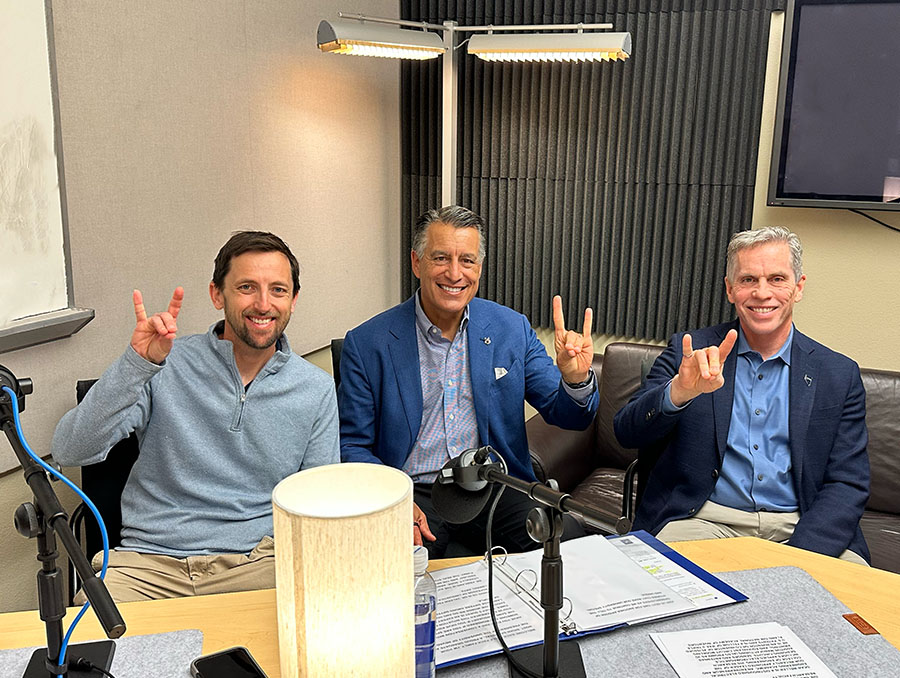
In this episode of Sagebrushers, University of Nevada, Reno President Brian Sandoval speaks with College of Engineering Dean Dr. Tom Weller and Dr. Russ Renzas, director of the Davidson Foundation Cleanroom.
Together, they discuss the College of Engineering’s role in preparing students for careers. As companies continue to expand in Northern Nevada, so does the partnership between the University and industry-related companies.
Renzas highlights the University’s nanofabrication cleanroom and how hands-on research is helping drive innovation in semiconductor and quantum technologies while supporting the growth of industry locally. Weller also shares his vision for the College of Engineering, emphasizing experiential learning, use-inspired research and student preparation to meet industry needs both in Nevada and across the country.
Sagebrushers is available on Spotify, Apple Podcasts and other major podcast platforms, with new episodes every month.

Sagebrushers season 5 episode 3: College of Engineering Dean Tom Weller and Davidson Foundation Cleanroom Director Russ Renzas
In this episode of Sagebrushers, University of Nevada, Reno President Brian Sandoval speaks with College of Engineering Dean Dr. Tom Weller and Dr. Russ Renzas, director of the Davidson Foundation Cleanroom.
President Brian Sandoval: Welcome back, Wolf Pack Family. I'm your host, Brian Sandoval, a proud graduate and the president of the University of Nevada. One of our crown jewels at the University is our College of Engineering. From work in cutting-edge labs to real-world internships during college, our students receive one of the best educations in the country when they come to Reno. Joining us are two faculty members helping guide the future generation of engineers: Dr. Tom Weller, the dean of the college, and Dr. Russ Renzas, director of the Davidson Foundation Clean Room and Research Facility.
Dean Weller is a distinguished electrical engineering academic, an entrepreneur and our recently appointed leader of the College of Engineering. His research includes applied electromagnetics, designing circuits, sensors and antennas, additive manufacturing, also known as 3D printing, and equivalent circuit modeling. He's an inventor or co-inventor of 45 issued U.S. patents and is a fellow of IEEE (Institute of Electrical and Electronics Engineers) and the National Academy of Inventors. Dr. Renzas specializes in surface science and nanofabrication, essentially controlling how services behave when building very small technology like microchips.
His professional experience includes leading a high-tech factory for quantum computing hardware and collaborating with companies around the world. He has given talks at Princeton, Harvard, Yale, Caltech and many other leading universities and national labs both in the United States and abroad. Today's episode is being recorded in the @One Podcast Studio at the Matthewson-IGT Knowledge Center. Thank you, Dean Weller and Dr. Renzas, for being here today. We're excited to have you.
Tom Weller: It's great to be here. Thank you.
Russ Renzas: Happy to be here, yeah.
Sandoval: Wonderful. So, let’s start with you, Dean Weller. You joined the University in August 2025—my, how time flies. Can you share with our listeners your background and your vision for the College of Engineering at the University of Nevada?
Weller: Yes. So, I was born and raised in the Midwest and received my undergraduate and graduate education at the University of Michigan. And I've been in academia now for over 31 years, but during this time, I've also worked with very large companies, and I've started a couple of companies. And for the three years prior to coming to the University of Nevada, I was leading large economic development efforts, which focused on creating partnerships between universities and industry and government venture-capital and community-based groups. And this experience has really influenced how I view my role here at the University as the engineering dean. And as far as the vision for our college, we are certainly focused on producing graduates who are as well as or better prepared than any college of engineering in the country but also making sure that we put our research to work and playing our role as an economic engine for the region. And we view semiconductor and quantum technology in the same light, which we'll be talking about a little bit more during the podcast. To fulfill this role of being a partner, it's really important that we focus on what I refer to as an outward mindset, which is really understanding our responsibilities to the people that we're working with and how all of our actions are impacting them.
Sandoval: So, you know, there are some amazing companies that, in the not-too-distant past, have moved to Northern Nevada. Tesla, Panasonic—the list goes on and on. How do you see what you just discussed fitting in with this new industry that’s coming to Northern Nevada?
Weller: Well, first and foremost, we're making sure that our academic programs are aligned with their needs, and we're producing the engineers that they need to hire. Recent examples would be our industrial engineering program and our new Gillemot Aerospace Engineering Program, but it also entails getting our researchers talking with their technologists to make sure that we understand their needs in the five or 10 years into the future and that we can play a role in helping deliver that technology that they'll need for their future products.
Sandoval: Ah, that's fantastic. Okay. Dr. Renzas, talk a little bit about the Davidson Cleanroom for us. What is it and what kind of work is going on at an academic and industry level?
Renzas: Absolutely. So, the Davidson Foundation Cleanroom is a nanofabrication facility. What that means is it's just like fabricating something when we think about metal fabrication. Well, we fabricate things, but just at a very, very small scale. The types of things we fabricate are really the layers on chips. So how do we make microelectronic devices? My own background was always in quantum devices, actually. I set up the fab for a superconducting quantum computer company called Rigetti Computing prior to moving to Nevada six years ago. So here in Nevada, we're joining the community of over 150 universities that have multi-user academic cleanroom environments. These are places where students learn how to make semiconductor devices, quantum devices, platonic devices, MEMS devices, everything that's in our phones and every other modern device that we think of today and into the future. We have wonderful industrial relationships. We have a sponsored graduate student doing research for Oxford Instruments, which is a company I used to work for working at the atomic scale processing level. So, we have corporate users, academic users. We're open to all.
Sandoval: No, and it sounds like we're in a pretty exclusive club to have an asset like that at our University.
Renzas: Absolutely. And I’ll say people are reaching out to us. It really helps me that I have a very strong industry background, which is relatively unusual in the academic research world. Not everyone has a decade of research experience in industry doing industry R&D. So other cleanrooms, Stanford right now, we’re working on proposals with them where they have approached us for our knowledge and our expertise because we’ve chosen an area of specialization atomic scale processing that’s really important for the future, not the past, the future of fabrication of all of these types of devices, especially quantum and semiconductors.
Sandoval: So, let's simplify it a little bit for someone like me and our listeners. So, what's happening in your labs and where does that translate out into the real world?
Renzas: Absolutely. So, our lab is about 3,000 square feet. We have tools which can do lithography, which is where you put photoresist on and make little patterns, and you can deposit metal at the nanoscale anywhere from like one nanometer up to a few hundred nanometers and you can etch, so you can pattern and make these things. These skillsets are what allow our students to get jobs in the semiconductor industry. Not only in the process side of it, which as we know is often down in Arizona and places like that, but here in Nevada as well, where we have component manufacturers such as Horiba here in Reno who make the components that go into these tools. If you don't know what these tools do, you have no experience, you don't know how they operate, it's really hard to be properly trained for that kind of work. However, now that we have this facility, we can provide the workforce that our existing local industry needs as well as the local industry that will be growing from University research and coming from elsewhere. So, I do work with the Governor's Office of Economic Development quite a bit. We have a lot of interest.
Sandoval: That's incredible. So, we've been talking at the nano level for a bit, so let's bring the conversation back to something a little bit bigger. Dean Weller, what is the value of an engineering degree, and can you explain the importance of experiential learning for engineering majors here at the University?
Weller: I really love this question because I get to brag a little bit and let you know that both my daughter and my son are electrical engineers and when my daughter was a sophomore in college, I asked her, "Why are you interested in engineering?" And she said, "It's very challenging and people respect what you do. " And it was very simple, but poignant answer I thought, and that certainly isn't anything I had said to her, and I don't think anyone else told her that either. I think she just observed that. And it's absolutely true that engineering is challenging, but it also allows you to do important things that really matter to society. And to me, that's the value of the degree is that it signifies that you're ready to do those kind of important things in the world.
I often tell middle school and high school students, engineers are the people that are designing and building and testing and securing all these really important systems that matter to society like transportation, communication, power, energy, water you name it. And as we often realize there's a massive divide between reading about something and actually doing something, and I know Russ can attest to this in the type of work that he does, even small pieces of these big systems that I just mentioned can often require thousands of steps to be done nearly perfectly for the entire system to work. And that's just something you can't understand and appreciate unless you're actually in a lab doing it.
Sandoval: So, it wasn't long ago where graduates from our college of engineering had to go out of state to find jobs, and now perhaps you would say that we need to produce even more engineers just to satisfy what's happening locally. So, are many or most of our graduates finding careers locally and getting great jobs with great salaries?
Weller: You're certainly seeing a tremendous shift in that direction. You mentioned companies like Tesla and Panasonic who are now here in Northern Nevada and telling us that in order to hire, say industrial engineers, they have to recruit them from out of state. So that speaks to the importance of some of these new academic programs. Also in aerospace, we have a booming aerospace industry in the state, and we view our role as creating the engineers and the scientists that industry is going to need.
Sandoval: Yeah, that's fantastic. I know on campus we have the Nevada Summer Engineering Academy, NSEA. Dr. Renzas, can you talk about that experience for our students and how the cleanroom is involved?
Renzas: Absolutely. So, the Nevada Summer Engineering Academy is a one-week program that we'll be hosting this summer. We had a variety of students apply on two tracks. One is in robotics; one is in nanofabrication and semiconductors. Those students will spend the week here on campus, this is in late July, and they will have hands-on experience. So, they will be trained not only in the safety pieces of what we do, of course. It's the first thing they'll be learning but also actually how to use these tools and make real devices that work. That's a very unique experience for them to have, and hopefully, it really inspires them not only to do more work in the lab and more hands-on work, but it also will transform the way that they approach their coursework.
And that's because it's one thing to learn about plasmas as an academic concept. It's another thing when you know that, “Gosh, well, I used this kind of tool and the plasma looked kind of different and it was located in this other spot in the chamber and it did this other totally different thing. Why did that happen that way? Well, let me understand the mathematics there and what's really going on as compared to this other tool that does something else and also uses a plasma.” So I think it's really great not only because they'll learn the hands-on skills, but also because it will enrich their educational experience for the entire time that they're here at the University.
Sandoval: That's amazing. And I should have asked you this before, Dr. Renzas, but the cleanroom is right in the engineering building on the ground floor, and there are windows and people can come and actually see what's going on there, correct?
Renzas: Absolutely. And I want to point out that you may look in there right now, you'd go today and you'd say, "Well, there's this one area that doesn't have anything in it." And that one spot is because we've cleared everything out there for a $1.1 million atomic layer deposition system that's coming in this summer. So you can go now and see it all. Soon you can see even more.
Sandoval: What did you call that?
Renzas: Atomic layer deposition.
Sandoval: What is that?
Renzas: That is an entirely different podcast, Brian.
Sandoval: Okay.
Renzas: And believe me.
Sandoval: That sounds really cool though.
Renzas: I’m pretty excited about it. You stop by my office. I'll give you the lowdown on everything.
Sandoval: Yeah, that's wonderful. Okay. Before we close, let's talk about the college's role in supporting and building industry throughout Nevada. Dean Weller, can you share a high-level view about these efforts?
Weller: Yeah. So, if you look at Washington, California, Arizona, Texas, Florida, Massachusetts, time and time again, you'll see a very strong college of engineering, which is playing a critical role in creating economic opportunity and very good jobs. And so as our College of Engineering continues to grow, we will have an increasingly important role working with the governor's office as Russ mentioned, but also local industry and our partners here on campus, in expanding and amplifying the impact that we're having in the region here.
So, I would put our high-level efforts into three buckets. One is again, creating those academic programs which are aligned with the needs of industry, as we talked about. The second is what we call use-inspired research, which is having our faculty talking with technologists in industry to understand their needs for the next five to 10 years and the research opportunities that that brings to our faculty. And finally, we need to continue to strengthen the innovation culture that we have in the college both for our students and for our faculty researchers so that we're getting more and more of our research out into the world, as you mentioned, and putting it to work.
Sandoval: So, real quick, 30-second elevator speech. I'm the CEO of a big company, who's thinking about coming to Northern Nevada, but I need a university that's going to give me engineers that can fill jobs so I don't have to go all over the country to find them. What do you say to him or her?
Weller: Well, we are absolutely committed to our land-grant promise of providing talented workforce for the region and being the best partner possible. And that also extends into our research partnerships. And I don't think you could find a better place quality of life for your employees here in Reno.
Sandoval: 100%. So, Dr. Renzas, can you talk a bit about your lab and how it's helping to build the semiconductor industry in Nevada?
Renzas: Well, why don't I give you just one really good example?
Sandoval: Okay.
Renzas: There's a company out here called Atlas Magnetics, wonderful company, great funding, serious business, startup company, but the founder is very experienced, very talented man. So, they were looking at, “Gosh, we're going to have to build our factory out overseas even though we were started in Nevada. We're going to have to go somewhere else for the workforce and everything else.”
Well, along the way, they started running into some technical challenges. They came out to our cleanroom at the Davidson Foundation Cleanroom here on campus and started doing some work talking to me, “How, can you help us solve this problem? Do you have the tools?” Gave them a little bit of guidance. They ended up making serious changes to the way that they were making their product and along the way deciding, “You know what, maybe we should build this factory in Nevada.”
So now they're planning to build their facility here in Nevada, and that's because we were able to support them on the research and development side and they saw, "Gosh, there's a lot of really talented people here. They have a good facility. Why don't we commit? We're here, anyways. Let's grow in Nevada. Let's not grow somewhere else." So, of course, who knows what they'll end up doing down the line, and there's a lot of complicated decisions in business, but we've moved from off the radar to on the radar, and that's because of this facility.
Sandoval: I love that story. So, we only have about a minute left, and Dean Weller, you've been here over a little over a year, Dr. Renzas, you've been here for almost six years. Best part of living in Northern Nevada?
Weller: Amazing skies and the views of Lake Tahoe are just, there's nothing like it in the world.
Renzas: Yeah.
Sandoval: Agreed.
Renzas: Outdoor access, whitewater kayaking, cross-country skiing, Mount Rose, you name it, the hiking, it's just an incredible place to be. I've never been happier.
Sandoval: I love hearing that. Well, unfortunately, that's all the time we have left for this episode of Sagebrushers. Thank you both for joining us today.
Weller: Thank you.
Sandoval: And join us next time for another episode of Sagebrushers as we continue to tell the stories that make our University special and unique.


