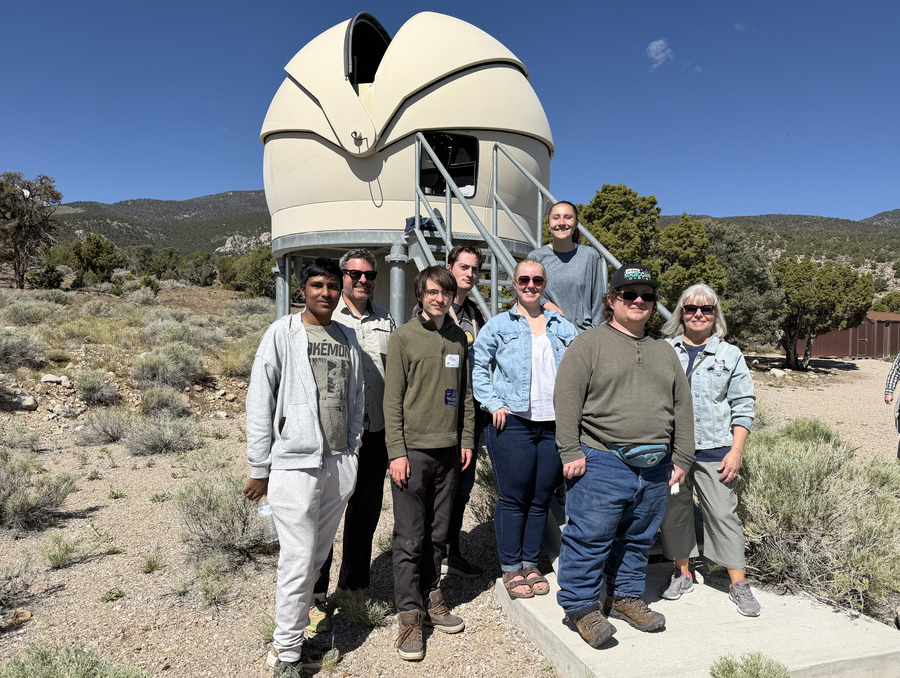
Two or three at a time, graduate and undergraduate students climbed a narrow outdoor staircase to step into the Great Basin Observatory, a remotely operated telescope used for research and education at Great Basin National Park.
The May morning was bright, a sharp contrast to the night before, when the group had camped under the dark skies. Led by Melodi Rodrigue, associate teaching professor in the Department of Physics at the University of Nevada, Reno, the group of students and faculty were there to see the Great Basin Observatory up close, after using the telescope’s data in classes and research projects on the Reno campus.
The Great Basin Observatory is not just a remote research tool, but a place in Nevada’s only national park that connects the University of Nevada, the state’s original land-grant university, to the Great Basin National Park Foundation. The Great Basin National Park Foundation funded, constructed and operates the observatory.
“It’s an exciting opportunity to see the park that I’ve actually been able to work with,” said Allyson Decramer, a recent graduate in physics with minors in mathematics and astronomy.
Decramer’s work focuses on binary stars. In her course last semester, students were tasked with identifying a binary star system observed by the telescope and determining whether it was a physical double star or an optical double star.
Decramer’s star, she said, turned out to be an optical double. The project also allowed her to use space velocity vector analysis.
“Dr. Rich Nugent published a paper last year, so I was one of the first who was able to analyze the space velocity vectors specifically for my star,” she said.
Decramer’s family has lived in Northern Nevada for generations and she said the Nevada connection to the national park and the observatory made the experience meaningful. This fall she will begin a graduate program in physics at Oregon State University and hopes to do astrophysics research.
“I’ve been following the Observatory for a while,” said Tristan Pulsipher, an undergraduate student originally from Las Vegas. “It was one of the main reasons why I decided to go to the University of Nevada, Reno.”
“This is the kind of job that I want to work at: a telescope operator.”
Pulsipher, who plans to graduate in spring 2027, used the Great Basin Observatory in the class Astro 310 to study exoplanets during their transit periods. The class gave him access to research-grade astronomical data while still an undergraduate. Visiting the observatory helped connect that data to the observatory and the Nevada landscape.
“Now I’m actually at it and I get to see it,” he said with excitement. “This is the kind of job that I want to work at: a telescope operator.”
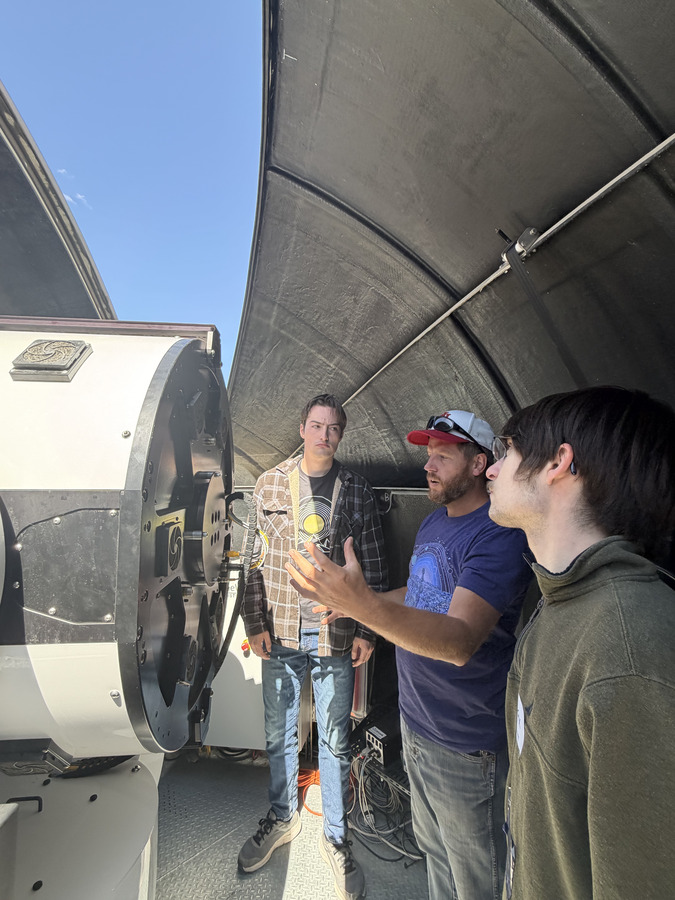
Remote data, close to home
Students studying astronomy and physics use data from telescopes across the world, but the Great Basin Observatory offers something closer to home: a research-grade telescope based in Nevada.
"It makes sense for Nevada’s original land-grant university to be connected to the research and programming happening in our state’s national park." – Executive Vice President and Provost Jeff Thompson
“We are proud of this collaboration and the opportunities it creates for hands-on learning in such a remarkable setting," said Jeff Thompson, executive vice president and provost. "It makes sense for Nevada’s original land-grant university be connected to the research and programming happening in our state’s national park. Dr. Melodi Rodrigue’s work is central to making this experience possible, connecting students to both discovery and stewardship in powerful ways.”
Michael Blaschak, who recently completed his master’s degree in physics at the University, said the symposium at Great Basin National Park was an inspiration.
“Coming out and visiting and talking to some of the other university partners gives us some ideas for future projects,” Blaschak said.
For students, the symposium was both academic and personal. They saw the telescope, talked about their research and spent time in the park with others who share their interest in astronomy and physics.
“If anyone has the chance to come out here, it’s absolutely incredible,” Decramer said. “If you have the chance even to do research with the GBO, highly recommend it.”
Marking 10 years, 40th anniversary
Ten years into the partnership with the Great Basin National Park Foundation, the Great Basin Observatory continues to give students more than access to astronomical data. It gives them a place to see themselves as researchers, scientists and future professionals connected to Nevada’s skies. And while that partnership celebrates 10 years, the Great Basin National Park celebrates its 40th anniversary this summer. To mark the event, the Great Basin National Park Foundation is hosting a virtual speaker series throughout the summer.
“Great Basin’s Dark Skies and the Great Basin Observatory” will take place at 6 p.m. on July 15, and “Dark Skies, Bright Minds: Great Basin Observatory Research and Impact” at 6 p.m. on August 12. More information is available on the Great Basin Foundation website.


