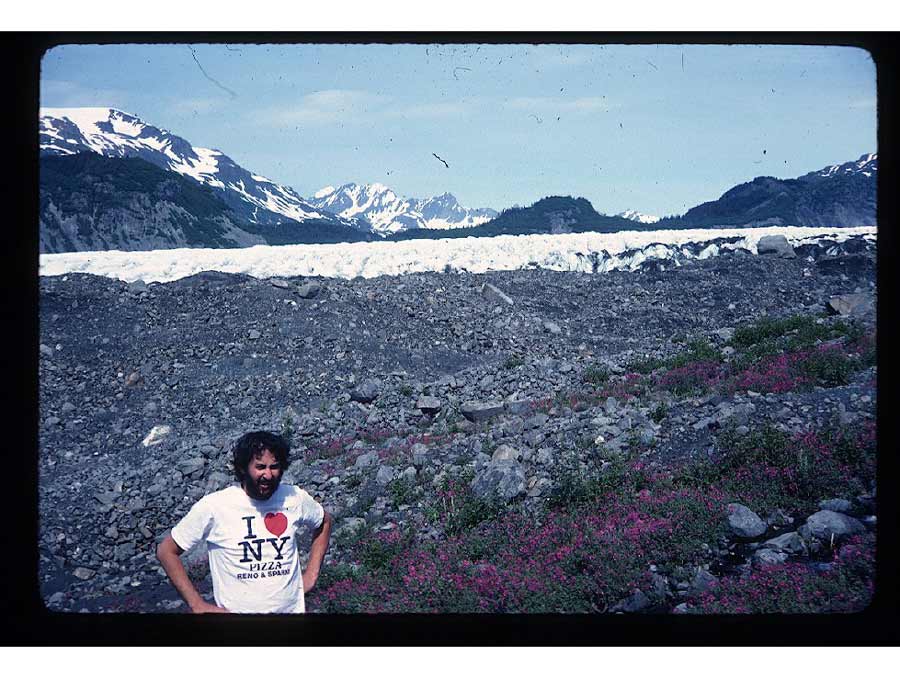
Richard Goldfarb ’81 M.S. (geohydrology) has a few stories that he said probably shouldn’t be told about the hijinks he got into during his master’s degree, a time he looks back on fondly. Goldfarb was a master’s student at the University of Nevada, Reno and worked on his hydrology degree with the Desert Research Institute (DRI).
Today, Goldfarb is a research professor at the Colorado School of Mines and the China University of Geosciences in economic geology. He also works as a consultant for mining companies.
Goldfarb is skilled in identifying how gold deposits formed and has published over 250 research articles on the relationship between gold and orogenesis, including one that’s been cited over 3,000 times. Tectonic studies or orogenesis help scientists identify how orebodies originated, which could be used to help find gold deposits in areas with similar geologic histories.
“I keep saying I'm writing my last journal paper,” Goldfarb said, but he gets frustrated when he sees “something in the literature that’s crazy. So, I keep writing my last journal papers, and I’ll probably keep doing it until I die.”
Goldfarb earned his bachelor’s degree in geology at Bucknell University in Pennsylvania. He moved to California to start a Ph.D. in fluvial geomorphology, but dropped out to enjoy life in San Francisco where he worked odd jobs. He eventually came across an ad for a job at the Lawrence Livermore National Laboratory (LLNL) and conducted stream sediment and stream water reconnaissance surveys as part of the Natural Uranium Resource Evaluation (NURE) program run out of LLNL.
Goldfarb then decided to pursue a master’s degree at the Mackay School at the University of Nevada, Reno and DRI. A geologist who he worked with in the NURE program at LLNL, Ken Puchlik, was connected to the Nevada Bureau of Mines and Geology within the Mackay School and worked for many mining companies in Nevada. He had a house in Reno that was often vacant, so he told Goldfarb he could live there for free. He also introduced Goldfarb to Helen Mossman, who Goldfarb described as “like my mother” in Reno. Mossman was an office manager for the Nevada Bureau of Mines and Geology.
“She took great care of me,” Goldfarb recalled. “Every Monday night, I'd go to her house, she'd make me dinner, and we'd watch Monday Night Football. She was in her 60s, 70s at the time, but she was just a phenomenal individual and I think pretty legendary in the Bureau back in the 1970s and early 1980s…. So right off I had a house and a family when I got to Reno.”
Goldfarb recalls having a great view out his office window at DRI and being close with the other graduate students there. He enjoyed the interdisciplinary nature of his coursework. From aqueous geochemistry to water law to geostatistics, he was exposed to many aspects of geohydrology. He also took a part-time job in uranium exploration for the Department of Energy around the Nevada Test Site and a summer job with the U.S. Geological Survey looking at mineral resources in the Golden Trout Wilderness in the Sierra Nevada. His thesis focused on stream sediments and mineral deposits in the southern Sierra. His advisor was Clint Case at DRI.
“Many of us really liked Clint just because he was very open minded and encouraging,” Goldfarb said. “He was just such a wonderful, worldly kind of guy that a lot of us who were doing hydrology sort of drifted to because Clint was always so positive and supporting.”
As his time at the Mackay School came to a close, the person who hired Richard for the job at Lawrence Livermore, David Leach, told him about a job in Alaska working for the U.S. Geological Survey in mineral resources. He’d have to leave Reno in a hurry after finishing his coursework.
“It's a dream place to go,” Goldfarb remembers thinking.
He missed commencement to leave for the summer job in Alaska, kicking off 35 summers of working in Alaska for the USGS.
During the first summer, he noticed that the genetic models for the gold deposits he was trying to understand didn’t make much sense. Goldfarb decided he needed to go back to school and started his Ph.D. in economic geology at the University of Colorado.
“And the same time I was doing this geochemical work in Alaska, there was a woman, Marti Miller, who was making the first metamorphic geology map of southern Alaska,” Goldfarb said.
Goldfarb said that the common understanding at the time was that Alaska’s gold deposits were epithermal, like Nevada’s, but that’s not what his geochemical studies were showing. Goldfarb and Miller started comparing notes and revolutionized how many of Alaska’s gold ores were understood, showing that most of the gold deposits in Alaska are related to metamorphic events.
Goldfarb honed his expertise on gold geology, eventually starting a consulting company.
“So, I sort of went from undergraduate school to Berkeley, [thinking] I'd be a geomorphologist, then I went to Reno, [thinking] I'd be a hydrologist, then I went to the USGS and I became an economic geologist,” Goldfarb said, laughing. “So, you never know where you're going to end up.”
Goldfarb still visits the University from time to time to provide guest lectures, particularly for the Center for Research in Economic Geology (CREG).
“Having a University alumnus like Rich, who is more than willing to engage with and educate current students in the CREG program and beyond and share his wide range of economic geology knowledge, is a huge bonus and I've personally benefited a lot by being able to call on someone with his experience,” Simon Jowitt, Nevada Bureau of Mines and Geology director and former CREG director, said.
Even though his work isn’t closely tied to hydrology, Goldfarb said his degree at the University of Nevada, Reno helped him understand fluid movement through the earth’s crust. Understanding processes of fluid movement, permeability, porosity, geochemical changes, and multivariate statistical techniques related to data processing, like factor analysis and discriminant analysis, helped him in his career.
“Even if it had nothing to do with ore deposits, my education at the University of Nevada, Reno taking all these water-related classes really gave me a huge advantage in trying to understand the genesis of gold deposits,” Goldfarb said.


