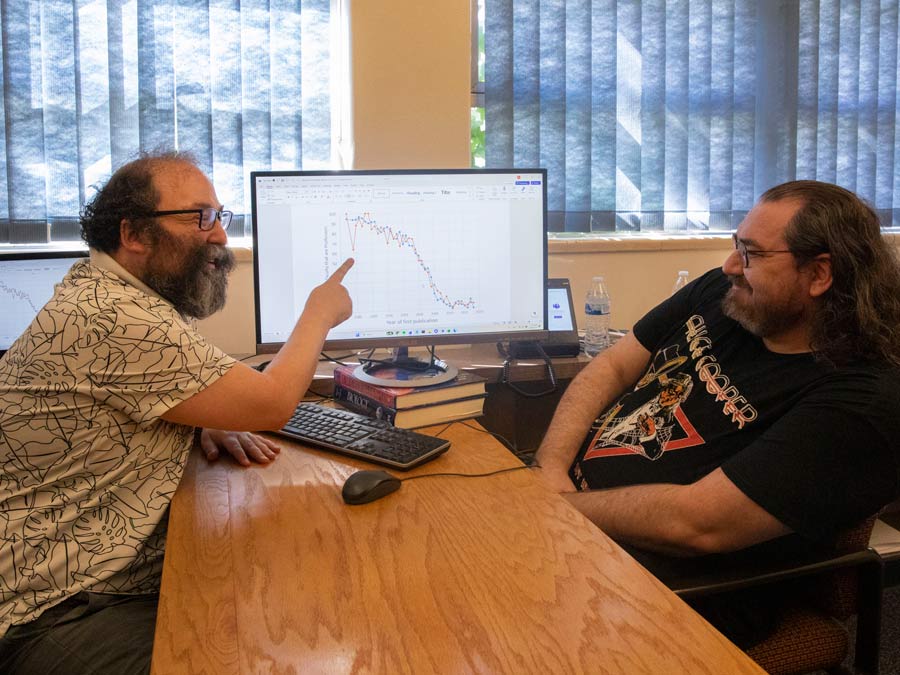
James Vesper, an undergraduate biotechnology student at the University of Nevada, Reno, said gender parity conversations were common in his household growing up. His parents were both engineers, and his mom noticed differences between how she was treated based on her gender. Vesper recently contributed to research showing that there are differences in how men and women perform on common metrics in biology research, shining light on disadvantages women face in STEM fields.
The research, published last week in the journal Scientometrics, found that there are differences in how men and women perform on metrics in biology research. Women in biology, on average, publish less per year and are cited less than their male colleagues.
“Even if you look for men and women who have the same number of papers and who started publishing in the same year, women on average are cited less,” Professor David Alvarez-Ponce, a bioinformatician at the University of Nevada, Reno, explained. “If there is discrimination, a very plausible scenario, I’d like to document it with data.”
The article is the latest in a series of articles Alvarez-Ponce has led exploring the differences between women and men in research publication. Previous research he's published has found that biomedical and life science articles by female researchers spend more time under peer review than similar articles by their male colleagues, but also that there are exceptions in fields such as evolutionary biology.
“There is a lot to be explored, I feel, about the differences in how men and women are treated by academia,” Alvarez-Ponce said.
For the latest publication, Alvarez-Ponce and Vesper, his student, sought to explore differences in the number of publications per year and citations that a researcher published or received between men and women.
Vesper spent a summer gathering a census of 5,825 researchers. The census represented all the tenured and tenure-track faculty members working at Carnegie R1 research institutions in departments of biology or related fields, like cellular and molecular biology or ecology, evolution and conservation biology. Vesper looked up each professor in a publication database called Scopus to collect information about their publications and citations and looked up each professor on university websites to infer gender by names, pronouns and photos on the websites. Sometimes, estimating gender required many internet searches.
“We had to go down pretty deep rabbit holes to figure out some of them,” Vesper said.
“James is a bit of a detective,” Alvarez-Ponce added.
The calculations Alvarez-Ponce ran on the census showed that women in biology, on average, publish less per year than their male colleagues, even when controlling for factors like how long women have been in the academic workforce. Women in biology are also cited less, even when controlling for the finding that women publish less on average than their male counterparts.
Alvarez-Ponce points to research that shows that women take on more teaching and service roles as part of their academic faculty positions than men do, suggesting that those time commitments play a role in decreasing research productivity.
“This is not the first analysis that has shown that women publish at lower rates than men,” Alvarez-Ponce acknowledged, but he added that it’s important to take a magnifying glass to the findings and try to tease out what gender differences arise in different contexts, such as disciplines or countries.
Nuances between fields of study and how publishing cultures vary could play a large role in factors like speed of publication or number of citations. For example, in biology, the common rule is that authors who contribute the most work are listed first in the list of authors. If the supervisor of the project is not the first author, then they often sign as the last author. Physics Associate Professor Richard Plotkin said that in many subfields of physics, having a last author position is ideal.
“This study could have been done by a team of sociologists, and that would have been great,” Alvarez-Ponce said. “But there is also value in a team of biologists doing it because we know how biology works. We can better explain, or at least we have firsthand experience with how things work in our field.”
Alvarez-Ponce has also taken on editorial board roles for scientific journals for several years.
“Overseeing the peer-review process has helped me better understand how academia works,” Alvarez-Ponce said.
Alvarez-Ponce is well-positioned to explore these discrepancies in publishing and citation rates between men and women, which require vast amounts of data and complex comparisons. As a bioinformatician, his biology research relies heavily on his data science skills. He also has some background in the social sciences, and he said he cares about people having equal opportunities.
“I’ve been interested more and more in the last years in trying to use that for social justice,” Alvarez-Ponce said. “This is one step toward that.”


