A simple paper strip can now detect a toxin found in contaminated food in 15 minutes.
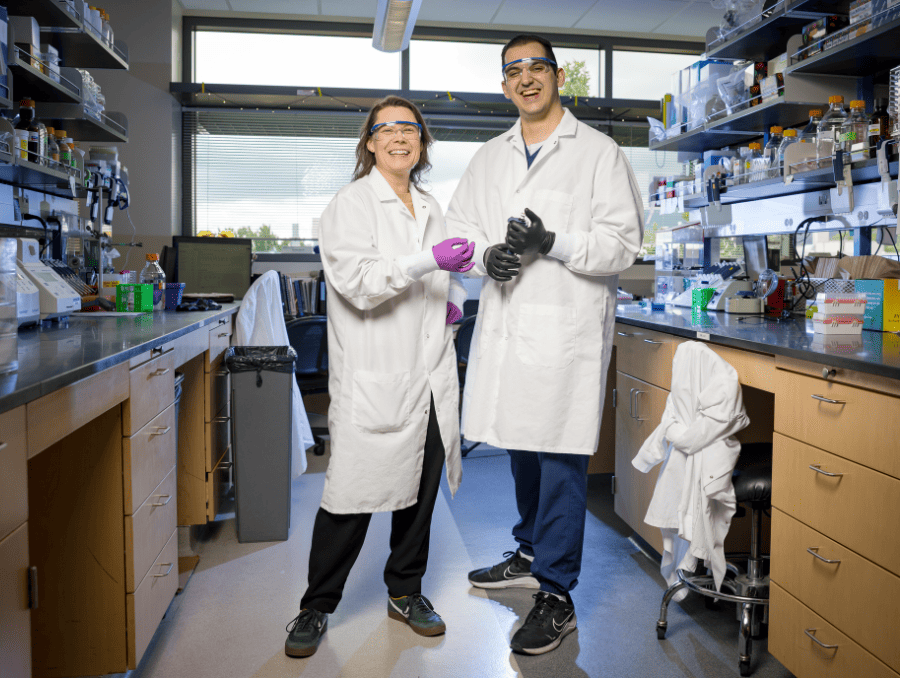
Vanessa Berner, Ph.D., a research faculty scientist in the Department of Microbiology and Immunology in the laboratory of David AuCoin, Ph.D. worked with third-year medical student Peter Asimenios to create this test. The AuCoin Laboratory at the University of Nevada, Reno School of Medicine (UNR Med) focuses on developing cost-effective tests used for at-home diagnosis of dangerous infectious agents and biological toxins.
The strip detects staphylococcal enterotoxin B, which commonly causes food poisoning that results in vomiting and diarrhea. Faster detection can help reduce the spread of the toxin while also providing a quicker diagnosis and treatment.
“For this particular project, Asimenios was a great fit as he had quite a bit of prior research experience and a really keen interest in the toxin biology and clinical impact,” said Berner. “He not only helped design the experiments to construct and optimize the tests, but he also performed toxin testing under rigorous biosafety conditions. Not all students are able to work with biological toxins and other select agents; only those with extensive experience and specialized training can perform this type of research.”
This test can identify contaminated foods at the source before they are distributed and is more sensitive than previous tests. Current detection methods are also time-consuming and laborious.
“The most surprising finding has been how well the test works across a wide range of foods,” said Asimenios. “Many other tests require lots of sample preparation, while ours is relatively ‘plug-and-play.’ This makes it more practical for real-world use.”
Contaminated food products can also be used in bioterrorism. Staphylococcal enterotoxin B has been classified by the U.S. Centers for Disease Control and Prevention as a select agent, meaning it has high potential to be used as a biological weapon. With this test, public health authorities could screen for the toxin more quickly to reduce outbreaks.
“I do think it’s important for college students to participate in research,” said Asimenios. “It builds critical thinking, adaptability and teamwork while promoting engagement with the latest scientific knowledge. It allows students to contribute meaningfully and advance their field by discovering new information.”
A 2019 survey by the Association of American Medical Colleges found that nearly 60 percent of medical students had participated in laboratory research. The organization also identified research as an effective way to hone critical analysis skills while preparing students for medical school.
“Being part of a student’s research journey is very fulfilling because I get to watch them make significant growth in their abilities and understanding,” said Berner. “When a student contributes something important to a project for the first time, you can see a fire ignite in them for science. It’s a privilege to be a part of that moment and to help get them there.”
A medical student’s application includes the Medical College Admission Test (MCAT) scores as well as experiential factors – students who participate in research can enhance their competitiveness.
“It provided valuable experience in interdisciplinary collaboration and how to adapt on the fly when experiments don’t go as planned,” said Asimenios. “It also exposed me to many important laboratory techniques, many of which are used extensively in other projects.”


