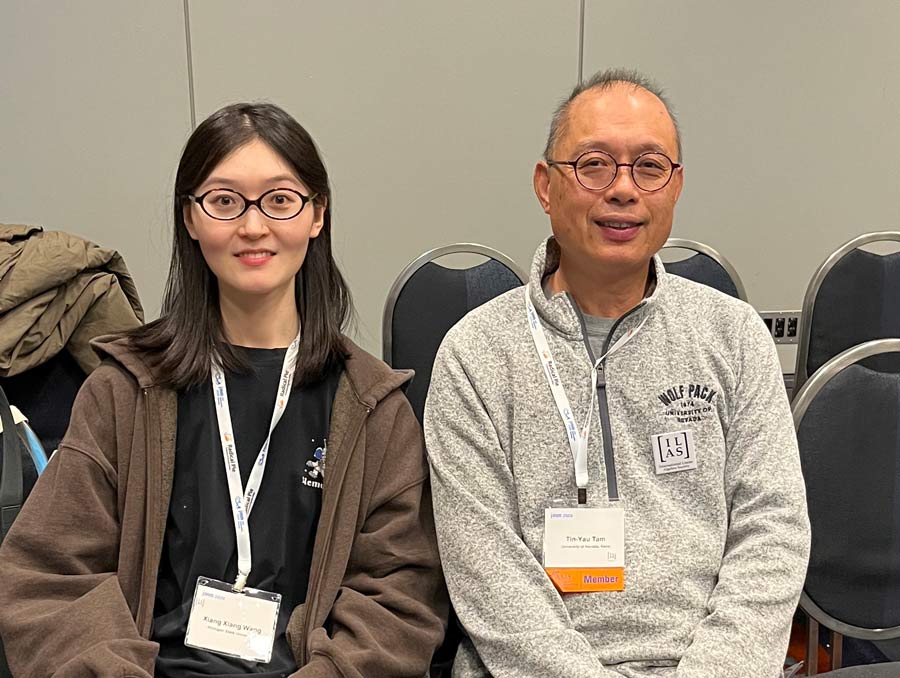
Since launching in 2017, the mathematics Ph.D. program in the College of Science has prepared graduates for impactful research careers across academia and interdisciplinary science. One recent example is Xiang Xiang Wang, who earned her Ph.D. in Mathematics in summer 2025 and is now completing her postdoctoral work as a research associate at Michigan State University.
During her doctoral studies at the University of Nevada, Reno, Wang worked under the supervision of Tin-Yau Tam, the chair of the Department of Mathematics and Statistics. She earned several awards, including the Graduate Dean’s Merit Scholarship, the Graduate Student Association Research Grant Award and Travel Award, and the College of Science Outstanding Graduate Assistant Award.
It can be difficult to comprehend anything beyond four dimensions, but that is exactly what many mathematicians graduating from the math department, including Wang, specialize in. With guidance from Tam, Wang developed mathematical frameworks for high-dimensional data representation. This allows for creative new ways to explore problems in areas such as machine learning and computer vision. Wang’s research explored Grassmann manifolds, quaternion matrices, and related geometric structures.
“This work reflects the program’s strength in combining deep theoretical foundations with emerging applications in data science and applied mathematics,” Tam said.
Wang now works in a research group led by Guowei Wei. The group develops mathematical and computational tools at the interface of mathematics, data science and the natural sciences, including mathematical artificial intelligence, machine learning, multiscale modeling and topological methods. Applications range from biological systems and imaging to complex physical phenomena.
In this interdisciplinary environment, Wang continues to build on geometric and topological approaches, including Grassmann manifold models and topological data analysis.
“Her work exemplifies how rigorous mathematical training at the University of Nevada, Reno equips graduates to contribute meaningfully to cutting-edge research that bridges theory, computation, and real-world applications,” Tam said.
Wang’s success highlights the growing national and international visibility of the University’s mathematics doctoral program and its mission to train the next generation of mathematicians for research careers in academia, industry and interdisciplinary scientific fields.


