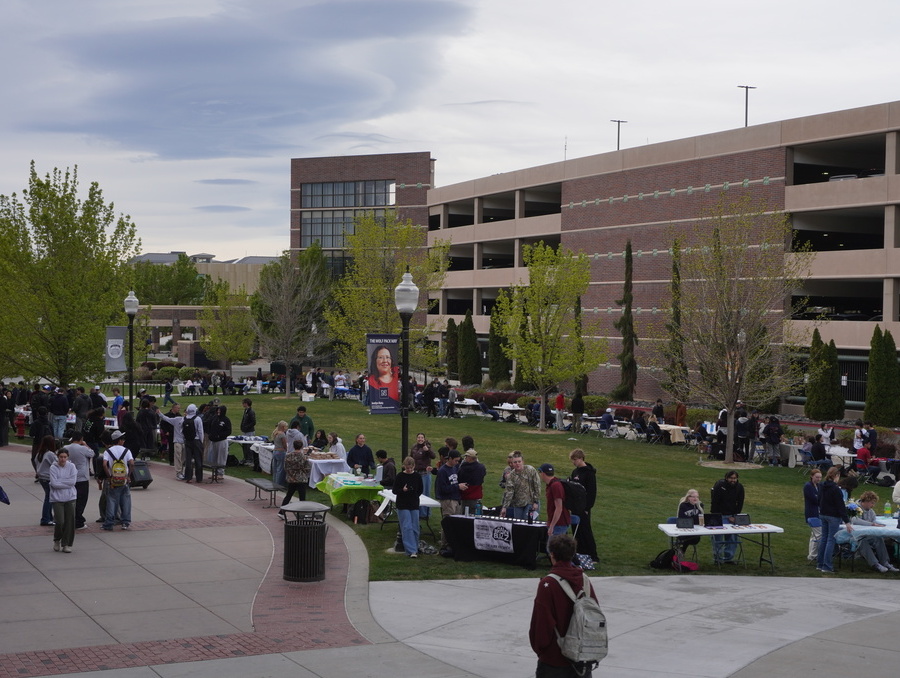
First-year business students at the University of Nevada, Reno College of Business stepped out of the classroom and into real-world entrepreneurship during the annual ENT 200 Sales Expo, where student teams created, marketed and sold products and services on campus as part of their coursework.
Held on the Knowledge Center lawn, the expo challenged students to turn ideas into functioning microbusinesses, setting prices, refining pitches and responding to real customer behavior along the way.
“The primary goal of ENT 200 is to give first-year business students a hands-on entrepreneurial experience,” said Gianna Hutton, coordinator of first-year experiences in the College of Business. “Rather than just learning concepts in a classroom, students actively create, market and sell products. They make all the decisions, from pricing and branding to customer interaction and sales strategy.”
For Dale Flores Jr., a freshman marketing major, that meant taking a calculated risk. His team launched WolfWash, a mobile car detailing service, which was the only service-based business at the expo.
“We wanted to stand out in the market,” Flores said. “We chose this idea to fill a need for convenient vehicle care on campus and to show our work ethic directly.”
Rather than targeting individual customers, Flores pivoted to a business-to-business approach.
“Our strategy was to pitch local companies on bulk washes instead of relying on individual customers,” he said. “I called the owner of Mountain High Lawn directly and negotiated a deal to wash his fleet of about ten landscaping trucks. This allowed us to hit our full $400 goal in one transaction.”
That shift also came with challenges. “Overcoming the initial skepticism of a business owner was the hardest part,” Flores said. “We had to earn his trust and prove that a team of college students could handle a bulk job and deliver a reliable service.”
Other teams focused on innovative products, including Chipdin, an NFC keychain designed to simplify networking by allowing users to instantly share personalized digital links with a tap of their smartphone. The product was developed by a student team that included electrical engineering student Wyatt Bordeaux and business students Roxy Totton and Trevor Page.
“One challenge we encountered was that many potential customers were unfamiliar with NFC keychains and didn’t immediately understand their value,” said Page, a finance and accounting major. “We adapted by incorporating live demonstrations and real-world scenarios into our sales pitch, which significantly improved engagement.”
Page said tabling at the College’s Career Fair provided exposure to recruiters and students actively networking. Team member Roxy Totton also connected with staff at the Regional Public Safety Training Center, helping the team distribute dozens of keychains.
Beyond meeting sales goals, students gained skills that can’t be replicated through lectures alone.
“The ability to pivot a pitch during a live negotiation was huge,” Flores said. “Lectures teach sales theory, but pitching a business owner taught me how to read their tone and adjust my value proposition in real time.”
Hutton said that kind of growth is exactly what the course is designed to foster.
“Students show significant growth in confidence, communication and problem-solving,” she said. “By the time of the expo, they’re more comfortable pitching their product, handling objections and adapting on the spot.”
The experience also teaches resilience. “Success builds confidence, but rejection teaches students how to pivot and keep moving forward,” Hutton said. “Those are essential skills that can’t be fully developed without real-world experience.”
For many students, the Sales Expo is an early glimpse into what it takes to turn ideas into action, and a reminder that entrepreneurship can start long before graduation.


