Spent nuclear fuel discharged from nuclear reactors are stored on site in sealed stainless steel canisters and concrete overpacks. Those storage systems were meant to be temporary, with the waste eventually moved to a geologic repository. But no repository has been identified, leaving scientists and engineers to manage and monitor spent fuel for the long term.
The spent nuclear fuel canisters are closely monitored using external sensors, according to the U.S. Department of Energy. But Mechanical Engineering Ph.D. student Lamia Belhassani is looking at ways to monitor conditions from inside the storage containers.
“It’s a major challenge,” Belhassani said. “Inside the canisters, you have extremely high temperatures and a very harsh radiation environment.”
But if that challenge is met, scientists would have timely access to data such as internal temperature, pressure and gas composition — factors that could indicate a canister leak or fuel breach.
“If we have sensors on the inside, we can monitor what’s happening in real time,” Belhassani said. “If something starts to go wrong, we can detect it early and respond.”
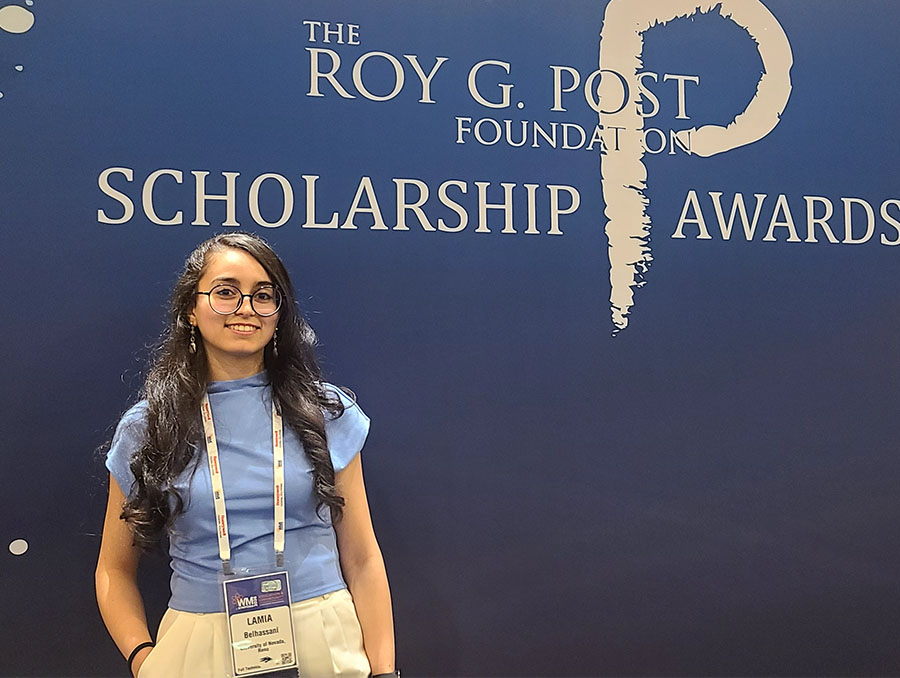
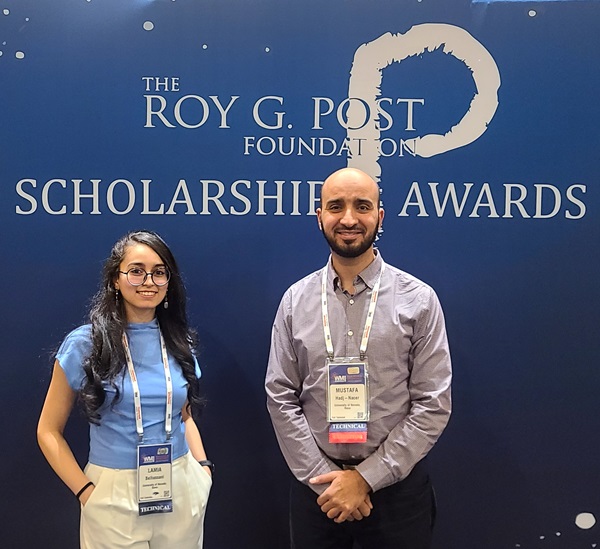
Last month, Belhassani presented some of her work at the Waste Management Symposia, an international conference focused on radioactive waste management. She attended the event in Phoenix as a recipient of a Roy G. Post Foundation scholarship, which helps students cover the cost of attending.
“This scholarship is awarded to highly achieving students worldwide each year who are working on nuclear waste management,” Mechanical Engineering Research Associate Professor Mustafa Hadj-Nacer said. “Lamia is a talented and motivated Ph.D. student in my Nuclear Packaging Research group, and a highly deserving student for the Roy G. Post Foundation Scholarship.”
‘That’s why I’m working on this’
Belhassani has been interested in clean energy — energy producing little to no air pollution — but she wasn’t always focused on nuclear power. For her master’s degree in mechanical engineering, earned in 2023 at the Ecole Nationale Polytechnique in Algeria, she wrote a thesis on optimizing airfoil shapes for wind turbines — designing blade shapes to capture more energy from the wind.
“I was motivated to contribute to the development of clean energy sources,” she said. “But when I was working on wind energy, I realized it’s limited and will not be able to meet the growing global demand for energy.”
The surge in electricity demand is driven partly by data centers for artificial intelligence and high-performance computing. Those facilities could increase total power demand by up to 20% over the next decade, according to a 2024 statement from the Department of Energy.
Around that time, one of her professors introduced her to her now-adviser, Hadj-Nacer, who researches nuclear waste management technologies.
She began learning about nuclear energy and its ability to provide “firm power,” or clean electricity on demand, regardless of weather or time of day.
“If you learn about nuclear energy in depth, you learn it’s very clean and very safe — you just have the challenge of managing the waste,” Belhassani said. “That’s very important, and that’s why I’m working on this. I believe it’s crucial.”
Since 2023, when she joined the University of Nevada, Reno, Belhassani has been researching a system that could monitor conditions such as temperature, pressure and gas composition inside a sealed canister containing spent nuclear fuel. The project brings together sensors, wireless communication and power transfer, experimental testing and computer modeling, she said. In addition to working with Hadj-Nacer, Belhassani is collaborating with faculty members Jihwan Yoon and Xiaoshan Zhu.
“Lamia is a wonderful student to work with,” Zhu said. “She caught the sensor concepts quickly through talking with me and can independently perform the sensor fabrication and testing with minimal supervision.”
So far, Belhassani said she and her colleagues have focused on computational work, including radiation simulations to estimate how much radiation internal sensors would receive and how to shield them. She highlighted that part of her research at the Waste Management Symposium.
“Both my poster and oral presentations led to valuable discussions, thoughtful questions and insightful feedback,” Belhassani wrote in a LinkedIn post after the event. “I’m very grateful for all the conversations, the great people I had the chance to meet, and the insights gained throughout the week.”
Belhassani said that although computational work has been central to the project, the team is already carrying out experimental work in parallel. This includes sensor development and testing, as well as work on the wireless communication and power transmission systems that will be essential to the overall technology. Future phases of the research will include radiation testing of the sensors and the overall monitoring system, in collaboration with a national laboratory that has facilities to conduct that type of work.
Belhassani is hoping to continue working in the field of nuclear waste management after earning her Ph.D.
“I know I want to do research, because I enjoy doing that,” she said. “So, whether it’s in academia or national labs — wherever the opportunity presents itself — I want to do this research.”


