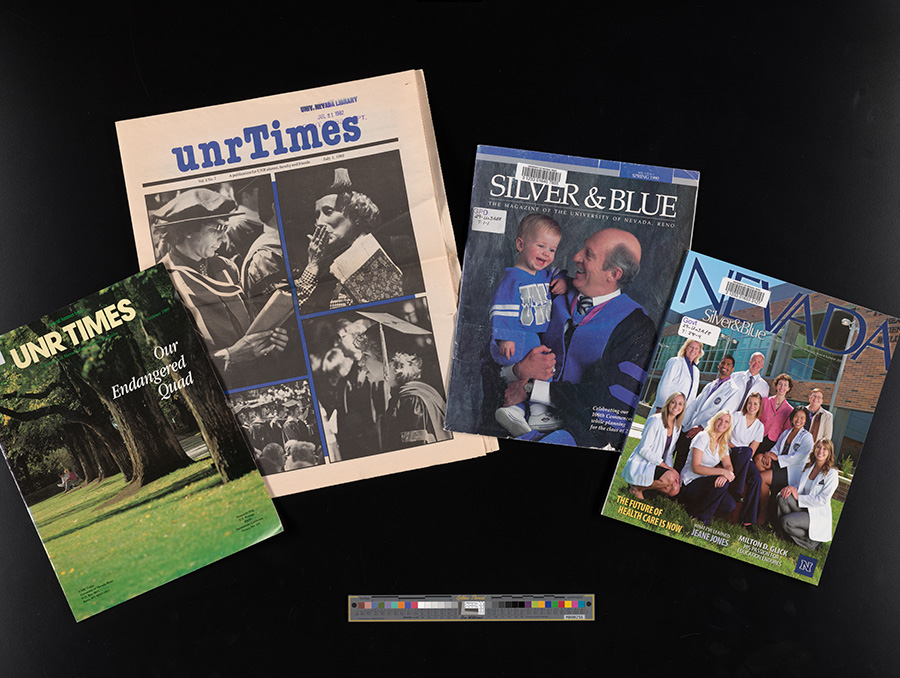
The University Libraries’ digital services department recently partnered with University Advancement on an impactful project to preserve "Nevada Silver & Blue," the University’s alumni magazine. The collaboration resulted in the digitization of 209 past issues of Nevada Silver & Blue dating back to 1972.
“For more than fifty years, Nevada Silver & Blue has told the stories of the University and the people who shape it,” Christy Jerz, University Advancement director of marketing and communications and Nevada Silver & Blue editor in chief, said. “Until now, that rich history had never had a permanent digital home. Digitization expands access for Nevada alumni and friends, ensuring these moments continue to live on.”
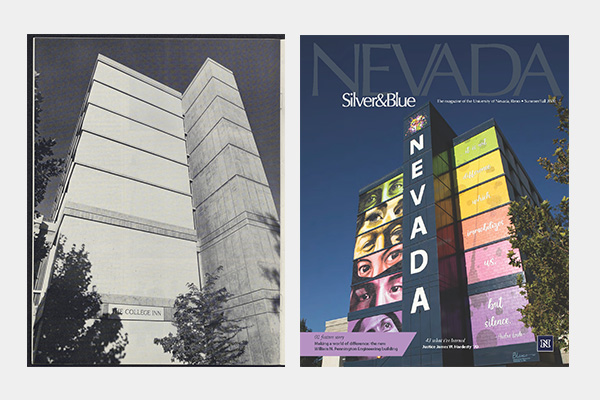
Containing a wealth of campus history, this newly digitized collection enhances the University Archives as it now accompanies other digitized campus publications such as The Nevada Sagebrush, Desert Wolf, Forum, and the Artemesia. It has the potential to make meaningful impact across a variety of key campus groups, community members, alumni, donors, friends of the University and more.
The Libraries’ Digital Services digitization lab manager Katherine Dirk and her team of two student assistants started scanning issues of the magazine beginning in the Summer of 2025. Work on the project was completed in the Spring of 2026. All 209 issues are now available online.
“The magazine feels like a love letter to campus,” Dirk said. “From campus events and new buildings opening over time, this collection shows how campus has grown, shows what professors were doing, and how visually different campus has looked over the years.”
Executing the work no one sees
To complete the project, several Libraries teams worked in collaboration. For the scanning portion, Dirk and student assistants Candace Durand (anthropology undergraduate student) and Samantha Strasser (music engineering graduate student) pulled physical copies of the magazine from the Libraries’ Government Documents collection and the Special Collections and University Archives department. When available, the team at Silver & Blue shared born-digital files of the magazine and other assets with the Libraries.
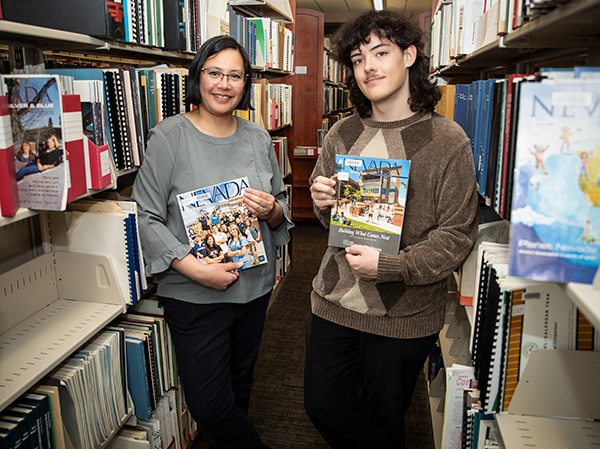
After the materials were pulled, Dirk and her team had to evaluate what was available through the library, selecting only the issues that were in the best condition for scanning. For example, the team looked for magazines that weren’t wrinkled and were without any torn pages. To be scanned and digitized, materials must be in good condition.
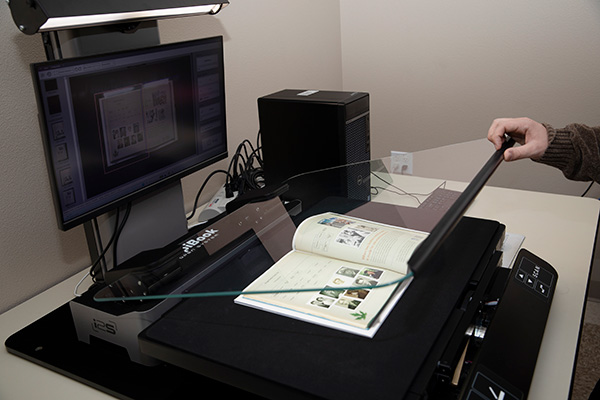
Once the magazines were evaluated and selected for scanning, the team decided what equipment to use to complete this large-scale project. They decided to use a high-tech book scanner.
“The scanner we used has a large glass plate that works well to keep the magazine flat,” Dirk said. “Once opened and positioned, the magazines need light compression to hold the pages down. This is important because it helps the magazine lay completely flat as the team captured the scans of the individual pages.”
Once each of the issues were digitized, file management work began.
The scanning software used on the project numbered everything the team scanned. From there, a folder for each magazine volume number and issue number was created. Then, scanned files were moved so they matched with the folder and issue number created by the team. Then, PDFs were generated and optical character recognition (OCR) work took place. OCR work is critical because it makes the scanned PDFs searchable.
Once each issue of the magazine was OCR’d, the project was handed off to the Libraries’ Department of Metadata, Cataloging, and One-Time Acquisitions (MCOTA), who attached descriptive information to each issue such as title, item and collection descriptions, and subjects.
“The MCOTA team identified the topics contained within each issue and then used what was identified to create subject headings,” Dirk said. “From there, the files come back to me in Digital Services so the technical metadata can be added to tell the Libraries’ digital systems how this information should be displayed when viewed online within the Libraries’ Digital Archive.”
The ability to discover this source online within the Libraries’ Digital Archive is directly connected to the work of MCOTA. The work of this Libraries department is known as “the hidden work of the library.”
“In order to see things like this online, it takes several Libraries teams and several student assistants to complete this specific loop: Scanning. Coding. Ingesting. Display online. Searchable. Findable,” Dirk said. “No one thinks about how the thing they are searching for was added online. They don’t realize how much work goes into adding objects to the Digital Archive.”
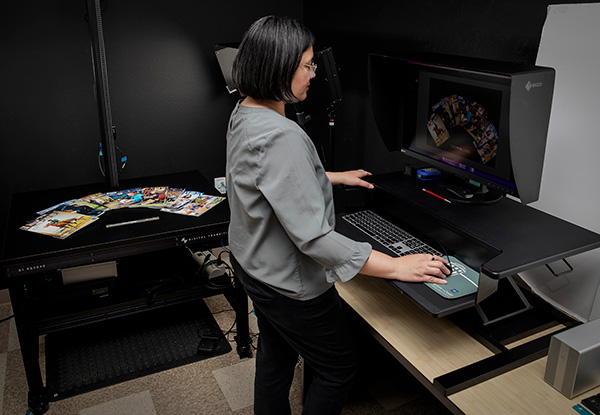
Dirk said, “This is the part of the project requiring the most attention to detail. There is a master Excel file that contains all the information related to each page scanned. I load this spreadsheet to the Libraries’ server, and from there the spreadsheet helps the server understand where the file lives, and where it needs to be displayed online. The spreadsheet also tells the server if the page needs to be displayed as a document or a photo.”
All the data has to be correct for the user to have the best experience with the material. Each item scanned in is put through a rigorous quality control process to make sure the data is clean, and there are no misspellings.
“There are a lot of different content types and file styles within the Digital Archive, which makes this step in the digitization process so important,” Dirk said. “It’s my job to make sure the correct file type and the correct content type appear online properly for the user searching for, viewing and using this collection. Ultimately, we want the user to have a positive reaction with the material when they interact with these issues of Silver & Blue online.”
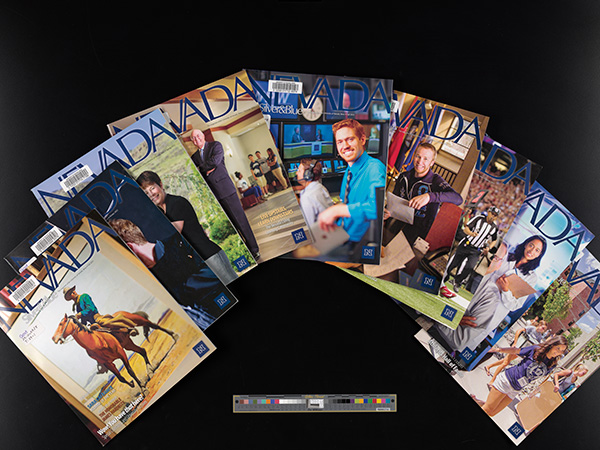
Since 2004, University Advancement has created and published the magazine, honoring its legacy while helping carry it forward.
“We’re deeply grateful to the University Libraries team, whose expertise and behind‑the‑scenes work made it possible to preserve and share this history so thoughtfully and completely,” Jerz said.
To learn more about the “hidden work” of the Libraries and how this unit supports the campus, its students, faculty, staff and researchers, along with the diverse community found across northern Nevada, visit the 2025 Best of the Best annual report online.


