High in the rugged hills of Virginia City, Nevada, where echoes of the Comstock boom still reverberate through old wooden saloons and historic mineshafts, a long-forgotten story is being unearthed. It’s not the well-worn tale of silver strikes and Gilded Age wealth, but a quieter, deeply human history, the story of Hispanic miners and families who helped build the foundation of this storied mining town.
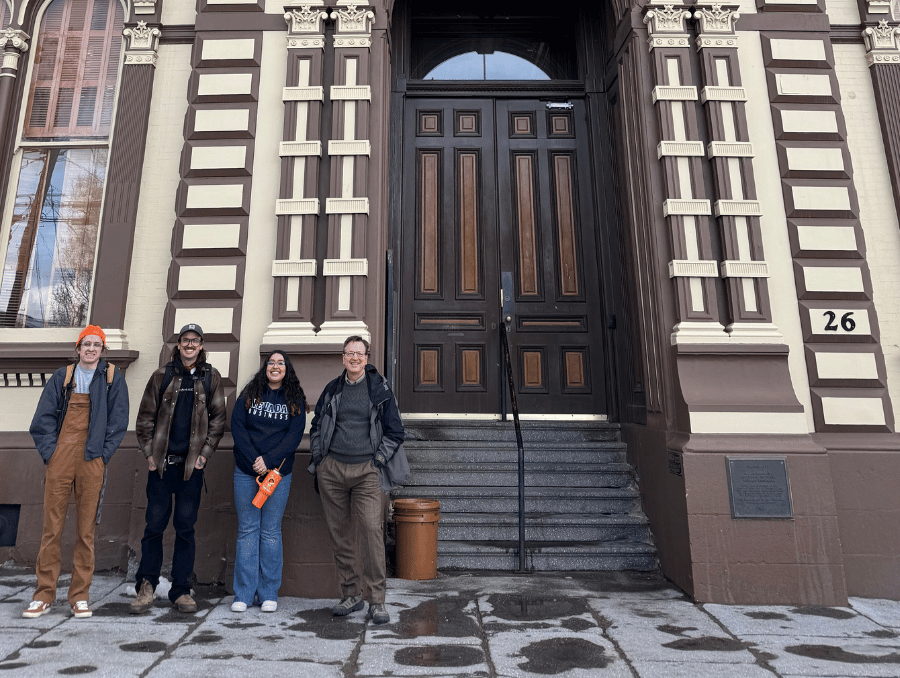
This overlooked chapter, long absent from textbooks and museum displays, is finally gaining recognition thanks to a group of undergraduate and graduate students from the Department of History’s Shared History Program at the University of Nevada, Reno. As part of the College of Liberal Arts, these museum studies students are stepping outside the classroom and into the archives, cemeteries and streets of Virginia City. Guided by Associate Teaching Professor and head of the Shared History Program, Christopher von Nagy, they are recovering the legacy of Hispanic individuals who lived, worked and persevered in the Nevada foothills during the height of the 19th-century Comstock Lode mining boom.
This project began in 2020 as a student-led public history project about the Mexican Mine, the role of the Mexican American Maldonado Brothers and the possible presence of other Latin American miners in the early Comstock. It wasn’t long before it took a compelling turn. As students dug through property deeds, census logs, cemetery records and business directories, a pattern began to emerge — Hispanic names, Spanish-language establishments and fragments of community life were quietly hidden in the historical record. The deeper they looked, the more visible these forgotten lives became.
“It's striking how the early Spanish-speaking population has been overlooked, not just in Virginia City, but also in other early Nevada towns and cities," von Nagy said.
They discovered that many Hispanic miners arrived in Nevada after the California Gold Rush, traveling by ship along the Pacific Coast before settling in silver-rich regions like the Comstock. These men and women toiled in dangerous underground mines, some in places like the lesser-known “Mexican Mine.” Many participated in a vibrant cultural and political life, organizing parades and celebrations and expressing staunch support for Mexico’s elected republic during the period of the French Intervention.
For several students on the team, many of whom identify as Hispanic Nevadans, this turn of research is more than academic — it’s personal.
Student Research Intern Dalia Gudino Landeros shares her near to heart experience.
"As a First-Generation Mexican American student, I gained hands-on experience in archival research, collaborative teamwork and museum curation. Most importantly, I was proud to contribute a principal role in a project that highlights Latinx contributions and addresses the underrepresentation of our community’s history," she said.
As their research expanded, a richer, more global picture of Virginia City began to emerge. Alongside Mexican and Latin American miners, records revealed Portuguese, Brazilian, Prussian, French, German and Hungarian workers, all part of a vast multicultural labor force that powered the Comstock boom.
Among the more surprising discoveries: a Brazilian telegraph operator stationed in nearby Nevada during the late 1800s and early hotels and restaurants run by Californio and Mexican immigrants. These fragments of history not only shine light on Virginia City’s diversity but challenge the long-standing portrayal of the Comstock as an exclusively Anglo-American enterprise.
This effort is not confined to academic papers. The students are taking their findings into the public eye, thanks to a partnership with Fourth Ward School Museum in Virginia City. There, they’ve been invited to create a permanent exhibit in a classroom-turned-gallery space. Featuring historic photographs, artifacts and interpretive panels, the display is designed to educate visitors, especially young students, about the Hispanic contributions to their own local history. The team is also embracing digital storytelling tools to amplify the project’s reach and make the narrative dynamic, inclusive and enduring.
This exhibit will tell the story of what one document in the Story County Recorder’s office referred to as “so-called Spanish Town.” Including property records and documents of homes and businesses owned by Virginia City’s Hispanic immigrants, including saloons, the Mariposa Café (Butterfly Café) and others just south of the early Mexican mine, established by the Maldonado brothers who brought their mining expertise north from the mining regions of Mexico.
The early 1860s saw the construction of one of Virginia City’s earliest brick buildings, home of the Mexican Patriotic Club, whose members constituted the third largest membership of the organization in the United States, just behind San Francisco and Los Angeles. The building was so well-regarded that other social organizations rented the space for their celebrations. “Spanish Town” was located on the north end of the city, just uphill from where modern Six Mile Canyon Road intersects South C Street. For a time, newspaper accounts note celebrations of Mexican and Chilean independence among other events spearheaded by the club in a spirit of solidarity among the city’s Latin American immigrants and other ethnic groups. The boom was short, however and many of the residents of Spanish Town had moved on to new opportunities in Nevada and elsewhere by the 1880s.
The "'Spanish Town' Latin Americans on the Comstock" exhibit will soon be announced for viewing at Fourth Ward School, 537 South C Street, Virginia City, NV 89440.
By digging up experiences of Hispanic individuals in the retelling of Nevada’s mining era, these students are helping to reshape not only the story of the Comstock but the broader story of Hispanic American identity. While silver once made Virginia City famous, the Shared History Program team has uncovered a multicultural past that’s been buried for too long.
"Our team worked diligently for about a year, dedicating countless hours in the archives to uncover this history. This effort was essential because, for far too long, the historical record has overlooked the cultural and material contributions of Mexican and Chilean communities in Virginia City," C McCombs said, graduate student lead of the project. "We hope this is just the beginning of a more comprehensive exploration of Latino/a/e influence across Northern Nevada."


