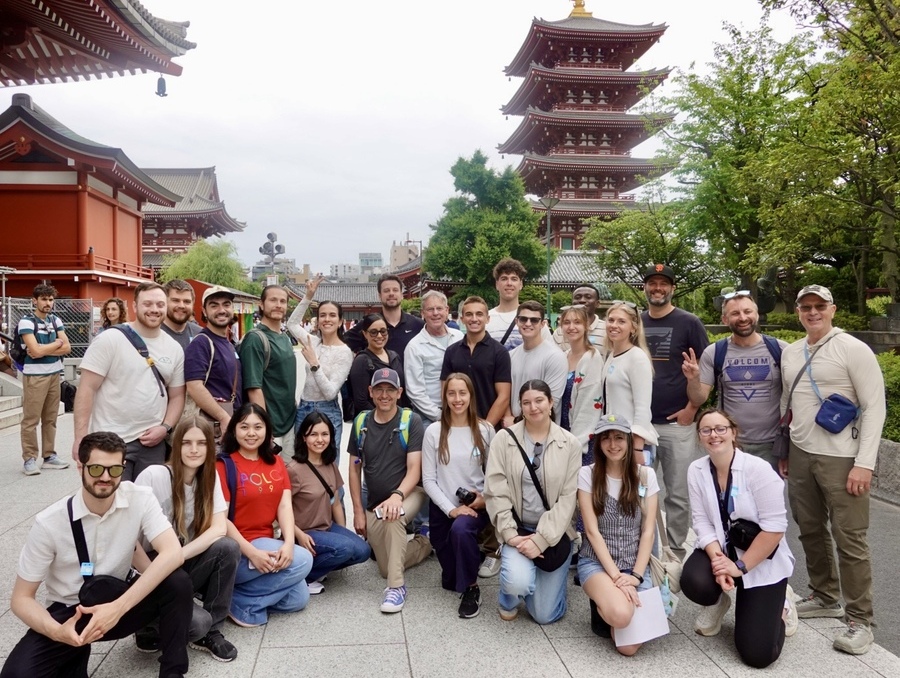
Students in the University of Nevada, Reno College of Business’s Nevada Global Business program recently traveled to Tokyo, gaining firsthand exposure to one of the world’s leading economic centers through company visits, cultural experiences and independent exploration.
Faculty leaders say the experience is designed to push students beyond textbook learning and into meaningful global engagement.
“I hope students leave with a broader global perspective and a deeper appreciation for how culture shapes business practices,” said Jasmine Stanley, assistant dean of business operations at the College of Business. “I also hope the experience builds confidence and curiosity to step outside their comfort zones and embrace new opportunities.”
Tokyo, one of the world’s largest and most innovative cities, serves as an ideal setting for the program. As the fourth-largest economy globally, Japan plays a critical role in international trade and investment.
“Japan is the number one source of foreign direct investment in the United States, making our trade relationship one of our most important,” said Bret Simmons, management professor in the College of Business. “Many large U.S. companies like Boeing, Microsoft, MGM Resorts and Bloomberg have offices in Tokyo.”
Before traveling abroad, students completed in-depth research on Japan’s economy, culture and business landscape. The trip itself then allowed them to apply that knowledge in real time: observing how companies operate, how leaders communicate and how cultural values shape business decisions.
“Company visits and in-country experiences bring international business to life,” Stanley said. “By hearing directly from business leaders and observing the culture firsthand, students can connect what they learn in the classroom with how business is conducted in different parts of the world.”
For students, one of the most impactful parts of the trip was the opportunity to visit global companies and engage directly with industry leaders.
“I wanted to gain firsthand exposure to international business practices and experience a culture that is significantly different from my own,” said Madison Pillot-Dahan, a senior majoring in marketing.
A standout experience for Pillot-Dahan was a visit to Sony, where students learned about innovation and leadership in a global marketplace.
“Seeing how this company balances tradition with technology gave me valuable insight into what drives long-term success in a highly competitive global market,” she said.
Emily Zedek, a first-year MBA student, was drawn to the program as her first opportunity to travel internationally.
“I was interested in experiencing a culture that blends tradition and modern innovation,” Zedek said. “The program allowed me to travel with a group while earning class credit and making the most of the experience.”
Zedek said a visit to the American Chamber of Commerce in Japan offered a deeper understanding of international business relationships.
“They shared how they advocate for change and support stronger business environments between countries,” she said. “It helped me see how global partnerships are built and maintained.”
Beyond company visits, students experienced the nuances of Japanese culture, which was an essential component of understanding how business is conducted internationally.
“Being in Tokyo helped me understand that successful business practices can look very different across countries,” Pillot-Dahan said. “I saw how cultural values influence everything from communication and decision making to customer service and workplace expectations.”
Cultural awareness became a key takeaway for many students.
“I learned that effective collaboration requires more than just understanding language differences,” Pillot-Dahan said. “It involves recognizing communication styles, business etiquette and approaches to teamwork.”
“Understanding customs and behavior is extremely important,” Zedek said. “Simple things like bowing, expressing gratitude and even how you handle currency can show respect and help build relationships.”
Faculty observed a noticeable transformation in students over the course of the trip. Navigating Tokyo’s vast transit system and exploring neighborhoods independently pushed students to grow more confident and resourceful.
“I was most impressed by how well students embraced the challenge of exploring Tokyo,” Simmons said. “They often invited the entire group when planning excursions, and the friendships they built will last long after the trip.”
Some students extended their travels beyond Tokyo, exploring other regions of Japan and even additional countries, further deepening their global perspective.
For many participants, the experience has had a lasting impact on their academic and career goals.
“This experience strengthened my interest in pursuing opportunities that involve international business and global collaboration,” Pillot-Dahan said. “I hope to apply the global perspective I gained in Tokyo to both my studies and my professional career.”
The Nevada Global Business program continues to provide students with opportunities to engage with the global economy, preparing them to succeed in an increasingly interconnected world.


