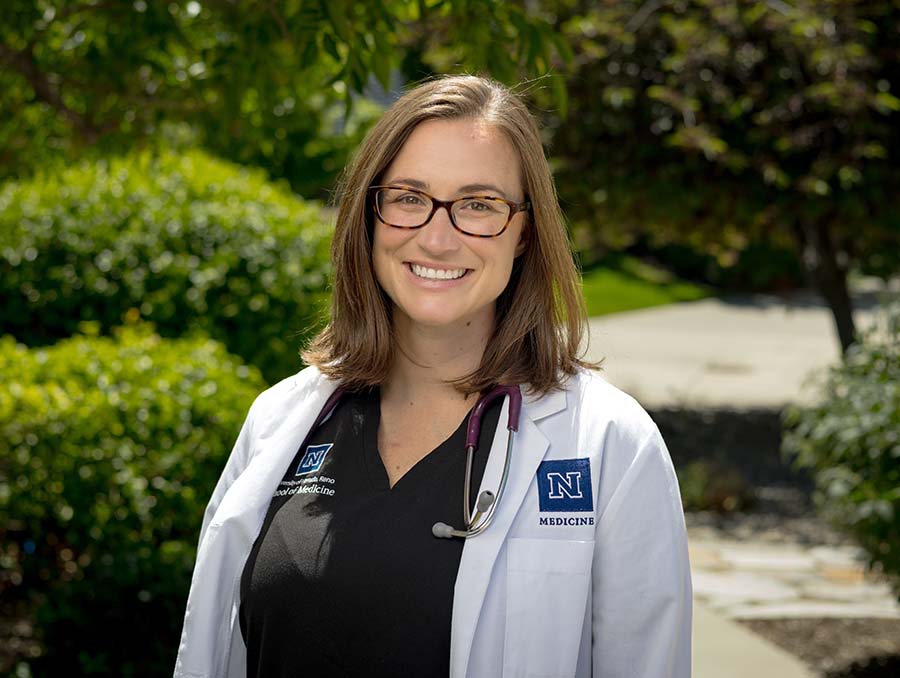
After nearly a decade of working as an occupational therapist (OT), medical school graduate at the University of Nevada, Reno School of Medicine (UNR Med), Miranda Hellman, decided to transition to medicine. With experience in occupational therapy and the determination to expand her knowledge, Hellman’s curiosity about long-term, generational health grew. Hellman will be starting her residency training in Grass Valley, California at Sierra Nevada Memorial Hospital as a family medicine physician where she will be combining her medical knowledge with her expertise in occupational therapy. While balancing family life with twin boys and medical training, Hellman persevered by taking one step at a time towards her future as a family medicine physician.
Why did you become a physician?
“The longer I was working as an occupational therapist with older adults, the more questions I realized I had. I had treated many different patients across the country, and had seen some people aging very well, and others struggling to maintain independence and health. Occupational therapy school gave me a really great background in psychosocial and environmental factors that impact health, but we didn't focus much on pathology and pharmacology. I realized that I wanted to learn more about what goes wrong and why, as well as additional methods to offer to enable people to live life in accordance with their goals. I thought my background in occupational therapy combined with knowledge gained in medical school would position me to be an excellent family medicine physician, someone who can really factor in all pieces of the puzzle to best help patients."
What specialty or area of medicine are you most passionate about pursuing and what draws you to this field?
“I was one of the lucky few medical students that knew exactly what I wanted to do when I walked through the doors of UNR Med. This insight came from nearly ten years of work experience as an occupational therapist: viewing the day-to-day impact of illnesses and the interventions used to treat them. I knew I wanted to be the type of physician that can partner with patients and families to make proactive decisions regarding their health, form longitudinal relationships, care for multiple generations of families, and work to improve the well-being of my community. In other words, I knew I wanted to be a family medicine physician.
“Although I came in knowing that I wanted to pursue this career path, there were many moments throughout medical school that affirmed my decision. From the first two didactic years, being fully immersed and interested in all body systems and pathologies, not just the ones in one body system or age group. Continuing onto the clinical years where I was able to fully appreciate the whole-person perspective that family medicine seems to embody more than any other specialty I encountered. I recognized that I didn’t want to limit my scope to only care for one part of the population, I wanted the training and skill set that would allow me to do the most good for the most people."
What is the biggest challenge you have faced in your medical education and how did you overcome it?
“When I first decided to work toward a career in medicine, I was eight years removed from OT school, working full time as an activity director/occupational therapist at Barton skilled nursing facility, and had one-year-old twins. My life could not have looked any different from my first go around with higher education. I needed to take prerequisite classes in chemistry, physics and upper division biology. I remember calling the admissions office at UNR Med and making a plan to meet the prerequisite requirements. I enrolled in both online and in-person coursework at Lake Tahoe Community College and Western Nevada College. I learned the importance of asking for help, communicating and relying on my village. The experience of going back to school and making a career change taught me a lot about time management, goal setting and living transparently. I could not work toward this major shift without telling other people and asking for help when needed. During my time at UNR Med, I continued to lean on my community of classmates, professors and Student Affairs staff. Special shoutout to our learning specialist, Lisa Kornze, who supported me academically through the transition and helped build my confidence throughout school, and UNR Med therapist, Shannon Mead, who helped me navigate personal challenges through medical school.”
Can you share a memorable experience during your medical training that has significantly impacted your journey as a future physician?
“The most impactful part of this journey has been the people I have encountered throughout the way: classmates, faculty, and patients. I have been constantly motivated by my classmates, who have such diverse passions in the field of medicine, and channel this energy not only toward their own professional development but lifting others up as well. From them I have learned the importance of slowing down, celebrating the small wins, and the benefit of having a village of like-minded people around you.
“From our faculty, I have learned the domino effect that sharing your interests and expertise can have. Dr. Thiele created a LGBT clinic within the Department of Family Medicine that provides vital services to our community. Drs. Greenberg and West did the same for menopause care, and Dr. Dieringer was instrumental in creating an outpatient palliative care pipeline for oncology patients at Renown Health. To be able to witness the impactful work of these local physicians, and learn from them, has been an immense privilege and has shaped my own goals for the future.
“The patients who so openly welcomed medical students like myself to participate in their care remind me that there is so much more to medicine than the textbooks and lectures that form the groundwork that we build upon. The opportunity to be in the room when a child entered the world, as well as when someone took their last breath taught me so much about life and medicine, and I will carry each of these experiences with me as I embark on my career.”
What advice do you have for future students interested in becoming a doctor?
“My biggest piece of advice would be to just start taking steps. I think if you sit and think about all of the work and time it is going to take, it can be very disheartening. If you start putting one foot in front of the other and break things down into smaller, achievable goals, it keeps you going, and before you know it, you reach the finish line.”
What was it like transitioning from occupational therapy to medicine?
“The transition took a lot of planning and effort but now being at this point of graduation and entering residency, I feel like things have really come full circle for me. I have been able to incorporate so many aspects of OT into patient care throughout medical school: discovering what matters most to patients, determining factors impacting independence or adherence to treatment plans and figuring out how to overcome them, and working with patients to set realistic, achievable goals. My OT training helps me see beyond lab values or imaging results to keep the big picture in mind and not lose sight of the things that matter most to patients. I am eager to take this skillset into residency and beyond to be the best family medicine physician I can be.”


