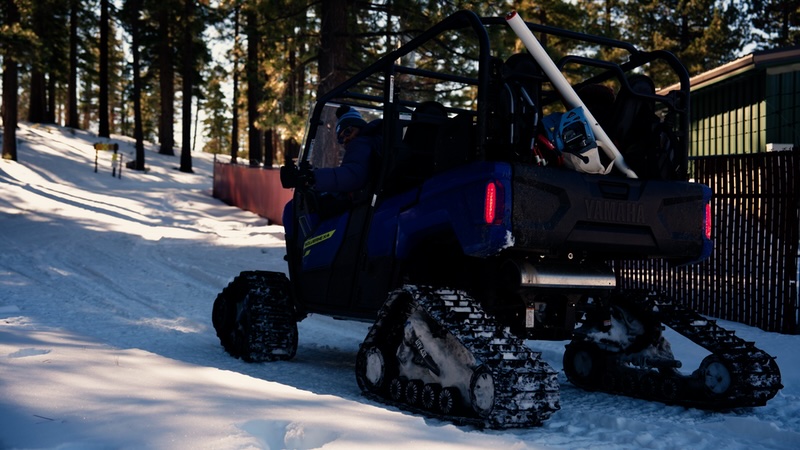
Snowmobiling through the Sierras is one way to get from place to place when conducting the mysterious and important work of snow hydrology. One can also mix in a bit of backcountry skiing or boarding to get from site to site, but be sure to be as prepared as Deandre Presswood, Ph.D. student in the Blaszczak Freshwater Ecosystem Ecology Lab at the University of Nevada, Reno, is. Presswood has been highly educated as part of his program through both the Snow Measurement Field School, a world-class snow hydrology summit held in Mammoth Lakes, California in 2025, and through avalanche safety and preparedness training.
Set to become the first Black American snow hydrologist, Presswood became passionate about snow hydrology early on in his education because it combined outdoor scientific research with an under-researched area that is critical to the wellbeing of individuals and communities. Here, we sat down with Presswood and discussed his path to snow hydrology, his journey at Nevada and his plans for the future.
Q & A with Deandre "Dre" Presswood
Q: Are you originally from Reno?
I’m actually from the Chicago area. My family moved around the Midwest a lot. Some of my youth was spent in Chicago and then we moved to eastern Iowa when I was in middle school.
Q: So how did you find out about the University of Nevada, Reno and what made you decide to come study your Ph.D. here?
It happened in a bit of a roundabout way. I earned my bachelor’s degree in Earth and Environmental Science and did two research projects for that degree – one in meteorology and one in hydrology. That’s when I first became really passionate about hydrology and research.
I had done a summer internship with park rangers and really gotten into doing outdoor scientific work. Then, when I took a hydrology course and completed a project in hydrology, I discovered how much there was to learn.
"Water is so important and everything I thought about water was true … plus more! I kind of got obsessed with it."
Water is so important and everything I thought about water was true … plus more! I kind of got obsessed with it. There was so much to learn about hydrology and many people don’t know a lot about it. I followed my curiosity. I did research, worked with local soil and water conservation districts, and local waste reduction centers as an intern environmental research assistant. I basically did all things water that I could.
Once I graduated from the undergraduate degree program, I debated whether to get a master’s or not. I ended up moving to Colorado for a bit and worked in utilities doing water leak detection. In a nutshell, people would report clean water spilling and seeping into the streets and my job was to test it and investigate where it was coming from. Already in the West, water is scarce, and losing clean water is a real issue. I loved the work and could have continued there, but I wanted to learn more, so I moved to Atlanta to get my master’s.
While finishing up the research for my master’s program, I received a cold-call email that was recruiting for some research happening here in Reno. It just so happened to be from the researcher whom I had been modeling my own hydrology research after! The email talked about the freshwater science being done here in the Sierras, and the snowboarding and mountain biking outdoor recreational opportunities, and I was intrigued. I applied and got the position.
Q: You touched on this already, but what do you love about hydrology?
When considering what to study, I knew I really wanted to work outside. That passion for hydrology came from my curiosity about water after taking my first course in it as an undergrad.
We really miss water when we don’t have it. It matters at a societal level, and it’s interesting, too. There are so many different tools, avenues and perspectives to pursue in hydrology, and that variety coupled with being outside, intersected with all my interests. It all came together.
Q: Now that you’re here, what do you think about Reno, Tahoe, and the Sierras?
I like Reno. Reno’s pretty random – but it’s a good thing. You never know what you’re going to get and that’s really fun. There are great outdoor opportunities, and there’s a lot of people coming from out of town. You never know who you’re going to meet.
Some people are blowing through town to get a degree or some are distinguished scientists coming in from a different location for research or to give a talk.
The outdoor opportunities are abundant. I got into backcountry snowboarding because of my research. It’s a fun way to get around from site to site when doing snow hydrology sampling.
I’ve learned everything about how to do snow science, including how to get out there in the field even without a vehicle.
Beyond the outdoor opportunities tied to my fieldwork, I like to mountain bike, and I play a lot of ultimate Frisbee and disc golf. On Fridays a group of professors and I get together at the rec center and play basketball against some of the undergrads. It’s all really fun and a great way to network and meet folks.
Q: I’ve heard that you went to snow school. Can you tell me a bit about that?
Last year I went to snow schoolthrough a consortium of hydrological scientists and institutions with the best-known snow hydrologists in the world. Each year they have the snow school in a different location throughout the continental U.S. and when I did it, it was in Mammoth Lakes, CA. About a month after that, I went to avalanche training, after encouragement from my advisor who wanted to be sure I stay safe when I’m out snow sampling in the back country.
Q: How has your experience been working in the labs on campus?
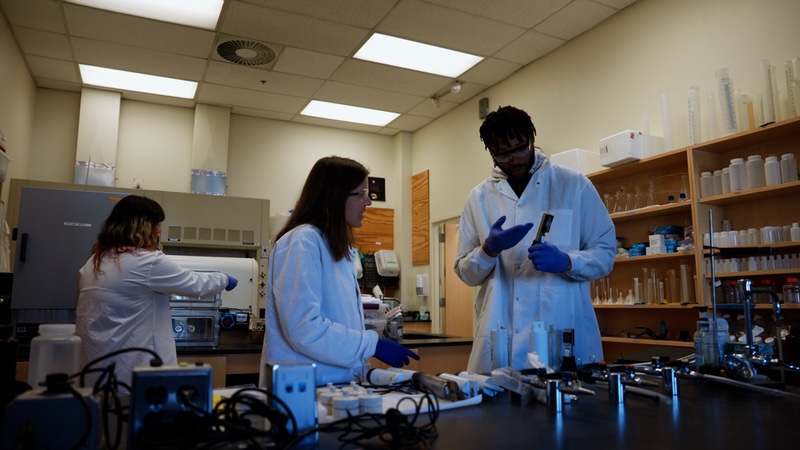
It’s been great. Everyone is very helpful, across disciplines. There are even postdoctoral researchers from around campus who help me out even though they are working tangentially to me. We see each other a lot but don’t necessarily do the same research, which is cool.
The faculty have been really nice and helpful. They give a lot of good tips and advice and help me learn how to streamline things that can be time-consuming. It’s really cool how they want to help me avoid some of the painful lessons they learned when working on their Ph.D.s.
Q: Which faculty members have been especially influential in your journey?
Definitely my advisor, Dr. Joanna Blaszczak. She gives me great advice and sets me up to succeed. Also, Dr. Anne Nolin is a snow scientist who lets me use her lab’s snow UTV, which was really cool to have that trust. Without her generosity, I wouldn’t be able to access my sites as easily as I can! I also want to give a shoutout to postdoc Dr. Emily Burt, who has been really helpful and a good collaborator.
Q: You’ve spoken about the importance of leading, communicating, and making an impact – how does that show up in your work at Nevada?
Hydrology as a whole is a really important field – it’s all about water resources. Being a Person of Color in this community is really important to me.
"My community has been underrepresented and under-advocated for when it comes to water resources. ... I want to be a figure of trust. Someone who gives out great information that will be helpful to people who will actually use it."
My community has been underrepresented and under-advocated for when it comes to water resources. We have a lot of mistrust with certain organizations, and I want to be a figure of trust. Someone who gives out great information that will be helpful to people who will actually use it.
Water is expensive and picking the location you live has a lot of influence on how much you pay for your water. Also, there are a lot of implications with water quality and health, so it’s important to me to give the best information and advice I can from my expert opinion. By doing this work, I can help members in my community have a better quality of life.
When you zoom out, there are a lot of water issues going on and we need to amplify that by talking about it and addressing it. I want to do that in a different way than it’s been handled historically, so that people will care about it. I know that science can be seen as boring. I want to make science cool and help advocate for people to pursue this avenue.
Q: Mentorship seems important to you, particularly working with undergraduate students. Can you share a bit about that?
I really enjoy working with our undergraduate students. They work as research technicians and do a lot of the important work that would individually take me a long time to complete. They do things like collect samples, label items and input data … we really rely on them.
"I teach them science, they get paid, and they get to experience a lot of things they normally wouldn’t, and in return, they really streamline our research processes."
It’s really neat to see because they come from a variety of research and scientific interests but by working in Dr. Joanna Blaszczak’s lab, they get experience working in a lab and in the field. I teach them science, they get paid, and they get to experience a lot of things they normally wouldn’t, and in return, they really streamline our research processes. We like to hire smart undergrads. It’s a good way for them to network, too. It’s a win-win-win situation.
One of the lab’s previous field technicians is now getting her Ph.D. at Oregon State University and another just graduated and is now getting a master’s degree in ornithology [the study of birds] at Eastern Illinois University. Being undergraduate research technicians with us has big implications for their future careers. It’s a launching pad. It helps to have “research field technician” or “lab manager” on your CV when you are applying for jobs.
The scientific community is a small, and we all help each other along the way. It’s really cool to shepherd in the new generation of scientists.
Q: You’re involved with quite a lot of campus programs and organizations, including the Graduate Student Union. How has that involvement shaped your experience?
Being part of the Graduate Student Union has allowed me to meet a lot of people. It’s a fluid environment where we meet when we can, and we advocate for all graduate students to have a high standard of living and good work-life balance.
Sometimes we meet up with local politicians to advocate for the things we need, when we can. Recently, I got to interact with a local Reno councilwoman who used to be the state geologist for a while. After that meeting, I got invited to a private hydrology seminar with her and the University department, which was great. It’s cool to meet people outside the University in a different way and interact with policymakers.
Honestly, the more programs and resources you learn about and take part in, the more people you can meet to make connections.
Q: It’s been documented that you are on track to be the first Black American snow hydrologist with a Ph.D. Would you share more about that experience and how you hope to inspire future scientists from diverse backgrounds?
I had done research in many different climates and time zones across the U.S., including in Iowa, Colorado, Georgia and Tennessee, but I hadn’t done research in the desert and hadn’t done snow hydrology. Reno has both – it is a desert that has snow and a hydrology program – and that was a big draw in coming here. However, when I went to snow school, I looked around and there wasn’t a lot of diversity in the field.
STEM fields aren’t diverse to begin with, and you’ll see that lack of diversity especially in niche fields like snow hydrology. I started to think about that, and I researched it, Googling to see if I could find any other Black snow hydrologists. There are, of course, other People of Color who have done snow science, and I found some Indigenous people who have done snow science, but after looking into it myself, I still couldn’t find any other Black Americans who have done snow hydrology.
"Once I get my Ph.D., I will be the first Black American snow hydrologist."
At snow school, I was around the most distinguished and well-connected scientists in my field, and I asked them if they knew of any Black American snow hydrologists – none of them did. It’s a longer story, but I was featured in the Black Wall Street Times and for that article, the journalists researched and confirmed what I had suspected. Once I get my Ph.D., I will be the first Black American snow hydrologist.
I’m excited to be in this field. Snow hydrology is so important, and doing this work is a lot of fun – it’s a great time! Even if you don’t live in a cold region, snowpack can still be the lifeblood of many regions and communities. We should know where that water comes from and understand it. We especially need to understand it and the dynamics of it in a warming world. I am proud to be a part of history.
Fun fact, the University had a professor, James Church, who invented the Mt. Rose Snow Sampler – a foundation tool in snow hydrology. Now it’ll also have the first Black American snow hydrologist!
Q: The University and the community are truly so lucky to have you. We can tell you are going to continue to do great things. Can you share with us … what are your plans for the future?
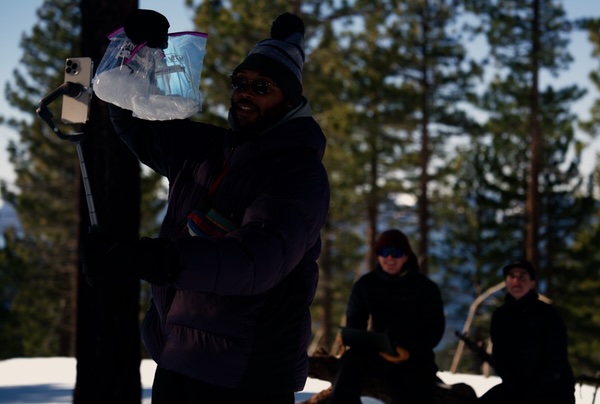
It’s a bit ambitious, what I want to do doesn’t quite exist yet, but I’m going to make it happen! I love networking and bringing people together. I love being outside and I love talking to people about science and science communication. The dream job is to bring all my passions together and create an engaging and inspiring show where I work with all my scientist friends all over the world as we do groundbreaking research. We will conduct the research, film it, publish papers, and document it all. I’d love to focus on those really difficult projects and feature scientists with different perspectives as we do work in difficult to access regions to better understand ecosystems that are understudied and that will have huge implications in nearby communities.
Thank you to Deandre “Dre” Presswood for sharing his story with Nevada Today. You can follow Dre on Instagram and TikTok.
About Find Your Pack
“Find Your Pack” is a video series that highlights real students at the University of Nevada, Reno as they explore their passions, overcome challenges and discover who they are. From student-athletes to researchers, artists to engineers, each story showcases the diverse paths students take — and the supportive community that helps them thrive.


