
Thank you to the team at the University Libraries @One Center for producing and editing this episode.
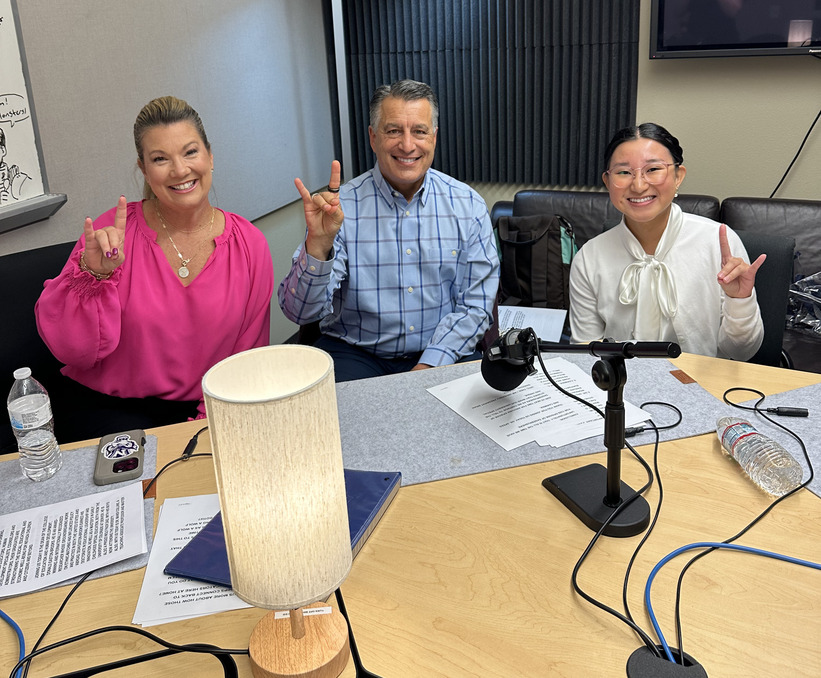
In this episode of Sagebrushers, University of Nevada, Reno President Brian Sandoval speaks with Heather Speed, vice president of the Division of Student Services, and Carmina Aglubat, president of the Associated Students of the University of Nevada (ASUN). Speed and Aglubat discuss the importance of finding a community on campus. Aglubat shares different ways to get involved, noting that the University offers more than 250 clubs and organizations.
As ASUN President, Aglubat understands firsthand the importance of being involved with a group outside of academics to build a personal community and find purpose while attending the University.
Speed expands on the importance of giving students opportunities to learn the skill sets they will need in life and in their careers. By joining campus communities, students can develop skills such as working with different people, time management and conflict resolution.
Sandoval, Speed and Aglubat also explore the unique role the ASUN plays in serving students before, during and after their time at the University.
Sagebrushers is available on Spotify, Apple Podcasts and other major podcast platforms, with new episodes every month.

Sagebrushers Season 4 ep. 8: Student Services and ASUN
In this episode of Sagebrushers, University of Nevada, Reno President Brian Sandoval speaks with Heather Speed, vice president of the Division of Student Services, and Carmina Aglubat, president of the Associated Students of the University of Nevada (ASUN).
President Brian Sandoval: Welcome back, Wolf Pack family. I'm your host, Brian Sandoval, a proud graduate and the president of the University of Nevada. Today's guests are diligently working to create a student‑first campus community. Joining us today is Dr. Heather Speed, vice president of the Division of Student Services. Dr. Speed has more than 20 years of student affairs experience in higher education, and she collaborates closely with several units on campus to transform the student experience and increase successful outcomes. The Division of Student Services under Dr. Speed's leadership includes the Dean of Students, Residential Life, Housing and Food Services, First Generation Student Center, the Multicultural Center, Disability Resource Center, Counseling Services, the Center for Student Engagement and ASUN, Student Persistence Research, and more. Wow!. And also with us today is Carmina Aglubat, president of the Associated Students of the University of Nevada. She is a proud Northern Nevadan McQueen High School?
Carmina Aglubat: Yes.
Sandoval: I thought so.
Aglubat: Go Lancers. Yeah.
Sandoval: Yeah. Yeah. Yeah. And a political science major. She also has served as a liberal arts senator where she championed advocacy and the amplification of student voices. Alongside Vice President Ethan McNamara, Carmina ran on the platform of Home Means Nevada, a commitment to creating a campus where every student feels a sense of belonging, empowerment, and embrace. Carmina remains active in the campus community as a member of the Kappa Alpha Theta sorority and several on-campus political organizations.
Today's episode is being recorded in the podcast studio suite within the @One Studios recording studio at the Mathewson-IGT Knowledge Center. So ,first of all, Heather and Carmina, welcome.
Heather Speed: Thank you for having us.
Aglubat: Thank you.
Sandoval: Yeah, very excited to have you today. So ,Carmina, I'm going to start with you. How do you define belonging on our campus and how does ASUN? And then for our listeners, ASUN is the Associated Students of the University of Nevada student government. How are you all working to build belonging?
Aglubat: Of course. So, before we jump into what we're doing to build for the belonging, I just kind of want to briefly discuss about why belonging is so important on the campus and the university as a whole. What we usually like to say is that students go to universities and seek higher education to receive a degree and to pursue their professional careers in the future. So they go here for an education, but what we like to say is that they end up staying because of the connections that they make with other people, whether that's students, whether that's faculty, staff, alumni. Whatever it is, belonging matters on these campuses for a lot of different reasons. A really big part of what ASUN is trying to do this year, especially with the platform that we had, is to make sure that every single student can feel like home.
An anecdote that I always like to use in President Sandoval and Dr. Speed, I'm sure you guys have heard this a million times, but a lot of people describe going off to university as somewhat sad because they feel like they're leaving home. But what we want to cultivate and create a space where people walk into doors and feel like they're finally coming home. So there's a lot of different things that ASUN wants to do, but that's basically just covering why it's so important for students to feel belonging.
So, a couple of different things that ASUN does is of course clubs or organizations. We kind of oversee that general sphere and we've got over 250 clubs and organizations on this campus and they range from all kinds of interests. So, if you're interested in doing club sports, we've got volleyball, we've got basketball, we've got flag football.
If you're interested in connecting with people over academics or connecting with people over your career path, we have pre-professional clubs like the pre-physical therapy club. We've got political science groups that students could come together and have active discourse. We've also got silly things too that build a lot of community. For example, we have lettuce club where they race to finish a head of lettuce and they get to choose whether they want ranch or whether they want barbecue sauce to go eat with their lettuce. I think that's just a fun community aspect.
And we've also got community service groups as well that work together and bond over the shared purpose of serving other people in this community. And so that's one aspect, which is clubs and orgs, but there's other aspects too. We do a lot of programming. We put on fun events for students to people to bond over, whether they're big things where there's huge yard games and where there's people congregating to watch people perform, or even if it's little things such as getting some emotional support dogs out here and allowing people to have conversation and share conversation, make memories together over a cup of coffee.
So there's a lot of things that ASUN seeks to do, and I think that's scratching the surface for now. But yeah, belonging is super important because students come here for education, but they stay here because of the connections that they make.
Sandoval: No, and I agree. And I love all the different clubs and organizations. I mean, you could go on and on. We have a Disney club.
Aglubat: We do. Yes.
Sandoval: We have a hiking club that actively goes and finds all the trails in the community. We have, I think it's called a rocket club where they literally build rockets and send them up in the desert. So, I agree with you completely. So, one question for you, what is the largest club on campus?
Aglubat: Yeah. In fact, I think you mentioned it. I think hiking club is one that's the largest in terms of students who register. And what they do is they open it up. They release on social media, they send out emails and students when they're about to go do a hike. And then so students sign up for spots on that hiking expedition that they're going to have, and so students can sign up for that. I was a member of hiking club my freshman year and I still get all the emails. And if I'm free on a Sunday, I definitely try to sign up. But of course, my hands are sometimes tied with student government. So that's what that is. And their signups get filled out really quickly. But with that being said, I think it's really cool since all of these clubs and organizations have different kinds of commitments. So, for example, hiking clubs, they'll release signups for people and they could sign up based on their availability and their interest for the trail that they're going to seek out. But there's also some other clubs or organizations where they require you to go to weekly meetings. For example, my sorority makes it so we go every single Monday and we have a lot of different events that go on. But then there's other clubs too where they do something once a month and everyone just comes together to talk and unwind. But that's the unique experience that students could get at the University of Nevada. The fact that the clubs range in interest, but they also range in commitment and they also range in kind of the interest and capacity that students can participate in them.
Sandoval: Carmina, thank you. And we could probably do a whole episode on just the clubs. Dr. Speed, why is student engagement such an important part of the college going experience and how does it enhance what's happening in the classroom?
Speed: Oh, sure. Well, student engagement is just fun, right? I mean, just off the top. Students want to come and they want to have fun, but there's definitely intentionality and philosophy behind why we offer all of these different opportunities and varied opportunities, as Carmina just explained, for students to get engaged on campus. We know that whether you're joining an organization, you're attending an event, you're volunteering, all of these things provide opportunities for students to become engaged, to learn some of the skillsets that they might need in life or in careers that will help them navigate better, whether it's getting to know how to work with different people, how to time manage, how to manage conflict, all of those different things. Getting involved on campus also provides opportunities for students to belong. And as Carmina so aptly described, belonging is the number one factor for why students persist and graduate. If they don't feel like they belong here, they're going to go somewhere else. So, it's so critical that the institution provide various opportunities for students to find themselves, find their friends, find their people, so they can be their authentic selves, find new experiences, broaden their horizons, challenge their skillsets and really develop into a holistic person. We're trying to develop a holistic student development for students. So ,not only are they so productive in their academic field, but they take this skillset that's going to help them be that well-rounded individual. So, not only do they do really well in this particular field, but they bring these soft skills to the workplace that employers are looking for.
Sandoval: So, Dr. Speed, you've been here a little over a year, right?
Speed: Yes.
Sandoval: And you've been at several institutions and you have an incredible experience. Now that you've been here, what is the secret sauce for you? I mean, obviously other universities have clubs and organizations, but what's different from what you've seen at the University of Nevada?
Speed: I think that the varied opportunities that we have here, so many different ways, whether it's student organizations or so many club sports or fine arts activities, there's such a wide variety of opportunities for students to engage, whether it's passive and just want to view things and see things and come as a guest to being front and center and being a leader, there's multiple opportunities for people to function at all of those levels. So, Carmina is our student body president, but there's lots of opportunities for students to be leaders on campus. There's lots of opportunities for students to maybe not be front and center, but be able to lead, stretch their comfort zone, maybe do a speech, something like that. So, I think one of the things that students see here that I've not seen in other places is the wide variety of ways for students to get involved and develop and grow and possibly where they start as maybe being more of an observer to really growing into positions to becoming leaders. I think that's one of the unique things we have here at this institution for our students.
Sandoval: No, that's great. Thank you. And Carmina, I'm going to come back to you. So, as you know, I went to school here and now I have a lot of friends whose sons and daughters come to school here. And a question I get is, "Well, my son or daughter missed the club fair on the quad. We have this club fair in the beginning and there are literally thousands of students exploring all these different clubs that we've talked about." So, if we have a parent listening and we always do, let's dive into how students can get involved. Where do they go? Where do they go to sign up? How can they become familiar with what Dr. Speed was talking about, about the opportunities that are there for them?
Aglubat: Of course. And on that note, for the parents who are listening, hi, um Charles Aglubat. Say hi to my dad because I know that he listens to this sometimes, so he'll probably be showing this off to his coworkers in the next couple of days. But with that said, yes, we do have that really big club fair, and I think it's really incredible to see, and just to touch on what you were saying and what Dr. Speed was saying is that it's so special, the fact that we have all these clubs and organizations. And I saw photos of other club fairs throughout the country and nothing beats just having it on the historic quad and nothing beats the fact that we have so many tables with so many different clubs and organizations and so many students interested, whether they're freshmen, sophomores, juniors or seniors and getting involved and getting other people involved. But so if you did happen to miss Club Fair during that welcome week, don't worry because we have a database that students can access and they could look up any club organizations they're interested in. So, it's UNR PackLife and if you search up UNR and then Pack as in Go Pack and then Life as in L-I-F-E, you'll be able to find it. And so you'll just click on it and it's got a pretty cool search engine. So if you're interested in, let's say, soccer, you could search up soccer and they could give you a couple different teams. If you're interested in cooking club, you could just search up the word cook and you can be able to sort it out that way. And they also divide them into different coalitions, but you could also even take a step further and you can go on the ASUN website and click on the clubs and organizations page.
And we have eight different commissioners who work for ASUN who are invested in creating the college experience through getting people involved in clubs organizations. And you could contact them and you could even schedule a meeting with them, whether it's 20 minutes, whether it's a five-minute phone call, and you could tell them their interests and they could do their best to match you guys to club and organization. So, there's plenty of opportunities and we understand that connection doesn't just stop after the first or second week of school.
Sandoval: So, Carmina, if I'm a student and I come to you and I say, "I don't have time for a club. I've got work, I've got all my classes, I've got family stuff." Why do you think that's an important component of the college experience?
Aglubat: Of course. Well, you know what I always say when people tell me that I'm too busy to do X, Y, Z because of college. I go, "Are you too busy or too full to eat your vegetables?" That's what I like to say. So that's kind of what I say where there's a plate theory where you have to have a very balanced plate in your life. You need to have your carbs, you need to have your protein, you have to have your greens. And so ,with that said, I believe that clubs and organizations are part of the plate that you should have in college because that's where you find connection. That's where you find like-minded individuals. That's where you find people who have the same passions as you or who have that same common pursuit to become better in the skillset or to take more time to enjoy the certain field of interest. And so with that said, I just like to tell people that it's important, building this connection's important.
Sandoval: No, and again, I have many stories, but one of which is someone's son, I'm not a hiker, I'm not into the outdoors. And then they found out about our eSports club and it was like angels were singing and all of those things and they found their people. So that's incredible. Dr. Speed, I'm going to come back to you. How are we as a university working in partnership with the Associated Students of the University of Nevada to ensure that every student feels seen, supported and included?
Speed: Oh, absolutely. This is great. I know we all in this room feel the same, that that is so incredible that every student, every one of them feels valued, seen, heard, all of that. And so, going back to your last question, what is unique about this institution? I think the partnership between the institution and our student government ASUN is really unique. There's a lot of communication. You've created a very open door for our students. You want to hear them directly. That is not always the case. And I think that transparency and trust is critical. And so I think it's through this partnership with ASUN where we work together. It's really important. They are our strongest voice, the student's strongest voice. And so we want to keep that communication, that door open to be able to share with them where are our struggles, where do we need students and student voice?
And then ASUN and our student body need a place to be able to tell us what is their pressure points and where do they need us? And through that collaboration and partnership, that's where the power is. I think that's where we can truly make a difference together. And through the partnership, through the communication, that's where trust happens. The transparency happens and students across campus can feel that ASUN is truly representing them. When we're talking to ASUN, we know we're talking with our students, our student body, which is really critical to have that platform. And I think Carmina and I have been working really well together in creating that. There's a great tradition of that. It's not new for us. It's been there at this institution and absolutely want to continue. And I think that's something that's unique about this particular administration under Carmina and Ethan is creating that transparency, communication, really making sure that students feel seen, heard and valued. That was part of their platform. And so proud to be a partner with Carmina and her team and how we can provide more opportunities for our students and make sure that we're addressing their concerns.
Sandoval: S,o Carmina, I'm going to come back to you. We've talked a lot about what happens on campus, but I know that you also work really hard to get out in the community and work with our alumni. So could you give a few examples of that?
Aglubat: Of course. Yeah. And it's what I like to call the past, present, future theory, right? Where it's like, as a university, we focus on the students that we currently have, and that's the present. In terms of the past, we focus on the alumni. In terms of the future, we think about how we can make students realize that this isn't just the affordable or the only option, but this is the right option because you'll be able to find your connections here and you'll be able to find your sense of purpose and yourself in this university. And so we do have a couple different things that we're working with for the alumni and the community, one of which is going to be the homecoming parade, which is taking place on October 19th. And it's all going to be on campus this year. It's the first time that we're bringing it back in, I believe, seven, eight years or so. And so we're very excited to have it on campus. And we've got roughly 40 to 50 university groups marching here. And so we're inviting the alumni to participate in this, but it's also other things like Paint the N. So of course, the N for a while, it needs a little bit of TLC. I'll just say that. And so we're working really diligently to invite people like the, of course, the student body, community service organizations. We're also working with the Alumni Association to invite people to take care of it because right now it's full of a ton of weeds. And so every year that the students are painting it, we just end up painting some weeds and of course it ends up wilting and then flying away. And so finally, we're pretty determined to clear it out after probably six years worth of, I think, growth up there. And so we're going to take care of the landscaping and we're working diligently with the alumni to do that. And then so it's bringing back old traditions, but also making new traditions with people in the community.
Sandoval: Oh, that's incredible. And that N is one of the iconic symbols in Northern Nevada. So thank you for that. So unfortunately, that is all the time we have for this episode of Sagebrushers. Thank you for joining us today, Dr. Speed and Carmina.
Speed: Oh, thank you for having us.
Aglubat: Yes. Thank you, President Sandoval.
Sandoval: Oh, love it. Join us next time for another episode of Sagebrushers as we continue to tell the stories that make our universities special and unique. Until then, I'm University President Brian Sandoval, and as always, Go Pack!


