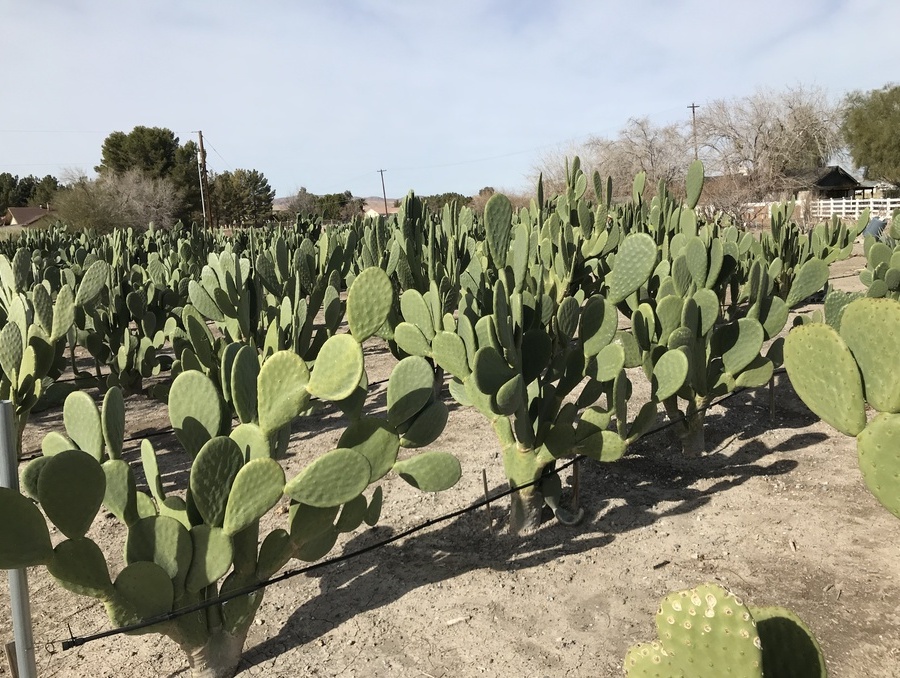
As the quest to diversify and expand sustainable alternative energy products continues, the U.S. Department of Energy has awarded a $9 million grant to support research that will be led by researchers at the University of Nevada, Reno to expand the use of cactus pear as a low‑water-use, climate‑resilient biomass crop and potential biofuel feedstock.
During the five-year, multi-institution project, a national team will conduct cactus pear field trials at sites across the U.S. to identify varieties that produce the highest biomass with minimal water and other inputs.
If viable, cactus pear could join next-generation bioenergy crops such as switchgrass, sorghum, miscanthus and energy cane, contributing to national clean-fuel and bioproducts goals. The major appeal of cactus pear lies in its ability to produce biomass using only a fraction of the water required by conventional biofuel crops, without directly competing with food production. The versatile desert plant also produces fruit used in cosmetics, nutraceuticals and specialty foods.
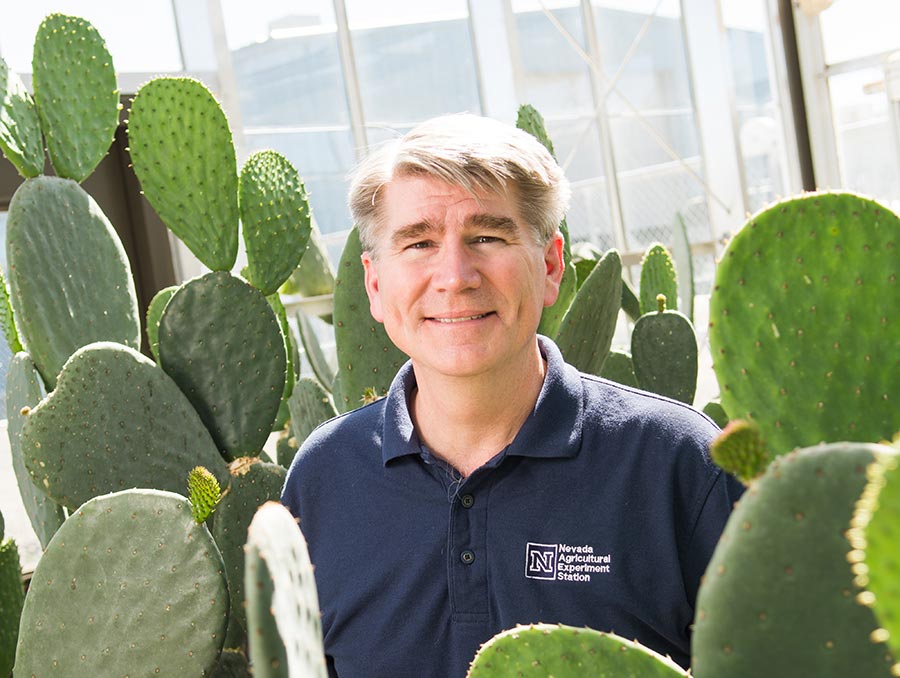
“Cactus pear represents a real economic opportunity for farmers and landowners in the West and the South,” said John Cushman, principal investigator on the project and professor in the University’s College of Agriculture, Biotechnology & Natural Resources. “It offers multiple revenue streams with minimal inputs, meaning Western and Southern producers could tap into the bioenergy and bioproducts economy in a way that fits their climate and makes financial sense while also conserving precious water resources.”
Rural communities in arid regions, such as southern Nevada’s Logandale, where Cushman and his team conducted their first long-term field trials of spineless Opuntia cactus pear varieties, could likewise benefit from new agricultural and bio-based industrial opportunities if the crop proves commercially feasible.
This Department of Energy-funded project builds on the Logandale trials and a three-year study in Parlier, California, supported by the University’s Experiment Station and the U.S. Department of Agriculture’s National Institute of Food and Agriculture. In the earlier research, Cushman, a foundation professor of biochemistry in the College’s Department of Biochemistry, Molecular Biology & Biotechnology, and his team compared biomass produced by 14 cactus pear varieties, finding that the top-performing variety yielded eight times more biomass than the lowest-producing variety.
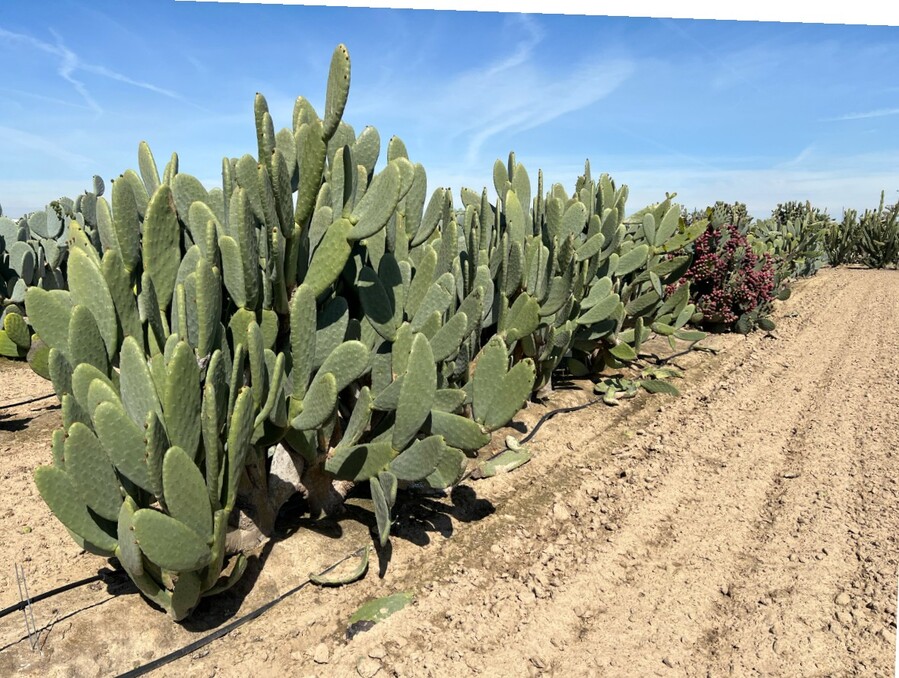
The new project expands the work to 240 cactus pear varieties from the U.S. Department of Agriculture’s National Germplasm Resources Laboratory, which facilitates the acquisition, exchange and documentation of crop genetic resources important to world food security. Using this larger set, Cushman and his team will examine how the plant’s use of crassulacean acid metabolism, or CAM, affects biomass production. CAM is a process in which cactus pear opens its stomata at night to take in carbon dioxide and keeps them closed during the day to conserve water.
The researchers will also study soil microorganisms around the plant’s roots to see whether they influence its efficient use of nitrogen and phosphorous, both essential for plant development.
A national, multisite “natural experiment”
Cactus pear will be grown at four two‑acre field sites. Two U.S. Department of Agriculture sites, the Arid Land Agricultural Research Center in Maricopa, Arizona, and the National Arid Land Plant Genetic Resource Unit in Parlier, California, receive only 147 and 213 millimeters of annual rainfall, respectively. Both will use controlled irrigation to assess responses to different water levels.
The other two sites, in Bremond, Texas, and Marianna, Florida, receive an average of 1,200 millimeters of rain annually, nearly eight times more than the desert locations, creating a natural precipitation gradient that allows the team to study cactus pear performance across both dry and moist conditions.
Multi-institution collaboration supports cactus pear biofuel and bioproduct study
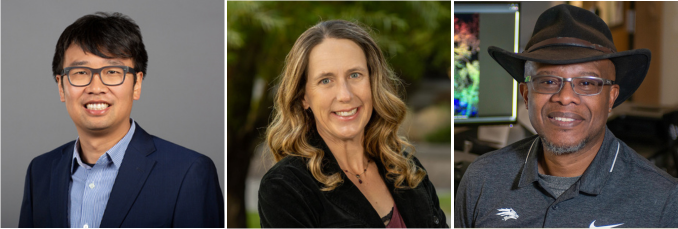
Other members of the team from the University of Nevada, Reno include Associate Professor Robert Washington‑Allen, a rangeland ecologist in the College’s Department of Agriculture, Veterinary & Rangeland Sciences; Associate Professor Won C. Yim, a computational biologist specializing in plant genomics in the College’s Department of Biochemistry, Molecular Biology & Biotechnology; and Tracy Shane, an Extension state livestock specialist with the University’s Extension unit.
Yim will lead research exploring how cactus pear works with beneficial microbes to grow and thrive. His team will analyze the plant’s DNA to identify the helpful bacteria and fungi living in and around their roots. They will then test microbes that are especially good at adding nitrogen to the soil or unlocking phosphorus, key nutrients for plant growth, to see whether these natural partners help cactus pear grow faster and produce more biomass.
Washington-Allen will lead efforts to use cutting-edge remote sensing technology to measure above- and belowground plant growth, 3D structure and biomass, contributing to measurements of nitrogen and water-use efficiency. Together with Shane, a licensed drone pilot, they will use drones equipped with specialized cameras and laser technology, along with ground-penetrating radar, to estimate how much cactus pear is growing above and below the soil, without having to dig up or cut down the plants.
“Traditionally, measuring biomass requires harvesting, drying and weighing plants, a labor‑intensive and difficult procedure,” Washington-Allen said. “Using remote-sensing technology, we are able to create precise, high-resolution models from which we can estimate biomass across hundreds of varieties quickly and consistently.”
The team, which also conducts research through the University’s Experiment Station, will be supported by postdoctoral researchers Monirul Islam and Uriel Cholula Rivera. Rivera, a graduate of the College’s Animal & Rangeland Sciences Program, works under Washington-Allen, while Islam is supervised by Cushman. The team will collaborate with the University of Florida Institute for Food and Agricultural Sciences; Loop Bioproducts, LLC; the U.S. Department of Agriculture’s Agricultural Research Service at the Arid Land Agricultural Research Center and the National Arid Land Plant Genetic Resource Unit; as well as the Pacific Northwest National Laboratory and the National Laboratory of the Rockies.

Looking ahead, the research team expects to deliver specific recommendations on top‑performing cactus pear varieties, along with validated remote sensing and modeling methods that can be applied well beyond cactus pear.
“If we can show that cactus pear reliably delivers high biomass with a fraction of the water other crops need, it changes the map of where and how we produce bioenergy in this country,” Cushman said. “It means the West and the South don’t just have to endure a hotter, drier future; they can help power the transition to cleaner fuels and bioproducts.”
Such forward-thinking by Cushman, along with his research expertise published in more than 180 scientific journal articles, has earned him international respect and recognition, with his work also featured in popular media such as National Geographic and MSN News.
“The fact that John was chosen to lead this $9 million collaborative project really speaks to his excellence in the field and his ability to work with others to achieve meaningful results,” said Bill Payne, dean of the College. “We are honored to have had the good fortune of John hanging his hat here with us at the University for more than 25 years. His research has fueled the education and mentorship of countless numbers of our students who will go on to impact our society for decades to come.”
More information about this latest project can be found at the project website.


