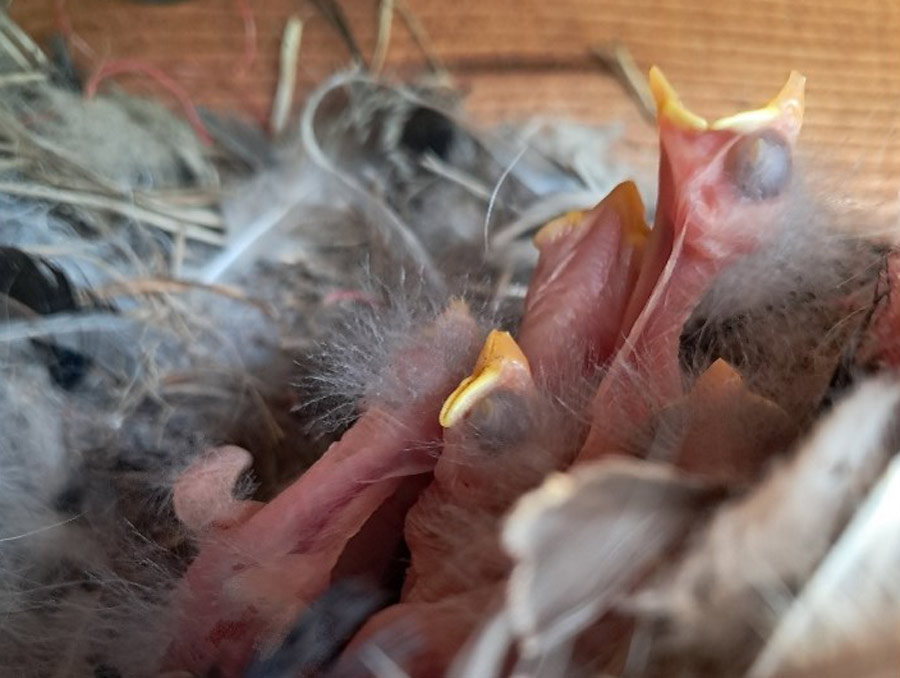
Family life in the animal world, much like in humans, is not always peaceful. Raising offspring demands time, energy and cooperation — and sometimes, parents don’t fully agree on how much each should contribute. Each parent would personally benefit by investing a little less and leaving more of the work to their partner.
“This tension, known as sexual conflict, helps explain why parental care varies so widely across species,” Davide Baldan, a biologist who studies parenting strategies in birds, said.
In some animals, both parents share the work, a strategy known as biparental care; in others, only one parent — most often the female — stays to care for the young while the other leaves, called uniparental care. Scientists recently found that chicks who are raised without bird fathers have higher developmental stress and worse chances of survival. Their findings were published in the article “Mate desertion affects offspring survival, development and physiology in a songbird with multiple parental strategies” in the journal Functional Ecology.
Many studies have focused on how the physical environment impacts the success of chicks or how parental desertion affects the other parent, but Baldan and his colleagues were interested in understanding how social factors impact chick survivability and health. Specifically, they explored what drives rock sparrow parents, specifically males, to abandon their families.
Rock sparrows employ both biparental and uniparental parenting strategies, providing an ideal natural laboratory to explore the consequences of mate desertion. The rock sparrow is one of the few species in which female desertion takes place, leaving the male to serve as the primary caregiver to the chicks, but that isn’t the case for the population monitored in this study.
The study, led by Baldan, an assistant professor in the Department of Biology, monitored the survival and developmental stress of chicks. The fieldwork was based in Sierra de Guadarrama National Park in Spain. Researchers built nest boxes equipped with cameras, where the rock sparrows could lay their eggs. Baldan’s collaborator and coauthor Alejandro Cantarero at the Complutense University of Madrid has been monitoring the rock sparrow population in the park for many years.
The eggs hatched after about two weeks, and that’s when Baldan and his colleagues became very busy. The researchers monitored the chicks’ growth, measuring them every three days and recording corticosterone and oxidative stress from blood samples. The blood samples were analyzed at the University by Baldan’s colleague and coauthor Jenny Ouyang, an associate professor in the Department of Biology.
Females worked hard to make up for the missing father, but they could only do so much. They found that male desertion resulted in about a 50 percent decrease in nestling survival compared to nests with biparental care. Nestlings were smaller and had higher corticosterone and oxidative stress as chicks with uniparental care, but long-term indicators of stress didn’t differ between the two parenting strategies.
“Our results revealed strong effects of mate desertion on both offspring survival and physiology, demonstrating that the absence of care from one parent can significantly challenge nestling development,” Baldan said.
The researchers plan to continue exploring parental strategies by studying what males gain by abandoning their bird families. Baldan is exploring several hypotheses, including opportunities for re-mating.
“Answering these questions will help us better understand why some males act as devoted fathers while others do not,” he said.


