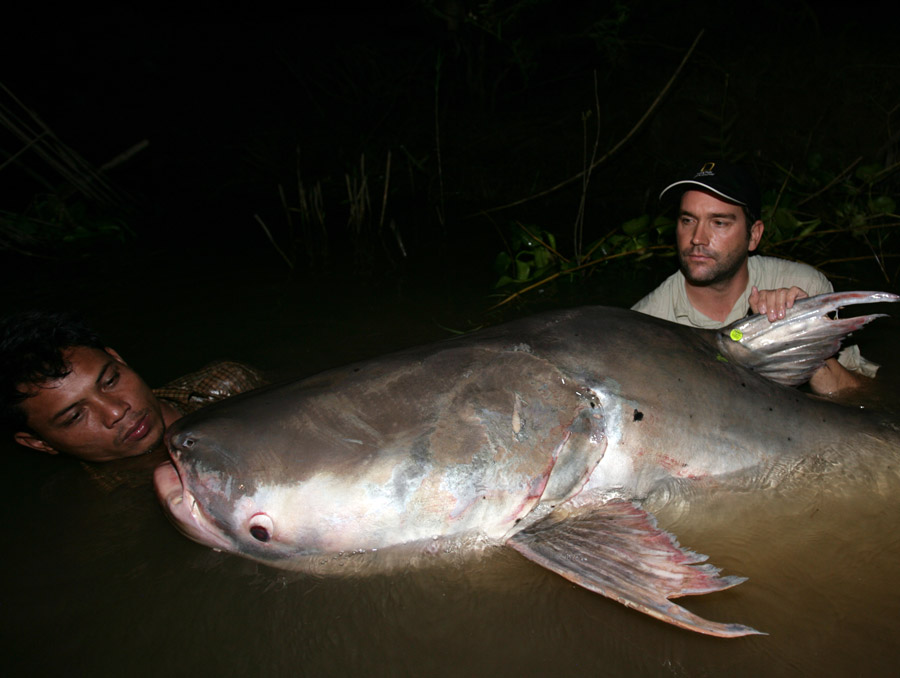
A new paper published last week calls attention to a major blind spot in global biodiversity policy: migratory freshwater fishes are missing from one of the most important treaties protecting migratory species. The paper, published in Nature Reviews Biodiversity, shows that only 2.5 percent of migratory freshwater fish species are protected under the Convention on the Conservation of Migratory Species of Wild Animals (CMS).
CMS is an environmental treaty of the United Nations and provides a framework for coordinated conservation of migratory species that cross national boundaries. CMS is hosting a Conference of the Parties (COP) in Brazil this March, which the paper’s authors point to as an opportunity for improvement for freshwater migratory fish protections.
Zeb Hogan, a research professor at the University of Nevada, Reno and a coauthor on the study, serves as the CMS COP Appointed Scientific Councilor for Freshwater Fish.
“This paper underscores that migratory freshwater fish are among the most threatened and most overlooked animals on Earth,” Hogan said. “CMS has practical tools that can help, and COP15 in Brazil is an opportunity to translate science into coordinated action across river basins.”
Migratory freshwater fish are essential to river health and human well-being. They support food webs and nutrient cycling, and they provide food, livelihoods and cultural value for communities and Indigenous Peoples across the world. While over 1,100 species are included in the CMS Appendices, the new paper shows that freshwater fishes are largely missing from this system.
At least 890 migratory freshwater fish species occur in two or more countries, and 87 are known to be globally threatened, but only 23 migratory freshwater fish species are currently listed on CMS Appendices, according to the paper, titled “The untapped potential of CMS for migratory freshwater fishes.” Sturgeons and paddlefishes make up all but four of those listed species, leaving most threatened migratory freshwater fishes outside CMS’s main listing mechanism. This policy gap comes amid an 81 percent average decline in monitored populations of migratory freshwater fishes worldwide from 1970 to 2020.
“This new publication emphasizes CMS's potential to coordinate international conservation for migratory freshwater fish,” Zach Bess, a doctoral student at the University of Nevada, Reno and coauthor on the paper, said. “We are now working with partners to translate the paper into concrete products and proposals that can help freshwater fish receive the attention they deserve at COP15. This has been a great opportunity for a student to engage with scientists and contribute to international science.”
The paper points to CMS COP15 in Brazil as a concrete near-term moment for governments and partners to strengthen protections for migratory freshwater fishes, including by considering proposals to add more species to the CMS Appendices.
“CMS already provides a proven framework for international cooperation on migratory species,” Fengzhi He, the corresponding author on the study, said. “Expanding the inclusion of migratory freshwater fishes while filling key science gaps could unlock real conservation gains at a global scale.”
Beyond listings, the authors highlight that CMS also includes other instruments for conservation such as agreements, memoranda of understanding, concerted actions, species action plans, and special initiatives that can help drive cooperation, including in regions currently underrepresented within CMS.
The paper builds on discussions initiated during a University of Nevada, Reno convened workshop at Lake Tahoe in 2025 that brought partners together to examine the global status of migratory freshwater fishes and identify opportunities to strengthen international conservation action. The study provides a timely introduction to the issue by outlining both the challenges and the pathways for improvement under CMS.
Building on the workshop outcomes and the publication of this paper, Hogan and Bess are working with World Wildlife Fund, the CMS Secretariat, and collaborators in Europe and South America on a suite of technical products, including reports and action plans, intended to elevate migratory freshwater fish priorities at CMS COP15.


