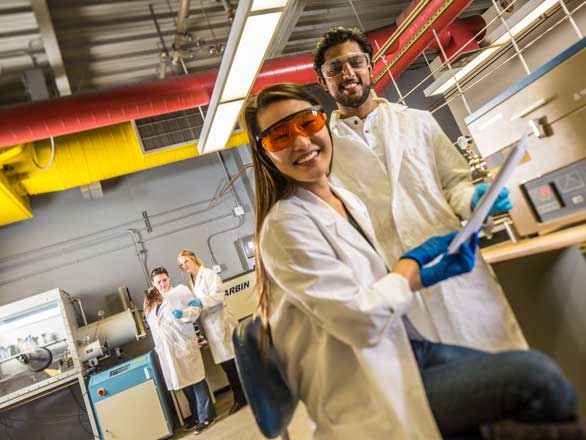
Capstone instructor

Mano Misra
Mano Misra

The 2024 Senior Capstone course in materials science and engineering was taught by Mano Misra. To learn more about the materials science and engineering projects, please email Mano Misra.

About the department

Our undergraduate programs offer you the opportunity to work closely with our research-active faculty. Small class sizes and undergraduate research opportunities help you get to know your professors and provide opportunities to get hands-on research experience. We offer Nevada's only undergraduate degree program in chemical engineering and materials science and engineering. Visit the Department of Chemical & Materials Science Engineering

Materials Science and Engineering projects

Explore student projects in materials science and engineering.

  • MSE-1 Controlling Oxide Thickness in Aluminum Anodization

    Students: Desmond Lacounte, Camdyn  Ernst, Zachary  Hitchcock

    This project focuses on understanding and controlling oxide layer thickness during the anodization of 6000-series aluminum. Aluminum samples sourced from diving board extrusion material will be cut into uniform coupons and prepared through a controlled surface preparation process. Each sample will undergo mechanical polishing followed by chemical cleaning using an alkaline degreasing soap, a caustic cleaner, and a desmutting treatment to remove contaminants and create a consistent aluminum surface prior to anodizing. Laboratory-scale anodizing experiments will then be conducted using a designed experiment (DOE) approach. The study will vary key process parameters including applied current density, immersion time, and bath temperature to determine how these variables influence oxide layer thickness and coating uniformity. After anodizing, samples will be analyzed using scanning electron microscopy (SEM) to measure oxide thickness and evaluate coating consistency. Electrical behavior during anodization will be recorded by monitoring voltage changes over time for each condition. The bath's thermal control system will also be evaluated to understand heat transfer efficiency. Periodic bath samples will be analyzed to track aluminum dissolution into the electrolyte. The objective is to develop a repeatable lab-scale anodizing process capable of producing uniform oxide layers with reduced variability.

  • MSE-2 Assessment of Al₂O₃ Film Structural Integrity

    Students: Hannah  Igbekoyi, Nicholas  Blondeaux, Ben Gardiner

    Anodized aluminum is widely used in structural and recreational applications due to its improved corrosion resistance, surface hardness, and durability. However, the anodized oxide layer can be brittle and susceptible to cracking when subjected to repeated or high levels of bending stress. This behavior is important in applications such as Olympic diving boards, where aluminum structures experience frequent flexural loading during use. The objective of this project is to determine anodization conditions that optimize bending resistance of anodized aluminum to cracking. To accomplish this, aluminum samples will be anodized under a range of conditions including variations in current density, temperature, and time. The resulting samples will then be mechanically characterized through cyclic bend testing to evaluate the resistance of the anodized layer to cracking during flexural loading and nanoindentation to explore wear resistance. By correlating anodization parameters with mechanical performance, this study will identify anodization parameters that maximize bending resistance while maintaining surface properties. The results will help inform anodization practices for aluminum Olympic diving boards.