Program at a glance
How long does it take?
This minor is designed to be completed with any major in four years.
How do I apply?
Open to all undergraduate students. Learn how to apply to the University of Nevada, Reno.
This minor is designed to be completed with any major in four years.
Open to all undergraduate students. Learn how to apply to the University of Nevada, Reno.
In the astronomy minor, you'll take foundational courses in planetary astronomy and stellar astronomy, which studies galaxies and star systems. You'll learn how to use a telescope for observation and how to calculate key measurements for planets and stars such as temperature and size.
Courses in astrophysics will apply basic principles from physics to understand astronomical principles, including the position and movement of stars. The minor also includes basic physics courses to give you the tools to understand the scientific principles underlying the study of the solar system.
Planetary observation is available on campus from the Planetarium and the Leifson Physics building. Additionally, Reno is home to the MacLean Observatory at the Redfield Campus in South Reno. The observatory features twin observing domes with 22-inch and 14-inch telescopes. Research resources for astronomy students in the physics department include telescopes as well as a spectrometer and CCD camera.
All students in the astronomy minor complete a senior thesis project, which is a individual research project that draws connections between your major and the field of astronomy. You'll draw on your previous courses in astronomy, as well as knowledge of you major field of study, to develop a research project. You'll use critical thinking and reasoning skills, as well as your knowledge of the scientific process to complete your project, which will be shared in a written in oral presentation.

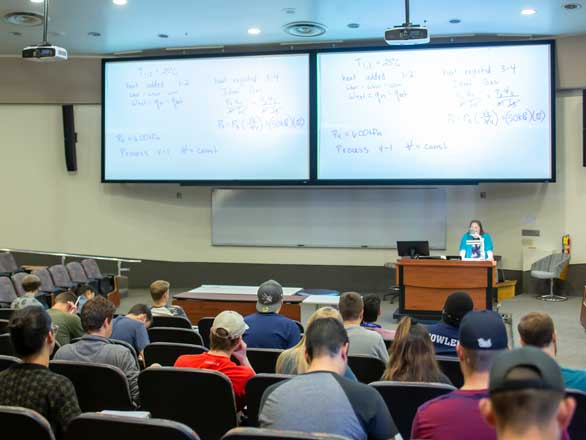
A minor in astronomy can be preparation for a career in physics or astronomy or it can be applicable to range of fields, providing you a set of specialized knowledge you can take to fields such as business, communications or education.
Within the field of astronomy, many jobs require graduate degrees, where astronomers develop research skills and expertise and go on to work in colleges or universities or laboratories. Some astronomers may find work in fields that draw on related skills, such as quantitative reasoning or experience with certain technologies.
An undergraduate minor in astronomy can also provide a strong background for entry-level positions in institutions like planetariums and observatories. The minor is also an excellent foundation for careers in science education or science journalism.
76% of students receive financial aid
Almost everyone is eligible to receive some kind of aid. We offer need-based and merit-based forms of financial aid to help you afford college.
54% of all students graduate with no debt
That's right. More than half of our students leave the University of Nevada, Reno with no student debt.
At the University of Nevada, Reno Honors College, our students maximize their unique gifts and passions through a series of personalized experiences that deepen their capacity for transformative societal impact.
Visit the Honors College