The Discover Science Podcast
This is your place to find the latest list of Discover Science Podcast episodes and transcripts. To explore our full archive of episodes, visit the Discover Science Podcast page on Spotify.
Discover Science: Alie Ward on why curiosity is your greatest superpower
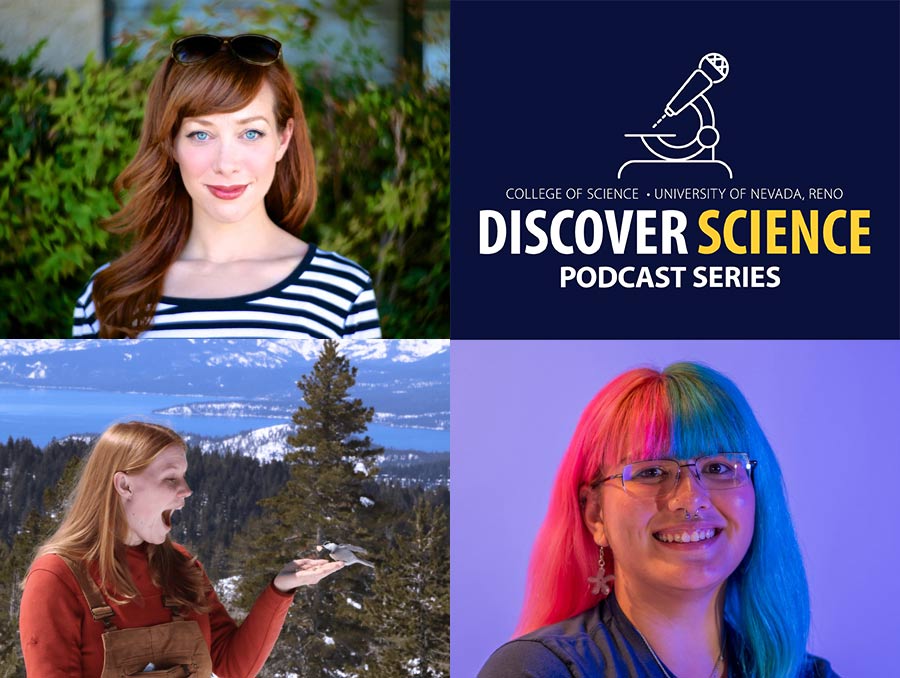
Host of the famous "Ologies" podcast Alie Ward gets a turn on the other side of the microphone in this Discover Science podcast episode. Seven years into her podcasting journey, Ward reflects on why Ologies is a success, and hints that curiosity has played a big role. This episode is hosted by Hitchcock Project for Visualizing Science student Katrina Perce and Ecology, Evolution and Conservation Biology Student Ai Ana Richmond.
LISTEN TO DISCOVER SCIENCE: ALIE WARD ON WHY CURIOSITY IS YOUR GREATEST SUPERPOWER
00:00
Katrina: Welcome to the Discover Science podcast from the College of Science at the University of Nevada, Reno. My name is Katrina Perce, and I am a graduate student in the Reynolds School of Journalism, where I'm studying science communication with the Hitchcock Project for Visualizing Science. I'm joined today by my co-host Ai Ana Richmond.
Ai Ana: Hi, Katrina.
Katrina: Hi, Ai Ana.
Ai Ana: I'm Ai Ana. I'm a Ph.D. student studying ecology and evolution, specifically the link between the gut microbiome and cognition in a teeny tiny little songbird.
00:33
Ai Ana: I spend a lot of time running around the woods. Your local cryptid field biologist, if you will. Katrina and I are beyond thrilled to be hosting today's podcast, diving into the world of science communication, asking many, many questions, and hoping to figure out what it really takes to bridge the scicomm gap with none other than Alie Ward.
Ai Ana: Alie Ward is the woman. A Daytime Emmy Award winning science correspondent for CBS's “The Henry Ford's Innovation Nation with Mo Rocca,”
01:02
Ai Ana: host of “Did I Mention Invention?” on the CW. You'll find Alie on Netflix's science series “Brainchild” and Science Channel's “How to Build Everything,” along with GE’s series “In the Wild,” where she co-hosts with Adam Savage of MythBusters fame. She's a contributor on Cooking Channel's ongoing show “Unique Sweets,” an actress, and at one point was a staff writer and editor for the LA times and on-air contributor to KTLA.
01:30
Ai Ana: A personal favorite of mine as well, with many others, proven by its over 50 million downloads in 2021. Alie is the creator and host of one of Time's “Top 100 Podcasts of All Time,” and the number one science podcast on Apple right now: Ologies.
01:40
Katrina: Now, if you haven't already given it a listen, Ologies is your podcast to answer all of life's curiosities. Described as the podcast for baddies that want to be educated and many people's current hyper fixation, Alie started Ologies in 2017, producing weekly episodes, interviewing experts in distinct fields like fromology, the study of cheese, or some that you might have never heard before, like ergopathology, studying burnout. Alie is truly a leader and inspiration in science communication and bridging the gap to understanding and loving science's role in our everyday lives. Thank you so much for joining us today, Alie.
02:18
Alie: Oh, I'm so happy to be here. You guys are amazing already. And fellow podcasters. It's not often I'm in a room with fellow podcasters, so this is exciting. We can talk shop.
Katrina: Yeah, it's very nerve-wracking interviewing someone that also does interviews.
Alie: You’ve got to watch out because I’ll start asking you questions. So I might like Reverse Uno card you without even realizing I'm doing it. So keep me on track.
Katrina: We’ll watch out for it.
02:49
Katrina: So we'll start off talking about your journey. When you first started off in college, you were pursuing biology and a career in biological illustration, and you ended up changing your course of study and obtaining a degree in cinema with a minor in biology. Can you talk a little bit about that transition?
02:58
Alie: Yeah, I mean, I always loved science from when I was a kid. My parents got me a microscope for some holiday and, you know, it was like a toy one. But it functioned. It didn’t have a light, but it had a mirror you could use, and I don't think they thought much of it. I think there I think they were procrastinators when they were shops probably like, I don't know.
03:17
Alie: And I loved it. I just fell in love with it. I would swab windowsills and see what was on there, or I'd try to look for bacteria from ponds and stuff. And so I was really like glued to that thing. And it started to make me realize that there's so much more in the world that we just can't see, because we don't have the eyes for it.
03:35
Alie: Once you have tools and once you're open to looking, you know, you really discover a lot about stuff around you. So I started loving science and ecology and nature and all that stuff. But I was really torn. I was also like a ham, and I loved drawing and I loved putting on plays and stuff. And so when it came to college, I started in environmental studies, and I really wanted to do biological illustration.
03:57
Alie: There was a guy named F. Netter, Frank Netter, who's like, absolutely the G.O.A.T. when it comes to biological illustration. And I realized, like, he kind of already did everything that I want to do. And I'm also not as good as him. And so I started, you know, I'd study studio art and then have an O chem class right after.
04:18
Alie: And so I went back and forth between labs and studios, and I ended up graduating in cinema with a minor in biology. So I've always kind of had one foot in each and a lot of new media, you know, we call it new and it's like 30 years old now. A lot of digital media have opened up a lot of opportunities to make more stuff that incorporates both.
04:42
Alie: And here I am with a podcast, which, you know, yeah, podcasts didn't exist when I was in college. When I was in college, we were editing film on actual film that we had to cut with a razor blade, and then you had to tape them together with special, expensive tape. That's how you cut film. You literally cut it. So I’m like, whole new world over here. You’ve just got to change with the times.
05:04
Ai Ana: So speaking of changing with the times, I've spent a lot of time thinking about evolution and studying evolutionary biology and to step back in time a little bit. Probably our most famous great great, great, great — it goes for a while — great grandparents is Tiktaalik, which is this really weird, amphibian looking thing with four legs.
05:24
Ai Ana: It kind of looks like a kindergartner went wild designing a dinosaur. And this is our beloved grandfather: Tiktaalik. And it's so important for evolutionary biologists because it's often considered this really pivotal moment in vertebrates’ evolution and transition from ocean into land. So, I've often used Tiktaalik as this metaphor in my own life for many of my own pivotal decisions in life and career, all these other big life things. So do you have any Tiktaalik moments in your crazy career that's gotten you to where you are now?
05:58
Alie: Number one, great segue, podcaster, I clocked that. That’s a great segue way up top. That's a really cool way to put it. And I think all of us do. You know, we were chatting up in the student lounge earlier over pizza about how you have all these paths that take you down different capillaries, almost, you know, like veins and arteries to vessels to capillaries.
06:16
Alie: But I think for me, I had those “Aha!” moments, you know, as Oprah would call them. And one of them was sitting on the dock in high school at a lake. My dad was raised on a farm in rural Montana.
06:28
Alie: So, I was on a lake at a family reunion, and I saw all these bats that were going across the water and my uncle was teaching me about ecology and I was like, this is the most exciting thing. And that was really what would also put me on my scholastic path, like academic path toward biology. But then I had another moment, like I was saying, with biological illustration, where it was in the library at, JC looking at illustrations, and I was like, “Netter did it better.”
06:53
Alie: What am I going to do? And so then I was thinking maybe I would do more cinema and do more TV and stuff. And so yeah, those were those were my floppy dinosaur moments back in the day.
Katrina: It warms my heart that you said your “Aha!” moment. The last podcast we did with Discover Science, I interviewed an ice cream scientist and she talked about the “Aha!” moment!
07:15
Alie: Oh that's great.
Ai Ana: The “Aha!” Podcast it might be, right?
Alie: That's great. And you really do have those moments where something strikes you. You have like a clarity and it's usually checking in with yourself with like what do you want or what are you capable of? Or what do you want your future to look like? You know, sometimes you have to be still for a second to have those bop you on the head.
07:35
Katrina: So kind of leading straight into Ologies with that, I love your slogan for Ologies. The whole “ask smart people stupid questions” or sometimes you play with it in your episodes with like “ask smart people shameless questions”, or “ask passionate people impassioned questions.” I feel like this really opens the door for something that a lay audience might never say, but definitely feel.
07:58
Katrina: I know as a non-scientist myself, talking to a scientist like I want to focus on getting it right and like I want them to respect me and the way I talk and everything. But I feel like that's a big solution with scicomm, like asking the questions even if you do feel quote unquote stupid.
08:15
Alie: We really censor ourselves a lot and what we're willing to ask and having it be so extreme. And there's of course, that adage of like, there's no stupid questions and there isn't, you know, and obviously that's like hyperbolic and ironic, but it really is like, let yourself ask the questions that you're curious about instead of the ones that you think are impressive. Like let yourself let your curiosity kind of drive the conversation.
08:35
Alie: And yeah, a lot of times, like I've asked questions that seem really basic and the scientists will be like, “that's a great question and we're trying to figure that out right now,” or “that's a really interesting way of looking at it.” And also in journalism and scicomm, you're a proxy for your audience. So if you don't ask those questions, you're doing a disservice.
08:55
Alie: And once you break that, once you ask a few what you don't think are impressive questions, you start to realize, like, “oh, this is actually good.” And also when you're talking to experts, like a lot of times they really want to talk about this stuff. No one at the Thanksgiving table cares about what they do. They're like, “Jeanette works in a lab. I don’t know.”
09:16
Alie: I don't know, but if you're like, “tell me all about it.” Jeanette's going to be like, “sit down. I would love to.”
Ai Ana: That's something I've really seen with my own students, too. You know, as a grad student, I've TA’d everything from introductory biology, it's the first time these kids have been in a biology space, all the way up to mammalogy and these are like 400-level class, students who are supposed to know what they're doing, though I don't know if any of us ever figure it out, but that's always something I tell them.
Ai Ana: I'm like, you guys, don't be scared to ask questions. If you have a question, I promise you, everyone else in the room has the same question and it’s probably because I didn't explain it right. Like, it's okay, just ask.
09:50
Ai Ana: And I really try and make our classroom a space where people feel comfortable asking these questions and interacting with science in the way that we're supposed to.
Alie: That's exactly right. Someone else wants to know is a big motivator, too. If you'd hold the door open for a stranger, why won't you ask a question that will also maybe help the stranger, you know, helps you too! It’s the only thing that separates people from people who know stuff from people who don't know stuff, is curiosity and inquisitiveness. You can't learn stuff without it. Trust me, it's what I do for a living.
10:19
Ai Ana: So in an interview you said that Ologies really, “helps people that love science and have the curiosity of science, but have been left behind by academia or feel like they don't have a place in there because their brains hop around too much.” Is this something you've experienced yourself, or is part of your motivation for creating and continuing with Ologies?
10:41
Alie: It's definitely part of my motivation, and I did experience it myself. When I was first coming up with Ologies, I had worked in science TV for kids for a while. You know, Saturday morning. And so, you always think science programing for kids, for kids, for kids, for kids, for education, for kids, for kids. And I was like, there are so, well, this is in 2017.
11:02
Alie: And I was like, kids don't vote, man. You know, like we need people voting who like, care about consequences and who just care about the world around them, and also maybe who understand that any given person has like stories. And I don't have kids and I'm not having kids. And so I felt like, well, why do people who have adult brains and interests, why do they have to consume things that are meant for someone who's 35 years younger than them?
11:30
Alie: You know, that doesn't make any sense. Like they're not watching HBO Max at midnight. You know, kids aren't. So why does everything have to be at a level of grade school and stuff? And so for me, I was like, well, I want to know about, you know, weasels and, the ocean and dolphin sex. And, you know, I wanted, but, it's weird.
11:52
Alie: And so I had a really big struggle trying to figure out if podcasts should be for adult audiences, but also like swearing. Should I swear in this? Should I show up with my full self because I have such a sailor mouth, horrible, I grew up around a lot of comedians. There's not a lot of holding back. And so I really was like torn.
12:13
Alie: And there were I looked at all the top podcasts for science, and none of them had this little red “E” next to it, which means, you know, explicit. And so I was like, well, am I going to be shooting myself by doing that, like shooting myself in the foot? But I was like, I would rather do something authentic and give it my all than do something inauthentic and get an audience that is not really who I want to attract.
12:35
Alie: So I went with it and it turned out, oh, that was missing. The thing that's not there was actually missing. And so I've ended up getting, cultivating an audience of really curious adults who, yeah, maybe loved science or maybe they're in the sciences, or maybe they study geophysics, but they want to learn about birds, too. So you know that authenticity and thinking of what I wanted and what I wish was around was a really big factor in how I kind of structured it.
13:02
Katrina: I really love how, intentional or not from the beginning, explicitly plus science really created a bridge between some sort of like appropriateness when it comes to science. Maybe I do just want to be chilling and hearing this quote unquote normal talk, normal conversation, while also learning. I mean, sometimes I feel like if I'm listening to a science podcast, I feel like I'm sitting in a classroom and I'm like, maybe I don't want to be in that environment.
13:26
Alie: Right, exactly. And I think that a lot of laypeople who maybe aren't scientists by trade, they don't want to feel like they're in a lecture. And I wanted to also highlight people's humanity, not have it be at a lectern or talking down, or have it be like, I'm educating you, but it's more like I'm just having a really bonkers interesting conversation, like, come on in.
13:47
Alie: And so I'm really glad I did it that way. And it's funny, I have Smologies now which are these shorter, like kid friendly G-rated edits that we do. We release them in their own feed. So people can just, like, listen when they carpool or whatever, because I would get like, reviews. I got this one review that was like one star and it was like, “I love this podcast and everything about it, but she used the F-word, so I'm giving you one star.”
14:12
Alie: This one in particular was like, “And it was labeled educational. It had a red ‘E’ next to it,” and I was like, oh dear, that means it's not for kid like that means I'm gonna say the F word and so I was like, don't get mad at me. It's labeled! You just didn't know what the label meant. So yeah.
14:29
Alie: So I peeled off to Smologies so everyone's happy and then I can still be myself when when I show up to interview, which is good.
Katrina: They took it as E is for everyone
Alie: You know what I mean? I was like, no, this is not Nintendo. No, this is the very opposite that. Yeah.
14:44
Alie: Finding your audience though, you have to just trust that if you're authentic, then the people who are into it will come to you and hang out. And the people who aren't, you know, buzz off. But I think it's the same as friend groups too. You know, when you're authentic, the people who are down with you are going to stick around. And if you're inauthentic, then you're going to attract the wrong people who eventually won’t stick around. So learning the importance of authenticity as like a preservation of your own sanity is something that I learned later in life through a lot of different ways, Ologies being one of them for sure.
15:19
Ai Ana: I really admired throughout your work in Ologies as a creative writer myself was how you integrate metaphor. It's really cool. You use it really well for communicating some of these really complex scientific ideas. In lutrinology, which is the science of otters, you use dachshunds as this really elegant metaphor, pun fully intended, to hypothesize how otters bodies have elongated through this artificial selection.
Ai Ana: I'm just curious, as someone who loves to learn myself, is this use of metaphor something that you've always done to kind of help conceptualize science for yourself, or is this been a skill that you really had to hone over time?
15:56
Alie: That's a great question. And I think because my family, they're great writers, my dad was a great writer, my sister was a journalist, and my other sister, I've been begging her to write a novel for years and years, and she's a county administrator, and she's like, “I know one day,” she's like the most brilliant writer I know.
16:09
Alie: And so luckily, my family's very awkward and awkward emotionally. So I think that they just try to use, like, humor as a way to cope with things. And so I think we're always trying to kind of entertain each other. But I remember my mom uses a lot of metaphor, and I remember her once we got like a computer, and this is when they were the size of like a refrigerator.
16:27
Alie: And you've probably have seen this in sci fi movies, but just like a black and orange screen, old school. And I was like, why can't you just plug it in and use it? And my mom was like, “Well, it's kind of like if you got a Mercedes, but there was no engine and you had to put the engines in like a program so it could run.” And I was like, okay, that's tight, I get that.
16:50
Alie: And so I think my mom was always looking for ways to conceptualize things. But I remember my dad was on the internet on an email list with like, my whole huge family. He's one of 11. And so he was an early adopter, and he was always a better writer than he was an oral communicator.
17:01
Alie: Even though he's in broadcasting, he could always really let his heart come out in writing. And so I think it's probably just a combination of my family trying to entertain each other, and my mom trying to explain things to me asking too many questions.
17:18
Katrina: Before you kind of get into an episode and you're discovering, like, these new Ologies and everything, are you kind of searching before it, like more about it so you can get sort of an understanding of it before, or are you kind of going into it blind?
17:26
Alie: Sometimes I go completely. I mean, I know like cursory information, but sometimes I find, and this is so counterintuitive, sometimes I find going into it not knowing a lot helps me ask the questions that the audience needs to know. I sometimes struggle like, I just did an M.S. episode because my mom has M.S. and she's had it for 20, 25 years, and I've read, I can't tell you how many papers I've been down.
17:53
Alie: And when there's a new paper out, I'm reading it. And so I'm more familiar with it. And it was almost hard for me to think, okay, like, what would you need to know if you had no idea what this was? You know, I wanted to jump in and ask, what about this treatment? What if I did …. and I was like, oh no, I have to first ask like, what is it?
18:09
Alie: And so sometimes if I research too much about an Ologist or too much about their work, their most interesting stuff is not a surprise to me. And so I sometimes have to hold back on reading too many biographies, like I'll listen to some things of how they present their stuff if they're enthusiastic, but I don't like reading a lot of articles about them, because then some of their best stories are reruns, and I want to bring that, like, you know, to the audience because the audience is usually like, “What?” too.
18:40
Alie: So yeah, it's it happens to behoove me there. I do feel like there have been other articles, and journalism articles and some that I do where I do show up really prepared because, you know, it might be a really complex topic. I did an episode on OCD recently, and Doctor Wayne Goodman, who's like the person who founded the scale by which OCD is measured.
19:00
Alie: You know, I was asking him a lot of questions and having a good conversation, and he was like, “You really know your stuff.” And I was like, I've been diagnosed. So I was like, I've read him. I read a lot about it. And so that one. No, again, I had to go from the perspective of misconceptions. What's a lot of the flimflam?
19:17
Alie: You know what I mean, to get the basic stuff. But yeah, it's funny. Sometimes I'm like, what's a tree? And then, you know, well, how is it different than a bush? And other times I'm like, so when we're talking about the latest trials with Ocrevus in New Zealand or, you know, whatever all over the map.
19:38
Katrina: So with that, you're having these conversations with the scientists, but you also include, like your little narration, your aside during it, and even in the neuropathoimmunology episode, the study of Mutiple Sclerosis
Alie: Katrina!
Katrina: Thank you, I practiced that
Alie: Good job
19:50
Katrina: So in that episode, you included a voice note from the guests and you add more context. Sometimes you'll clarify information or even correct information after the episode. So what's that process kind of like after having the guest and everything, like how do you manage which sections are given more context or given additional notes?
20:06
Alie: Oh, that's a great question. This is like how do we make the donuts? And this is something that took me a lot of trial and error to figure out too. And there were moments where I was like, I am never going to figure out this podcast. I just had the raw interview. I remember asking my first guest, who was an entomologist, about elytra, which are these, things on the back of beetles?
20:26
Alie: And I remember being like, the audience doesn't know what elytra was. And that was me also trying to be like, I know this word before and I realized, like, that's not how I want to approach it. And so I was like, okay, well, I do want to add more context. Or I remember the first episode that went up was a volcanology person, and she mentioned something about some springs.
20:43
Alie: And I was like, oh, I don't, I was like, I'm not going to stop her to be like, explain to me what these hot springs are. But when I was listening to it, I was like, you know, well, what's that? Why is that a place that she feels like I should know about? Because she's not used to talking to people who maybe aren't volcanologists.
20:58
Alie:
And so I started when I went from these raw interviews to making them easier to follow for the public and sometimes less dry like, sometimes the information can get kind of dry or serious. And so then you can pop in with added context or a rabbit hole you went down, or the etymology of something that is surprising, just to kind of lighten it up and give little brain breaks.
21:19
Alie: And so I started doing that more because I realized it was better than interrupting my guest to have them explain something that is just tangential. And so going on those tangents, I think has been really fun and it's also a way for me to answer questions that the audience might have that they're going, “What are these hot springs?”
21:37
Alie: And then I bounce in with like, okay, here's the deal. I think a lot of times those are the questions that the listeners want to Google. And so what I do is and I brought my kit, I'll show you after. But my whole audio kit, what I use on the road and what I use for the first couple of years before a lot of it started to be remote after quarantine.
21:55
Alie: It's a purse. It's a JCPenney purse I got for $10 at a flea market, and it’s like indestructible. And it fits my recorder, which is a Zoom H4N, old school one.
Katrina: Love that recorder
Alie: Right? Yes, again, a tank. It is a tank. And you drop it off into a canyon, you just find it, keep using it.
22:17
Alie: So I've got that a couple, sure, SM58s and some good cords. I bought really cheap cords when I first started and they buzzed a lot, and I replaced my mics before I realized that it was just cheap cords. So I use those. Get it off the card. I take the file, I put it into a transcription thing called Temi.
22:34
Alie: Which used to be $0.10 a minute, which is why it was Temi and now it's $0.25 a minute. I'm really pissed about it and I have written them being like, this is wrong. And it also doesn't transcribe swear words. It cuts them out. So I'm like, if I need to know where I swore for Smologies... So I was like, anyway, I have a bone to pick, but then I have a transcript.
22:53
Alie: What I do is I listen back to my interview and wherever there's a spot where I'm like, this could use some clarification or it's getting a little dry, I might add, like a sound bite or a drop, we call them, or I'll add an aside and I color code it. So anything that gets cut, which could be paragraphs, it could be ums, it could be coughs, it could be stammers.
23:11
Alie: All of that I highlight in red, everything that gets added that I write is an aside, I highlight that in green and I number them. And then anything that's a drop, a sound effect, a sound bite gets highlighted in yellow so that when my editors, now I have editors, I used to do it myself, but now I have two editors, Jake and Mercedes.
23:30
Alie: When they go through, they can see what needs to be cut. Jake might do all the red lines and Mercedes might do all the drops and back and forth. They switch depending because they're in two different time zones. So that's kind of how I build it. And then once I have that cut, I do a QC pass. I listen to it again and maybe I'll be like, that's too many drops or cut this aside, it's, there's too many.
23:49
Alie: And yeah, so that's kind of how I do it. And when I record asides, they're all numbered so that we know where it goes where. And then a very helpful tip if you're doing audio and you need to do different takes or you need to do different voice overs is I do a snap in front of the mic and you can usually see a spike, a really vertical spike.
24:06
Alie: So on your audio timeline you can see, okay, that's a new take. That way you're not looking around for like, where is that take? You can go 1234 okay. Take seven. There you go. So yeah that's kind of the system we have. And it involves a lot of highlighting of Google Docs, a lot of highlighting of Google Docs.
24:22
Ai Ana: What are your preferred highlight colors?
Alie: Oh it's oh it's so funny. My life is literally like in this color scheme. It's a dark pink for the red lines that get cut. It's a nice sea sage green for the asides. And then it's a nice golden yellow, for the sound effects. And I dream in those colors because it's just like what's in my eyes all day long.
24:49
Ai Ana: I'm glad I asked.
Alie: Yeah, I'm glad you asked, too. It's something that, you know, when you're building an audio format or, you know, even video, having a transcript can really help. And having that roadmap can make it a lot more accessible. Because we've been writing papers since we were in grade school. We write letters, write notes. And so sometimes when you're working in audio/video, it can be hard to know where to put things.
25:09
Alie: So definitely help me organize. And then I can realize, okay, I should switch this instead of just going at it like, you know. So if you're making videos for scicomm, that's my tips.
Ai Ana: I just worked, actually. Katrina and I were in this scicomm class together in the spring.
Alie: That’s great! That's amazing.
Ai Ana: Yeah, it was awesome. I was like, well, one of my really big goals as, as an ecologist, as we're facing climate change, I really want to make sure that each chapter of my dissertation, you normally have to do four chapters for a Ph.D., in each one is an individual study, and my first one is in peer review process right now. But it is incredibly complex. I'm talking this is someone else's dissertation deep into cognition, and I'm coming in like I just graduated my undergrad.
25:54
Ai Ana: I applied to this Ph.D. position kind of as a joke for my friend. So I'm in over my head, and it took me a full year to understand this project. And then I'm like, I'm taking a scicomm class and I think, oh, for my final project I think it would be awesome, because again, I want to make each one of these chapters accessible.
26:13
Ai Ana: How do I do that? I guess a scicomm piece that goes with each like proper scientific publication, right? One of my buddies is a science journalist and I was like, come visit me for a week, let's work on this project together. And it takes me the entire week to explain this to him. We go over and over and over and he's like, okay, I think I got it.
26:30
Ai Ana: I was like, cool. Then we film it, we and I'm feeling pretty good about it. But I'm like, hey, this, this part right here. We explain it too quickly. It's too tricky. I know, because it took me months to understand this. This we need to do more than a 15 second recap. Yeah. And he's like, no, no, no, I think it's fine.
26:44
Ai Ana: I'm like, no, it's fine because I spent a week teaching you this.
Alie: So he had done the work
Ai Ana: Yeah, yeah. And so then we he was like no, no I showed it to a couple other people. You were right. I was like, I know.
Alie: Yep, yep, yep.
Ai Ana: Thanks buddy. But like yeah it was, it was, it was a little tricky.
27:00
Alie: Because when you already know something, you can skim by it. But if you're trying to do something for a lay audience or someone who's not in chickadee cognition, for example, and microbiome, then yeah, you have to back up a little bit. And I think that's why it's helpful to learn things by other people. Before Ologies went out, I made like 4 or 5 different friends.
27:18
Alie: Two of my friends, not scientists, on their way to Burning Man, were like, cool. We’ll listen, man, and then, you know, other people who are physicists and neuroscientists. So I had a bunch of different people listen. And, and I think that's really, really helpful. So you can understand if you're going into it cold, like what makes sense and what doesn’t? And also what do they not need to know in order to still be invested.
27:42
Alie: You know what I mean? Like, sometimes you think more info is better, but sometimes it's the like the little facts that will stick with them, or it's the context and how it changes their life, you know what I mean? If they hear different bird songs in their yard, or if they see different birds at their feeder or whatever, then they'll remember that, you know, more maybe than, than some really, really deep detail.
28:05
Alie: So it's, and that's a problem with Ologies too is knowing what to cut and what to explain more. What's TMI? And luckily I have a long, you know, hour, hour and a half every week so we can go we can get pretty in-depth, but yeah, sometimes you’ve got to summarize.
Ai Ana: I guess that segues pretty well into our next question too, where we kind of look at sitcom and the general public eye as well.
28:26
Ai Ana: Right now we're seeing a huge growing skepticism of science by the general public.
Alie: Really?
Ai Ana: But also, like academia is so inaccessible. It's so unjust. Many scientists have such poor communication skills, which is not something you're often taught in grad school, is how to communicate your science point blank, even like to other scientists. So obviously Ologies really helps bridge this gap.
28:49
Ai Ana: But I wanted to ask you, like a two part question as someone with a foot kind of in both worlds, what are ways you'd encourage the general public to engage with science? And the flip side of that is when you speak with these scientific experts, what are some of the patterns you noticed with a really stellar science communicator so I can take my notes?
29:09
Alie: Okay. Oh great question. So I would say if you are just a layperson and you see something you're curious about, look for papers on it. Look for YouTubes on it, seek out the information instead of just going “huh.” Take a note in your day of what you're curious about, put it in your notes app and then go look it up later.
29:27
Alie: Treat yourself to that instead of just scrolling aimlessly. So I think getting people used to finding out the answers, and also not through ChatGPT, not through AI. I did an AI ethics episode recently, and it like 79% of the time, it hallucinates like it has told me wrong information about myself. It said that I had a thyroid operation.
29:51
Alie: No I didn't, mine's fine, you know. So I think people have to get used to respecting experts. And I think that's one thing I try to do with Ologies is like, respect this person as a human being who's dedicated their life to it. But I think it's also that scientists are sometimes more accessible than you realize. If you see a really cool spider and you email a spider expert, they might get right back to you and say like, “Oh, that's, that's what that is,”
30:14
Alie: and, you know, “here's where you find out more about it.” So I think getting used to scientists as people and respecting them in their work as people. Science doesn't come from the ether. People looked into something, had a question, looked into something, experimented, investigated, wrote it down. And so I think that respecting those people who are in there already who are doing the work, and also I think the bigger part though, is context, is everything affects your life.
30:41
Alie: If you go back enough. And I think any science can change the way you look at the world. Learning how something evolved can change the way you look at your own life. And so I think I'd anthropomorphize a little here and there because I want things to be emotional. I know that you're not supposed to do this, but when you can make science emotional for someone learning it, that really tends to stick with them.
31:04
Alie: And they tend to respect those facts and respect that process. So I try to make it as relatable as possible. And talking about otters, debunking flimflam, that they have a favorite rock. Like the next time someone sees that, they'll be like, no, actually there's an expert on otters who says that is not true. And that is cool because look at that.
31:27
Alie: I know something that is a myth that has fooled other people. So yeah, I think really trying to give it context and give people, relate it back to their life in some way.
Ai Ana: I really appreciate what you said about the emotion, because it's true. You can sit there and be like, oh, that's a lioness, Panthera Leo. Look at the sagittal crest.
31:45
Ai Ana: Like, can you tell I just did my skull section? I am in my mammalogy earlier this week. It's like go sagittal crest and the masseter fossa. I'm like okay, these are all just words. Lions. Yeah they're cool. And then you go out on a safari and you see one at the sunrise, and it's just like the most emotional... I, I'm stumbling for words because there aren't words for these experiences.
32:05
Ai Ana: Right. When you detach, sometimes I think we see this struggle with science a little bit, where it's taken out of that context and it's so sanitized and clean and completely objective. It is like, well, no, this this is also something that you can experience and it's so beautiful when you do.
32:19
Alie: And biology is messy, science is messy. And there's feuds! I love talking about science. I love talking about going to blows over a dinosaur skull. It's like there is passion. There are weirdos out there and they do good science. Tycho Brahe, a famous Dutch astronomer. The guy got his nose cut off in a duel with his cousin. He had a fake golden nose. He had a moose that would drink beer and get drunk at his castle.
32:46
Alie: There is a crater named after him that looks like the moon's butthole. There is, there are stories, and it's kind of fun to gossip about science. I like gossiping about the stories behind it. And yeah, it's funny that you were, you know, how do you relate that emotionally? I just learned about that, sagittal crests and how they chew and how important that is for muscle attachment from the jaw to the skull.
33:08
Alie: And I was hanging up my friend, Simone, she's got a dog named Bubba, and she was like, “Why's Bubba have such a pointy head? I don't know.” And I was like, oh, you know, it's just sagittal crest. Like he's a pit mix. So he's got like big jaws and you know, it’s really true. And she was like we pulled up a picture and it's like a sagittal crest means nothing to some people.
33:26
Alie: But if that's why Bubba has a cone head, you're like, cool. That's because he's got bonkers jaw muscles. That's awesome. And sure enough, he destroyed so many toys in the time we were sitting there, which I love because my dog does not care about toys. So he goes through Gremmy's toy box. But yeah, so those kinds of things, when you can apply it to people's lives and suddenly they, they care about it.
33:47
Ai Ana: Well then what's the flip side of when you get these good science communicators is applying that is having that like link to someone's direct life?
Alie: I think having that link to their life, meeting people where they're at, which is if they are resistant to science, if they for some reason don't trust vaccines, or if they don't trust global warming, you have to remember people's humanity.
34:10
Alie: And even though some people make choices that really hurt people and they say and do things that really hurt people, you want to write them off and you want them to fall into a chasm in the earth. And I have been there. But you also have to think, okay, they don't trust some things or they're scared of some things, and maybe this person had a bad experience with a doctor, or maybe they were misdiagnosed, or maybe they're really worried about someone else's health.
34:35
Alie: So usually comes from a place of fear, that kind of ignorance or that willing ignorance, which we did an episode called Agnotology with Dr. Robert Proctor, who studies willing ignorance. And you know that willing ignorance is usually to protect something that they hold dear, and they think that's a way to protect it. So you don't want to think about climate change because you've got five grandkids, you know, what's it going to look like for them?
34:58
Alie: You don't want to think about climate change because your house is on, or you don't want to think about it because that changes the way your crops grow. And so it's easier to say the data is falsified because you can't grapple with the reality of it. And so you say this information I can't grapple with. So the people who gave it to me, I don't trust them.
35:16
Alie: So you kind of have to go backwards as a science communicator, and you have to try to find the humanity in everyone, from the person that you're interviewing who is maybe not used to talking to a lay audience, you have to find that they're a person. You have to think about them of like, what was the worst birthday they've ever had?
35:32
Alie: What are they mourning right now? What is the song that they turn on when they're in the car by themselves and just wail to in a good way? So once you try to speak to people's humanity, I think it helps a lot. And I try to do that no matter who I'm interviewing or who I'm like trying to communicate to.
35:50
Alie: And sometimes it's tough as a science communicator because your audience wants you to scream at people. And trust me, there are things that I want to make my position known. But I'm also like by laying out all of these facts on something, you got to know where I'm standing. I'm fact based. So if I'm giving you these facts, you got to know where I'm landing on it.
36:09
Alie: But then I use my personal Instagram, my personal things to say, hey, let's donate to this, cause let's speak up about this genocide. Let's look at these facts about climate data. But when I'm presenting to an audience for Ologies, I try to really just give objective facts that you can absorb, and maybe it can change the way you look at things, but it's a struggle.
36:28
Alie: I mean, it's not easy for science communicators. It's not easy for scientists. It sucks right now. It sucks real bad and you're up against a machine of disinformation, whether it's from AI or whether it's from entertainment news sources that pose as fact-based journalism. And it's just, it's nuts. You just got to keep fighting the good fight.
36:59
Ai Ana: I had such an interesting example of this recently. I was at a friend's house and there's this really crotchety 80-something-year-old woman, like with the walker, with the like, perfectly like coiffed hair and like, lipstick and everything. So I'm just I'm just chatting with her and she's like, oh, you know what? What are you doing here in Reno? And I'm like, “Oh, you know, I was offered to be in this Ph.D. program, I'm studying chickadees and cognition and hopefully relating some of that to climate change.”
Ai Ana: And she just goes, “what good does that do for the world?” And I was just like, okay. And, you know, I, I really was gently, kindly tried to be like, “oh, you know, for me, I feel like this is how I can contribute to society and really help make science more accessible to people with climate change coming up.”
37:33
Ai Ana: And she just kind of, like, scoffed it off. And then I asked her what she did, and she's like, oh, I was a ballroom dancer. And I was like, oh, okay. A couple months later, I bumped into a mutual friend of ours and she was like, you know, “That conversation you had with Sally was amazing. She's still been thinking about climate change weeks later, we're still talking about it.”
37:51
Ai Ana: And I was like, oh, thank God. I took the breath to look at someone's humanity, really connect with that instead of just being like, “Yeah. Idiot. You don't know anything. Whatever. I'm going to sit here in my ivory tower in academia and look down on all you peons.”
38:05
Alie: It's like if you're doing work to help the world, you want not just peers to know about it. Well, you want people to understand the context of it and why sometimes dollars are funding it and why it does matter. Sally probably has grandkids or has younger people that are going to be around longer than her, and chickadees can be a canary in the coal mine.
38:24
Alie: Kind of. So it's like relating it back to someone and also trying to erase just the first bit of resentment is important. And so you got to keep the why in your brain because, yeah, it can be something little that maybe makes someone curious about it, or it can be a little fact that does it. Or we had a philologist on they study the change at the seasons and I you know, I always ask what the hardest part about a person's job a lot of times are like email or writing grants or the commute, or you could do all kinds of stuff.
38:55
Alie: And she started crying. She was like, people don't believe me. People don't believe us. Everyone that I work with is working so hard to capture so much data, to put information together to like, try to pump the brakes. And people just don't believe me. So I think having something like that in an interview where you see it's not just someone wagging a finger at you saying you don't take your boat on the lake or don't ride your ATV because of the carbon, when you really see people trying to help each other, I think that's when people are more open and also like ballroom dancing contributes to the world.
39:30
Alie: I love to watch it. Fun. Thanks, Sally. You know what I mean? Like, is she saving the planet? I don't know, maybe someone who would have been a really big jerk, turn out ballroom dancing, and then they wound up being great. You don't know. You don't know how it can change people, so you just got to keep doing it.
39:46
Katrina: Speaking of, keep doing it. With over 400 episodes of Ologies now, do you feel like you'll ever run out of Ologies?
Alie: Katrina, I have nightmares. Woken up in a sweat. I've had nightmares where I got to the end of a list and that’s it, there's no more Ologies. And then, and I woke up and I was like, oh, thank God, thank God, because I got books of them.
40:09
Alie: There's so many new ones are being invented every day, sometimes by me, but I usually always try to find it in the literature every once in a while. Let's go to scotohylology is the study of dark matter, and there just wasn't something to capture that. You know, there was cosmology, dark matter cosmology. “Scoto” means dark “hylology” means matter.
40:26
Alie: So I ran it by Dr. Flip Tanedo, and he was like, I love it. And I was like, great, well, you're an expert on this. So that's a word now. And now it is. Now people use it five people, but that's five people more. And so yeah, I, I usually look up the Greek, sometimes the Latin, it's usually Greek that it's based on.
40:43
Alie: And I look to see if that Ology exists. And a lot of times you find it and you go, oh, it's in a paper. Sometimes it's in a letter that two scientists wrote to each other jokingly, I think sea cucumbers. That particular Ology was coined in a joking letter. But yeah, so I'm never going to run out, never going to end. You know how many objects there are in the world?
41:03
Alie: I remember I was being interviewed for this one article and I was like, anything's interesting if you give it context, if you're related to people's lives and stuff. And I was sitting across from a brick fence and I was like, bricks. Masonology is probably a word. And like, who makes bricks? Why are they red? How old are they?
41:20
Alie: Why do people steal bricks out of ashes in Saint Louis? What's so specific about their bricks? You know, all these things. And it's funny because we're talking about that now. And there's like a brick wall behind me. And I was like, oh my God, I do that one on bricks because it's going to be weird and interesting. There's going to be someone who's stoked to talk about bricks. I can't wait to meet them.
41:39
Katrina: I personally love watching a brick TikTok.
Alie: Oh! Masonology TikTok. You kidding with that grout and stuff?
Ai Ana: When they like flip it over, they line them all up and flick it and like a hundred of oh fall into place.
Alie: Oh, the in the mortar texture. Sometimes it looks like buttercream. It's like forbidden, like rock flavored buttercream, I know.
41:58
Alie: So yeah. So there's something interesting about everything. What are the most famous bricks thrown through windows? I don't know, but you can go in a lot of directions. So once you have context for something, everything's interesting. And I'm never going to run out of Ologies.
Katrina: We kind of invested in our own kind of Ology. If you were to create, you know, the study of Alie Ward, what would the Ology be called?
42:23
Alie: I think the only thing I'm really qualified for is an Ology-ologist, the study, because ology is study. So I think I study the study of and I, I do feel quite qualified. And Jeopardy has a round called “Ologies” used to be called study groups. Now it's called “Ologies”. And I wrote to the Jeopardy Team and I was like, every time you guys have this category on, I get so many tweets.
42:47
Alie: I live in LA, put me on. It was started in quarantine. And then there was a writers strike. So I have to swing back around. But I was like, let me know if I can announce some clues because I'm there. But I am almost certain that I would win any round of trivia that had to do with an ology.
43:02
Alie: People will say things like, is there one for this? And I'll be like, yes, and we've covered it. It happens so much. So yeah, I'm an Ology-ologist.
Ai Ana: Well, now I want you to like, give me an Ology. Like, what would you name the study of cognition and microbiome? I mean, be careful. This is what I'm titling my dissertation.
43:20
Alie: So, cognitive neuro microbiology. But it would have to be ornithological cognitive microbiology.
Ai Ana: I’ll take it.
Alie: I do three words sometimes; attention deficit neurobiology, we do that. Sometimes you need more than one word. Crow funerals, corvid thanontology. Sometimes you got to get specific.
43:40
Katrina: Well I want to thank you so much, Alie, for joining us on the Discover Science podcast. It was such a pleasure getting to talk to you and talk science. Dream come true.
Alie: Love it, love it. Loved being here. Amazing segues, great preparation, wonderful questions, great stories. Loved it. Ten out of ten, would Discover Science again.
Katrina: Nice.
Ai Ana: Yeah, yeah, we had a lot of fun. But we like prepared for this and sat there and read your Wikipedia article.
44:10
Alie: I think that a guy went to high school, wrote most of it, and then my niece contributed a little bit. So to me, I was like, oh, you don't have to do that.
Ai Ana: And the thyroid problems, that came from somewhere.
Alie: My thyroid is fine. Everyone okay? Don't trust the AI, it is fine. Do not trust everything that AI tells you.
Katrina: You heard it here first.
Alie: Yeah. Listen to the AI ethics episode. You'll never use it again.
44:39
Ai Ana: A little off script, but this is one of my favorite stories about bird behavior. The Raven master in London. Because in London they have this Tower of London has this myth about like, oh, if there's no ravens around the tower, it'll fall just like, so ominous. And no one has any idea where this nursery rhyme came from.
44:57
Ai Ana: Like, oh, of course we have to have a raven master who goes and takes care of the ravens, and they have a colony of captive ravens, and they're so intelligent. They live to be 40 years old in captivity. And so they recognize that they're the Raven master. Of course, and interact with them and they die eventually. And one day, one of them died.
45:15
Ai Ana: And of course, the Raven Master is just distraught because he’s taken care of these animals, his whole life and they go through and again, it's the British. So this is some giant ornate funeral and yada yada yada. And the other ravens are watching this and get jealous. And so the next morning he comes in and finds a second one dead.
45:33
Ai Ana: No. And is like, oh my God. And goes in and like, like goes to pick it up and it caws off laughing it like flies away. Wow. Oh, I was like, you just got pranked by a raven.
Alie: Like, oh, that is, that is such an evil genius maneuver.
Katrina: So funny.
Alie: And also like, what do you expect from like, corvid royalty, but to toy with a commoner that is amazing and doesn't surprise me at all.
46:04
Alie: Gelotology is the study of laughter. So it could be Corvid Gelotology. They're just playing pranks. They're like “sike!” So, so they're like that guy. He's a real cut up. He's like the real class clown.
Katrina: He goes “watch this!”
Alie: He goes, so yeah, you know, he's like, look, you guys, you guys, you guys, you guys, you guys, you guys. I got a really good one. Yeah. Okay, when he comes in. Don't say anything. Don't say anything.
Ai Ana: Someone's filming this for TikTok, right?
Discover Science: Maya Warren and Page Buono on how ice cream makes for a sweet way to communicate science
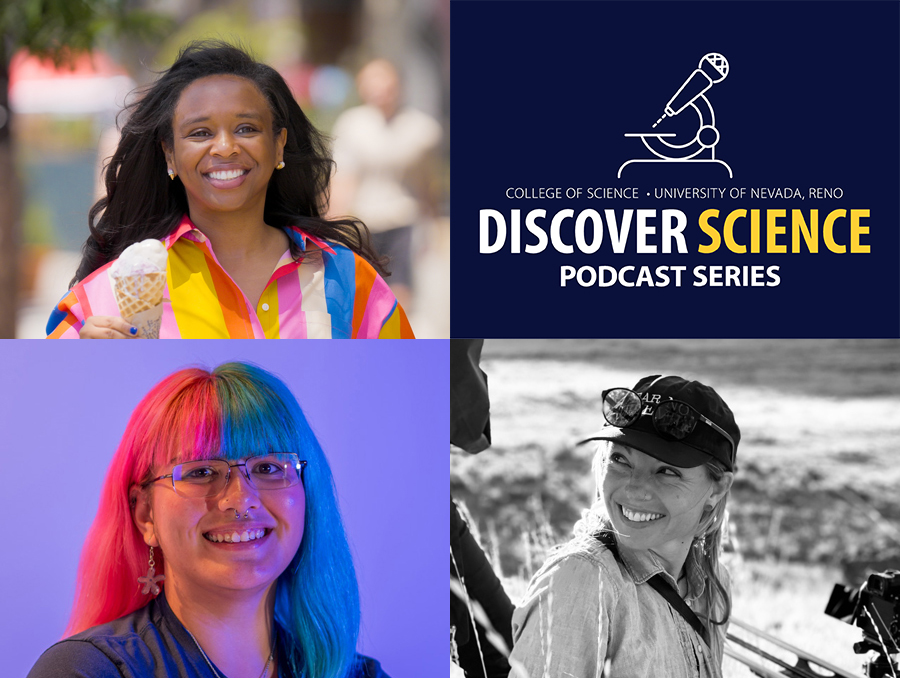
Communicating science is a tricky job, but "The Ice Cream Scientist" Dr. Maya Warren is up to the task, with help from filmmaker Page Buono. Warren and Buono collaborated on the film, "Frosty Formulations" which shows audiences that science can be sweet and fun, just like ice cream. This episode is hosted by Hitchcock Project for Visualizing Science student Katrina Perce.
LISTEN TO DISCOVER SCIENCE: MAYA WARREN AND PAGE BUONO on COMMUNICATING science THROUGH ICE CREAM
00:00
Katrina: Welcome to the Discover Science podcast from the College of Science at the University of Nevada, Reno. My name is Katrina Perce. I'm a graduate student in the Reynolds School of Journalism, where I'm studying science communication with the Hitchcock Project for Visualizing Science. I'm excited to be hosting today's podcast, where we'll be discussing a very sweet topic with guests Dr. Maya Warren and Page Buono.
00:23
Katrina: Dr. Maya Warren is a food scientist with some great chemistry with ice cream. Taking a liking to ice cream at her Missouri high school, Maya earned her B.A. in Chemistry at Carleton College in Minnesota. Maya was inspired to pursue a career in food science after watching Food Network show, Unwrapped, about what goes into creating some of our favorite foods, like French fries and peanut butter.
00:42
Katrina: After an internship at a cereal company, Maya went on to earn her Ph.D. in food science from the University of Wisconsin-Madison, specializing in the microstructure, sensorial, and behavioral properties of frozen, aerated desserts. Maya's excitement for science and ice cream is contagious. She shares her love for both as she travels the world making ice cream and other frozen, aerated desserts.
01:01
Katrina: And a quick aside, her love for travel is not restricted to her duties as the ice cream scientist. Maya competed and won in the 25th season of the reality show The Amazing Race with her friend and former lab mate in 2014.
01:11
Katrina: We are also joined by Page Buono, a director, producer and writer at Day’s Edge, an award-winning production company, producing documentaries involving science in nature.
01:21
Katrina: Following her degree in environmental journalism at Western Washington University, Page earned her MFA in Creative Nonfiction from the University of Arizona. Alongside writing and producing for the Emmy nominated PBS series Human Footprint, Page is also directed and produced numerous short educational science films, including Frosty Formulations, a film featuring Dr. Maya Warren, her career, and the magic of the science behind ice cream. Page's creative style brings a bright, fascinating and unique look to science communication through film. Thank you for joining me today, Maya and Page!
01:51
Maya: Thank you.
Page: Thank you for having us.
01:53
Katrina: So, kind of starting off, Maya, you labeled in Frosty Formulations, chemistry as your first love. Can you talk a little bit more about that love story?
02:03
Maya: Yes. So I fell in love with chemistry before I knew it was chemistry. I fell in love with creating and sort of phase transitions of items or foods back when I was just a little kid, but I didn't really know that making slime was actually doing chemistry. I just thought I was making slime. And so being able to then put that into actual understanding of what I was doing, like when I was in high school and really fell in love with chemistry, is kind of where it really all started, and where the sort of ideas of, wow, this could be something that I could actually do in life.
02:35
Maya: It doesn't have to just be something that's like a thing that I like, but it's something that I can actually apply to my life. And then being able to settle then into the food part of it kind of came after that. But I would say it, it started, I guess, when I was young, but not even really knowing I was actually doing science or chemistry for that matter.
02:54
Katrina: I feel like that's a lot of things you don't realize, like behind it, a lot of things around us are actually science.
Maya: Most things are so hard to get it. Yeah, yeah.
Page: Like what isn't.
Maya: Yes. From your shampoo to the clothes that you wear to the the watchband, I mean, anything you name it. Like it's all science.
03:14
Page: Yeah. The whole world. We existed. Yes. Yeah.
Katrina: Kind of getting into more specifics with your work and everything. Can you talk about what makes working with ice cream and other frozen, aerated desserts so fascinating?
03:24
Maya: Oh my gosh. So, if you could feel my eyes light up through this podcast right now, I absolutely love the science of ice cream.
03:34
Maya: I really feel like it found me and that I was put on earth to be able to explore it, as well as be able to share it with the world. And one thing that I love most about it is that it's a relatable science. So, people, regardless of your age, you can understand it and it can be broken down for you in a way, and which is not intimidating.
03:55
Maya: As scientists, we often get this sort of stigma of like, oh my gosh, science, like stay away, like it's really difficult, but it doesn't have to be. And I love food science and the science of ice cream because it is so approachable. Going deeper into the sort of focusing on ice cream itself, when you say the word “ice cream,” like it puts a smile on everyone's face, like, let's just admit.
04:14
Maya: So, it's one of those things that it's like, okay, I don't mind learning about that because it's ice cream. And so, the approachability of it is something that I have really fallen in love with even beyond just, of course, me loving the science and me, loving the art of it. I look at ice cream as a blank canvas and it's awaiting whatever we want to throw at it.
04:34
Maya: And I love for people to be able to think about that and what they want to sort of do and like what can be your blank canvas, what can you sort of design and create in a way in which you might be able to stand, like in a league of your own? Because at the end of the day, I didn't invent ice cream.
04:49
Maya: I just look at ice cream a little bit differently than most people do. And I think I have a different appreciation for it because I am so close to it. But at the end of the day, it does make people smile. And I think that that's one of the things I love so much about it.
05:04
Katrina: So, kind of related to that, you're working on some really neat projects. Can you talk a little bit about Ice Cream for Change and why this project's important to you, what it is and everything?
05:12
Maya: Yeah. So, Ice Cream for Change actually came out of everything that was going on back in 2020 with COVID and with the unfortunate incidents in Minnesota with George Floyd and wanting to be able to bring the community together and the ice cream community together in a way in which we could make a difference.
05:31
Katrina: And so, my friend and I, Mona, Ms. Mona Lipson, actually is also an ice cream guru. She loves making ice cream. We met on Instagram, had never met each other in person during COVID, and we created Ice Cream for Change as a way for people to be able to come together, serve scoops of ice cream, and people will be able to donate money towards organizations that were looking to really make an impact in social justice and things that needed change.
05:57
Maya: So, it's not actually just loose change like money, it’s actual ice cream for an important, actual change. And so, through Ice Cream for Change, we also, not even just focusing on like injustices and racial issues. We also want to focus on making an impact with sustainability issues and environmental issues, etc. So, we sort of taken a little bit of a pause.
06:17
Maya: We're hoping to gear back up actually this year or next year with Ice Cream for Change. We both had a lot of changes in life – no pun intended – we both have had a lot of changes in life. You know, really, it's been both dear to myself and Mona's hearts, and so we hope to be able to get back into it. We raised quite a bit of money for different organizations when we launched Ice Cream for Change and so, we definitely hope to get back into it.
06:40
Maya: But it's important for people to be able to realize that ice cream really has no boundaries. It has no isms. If you go to an ice cream shop and get a scoop of ice cream, no matter who is behind the counter, no matter what they look like, no matter the gender or political values or religious beliefs, you get that scoop of ice cream, you get a smile on your face.
06:58
Maya: And so I love the fact that ice cream really does break those boundaries and those walls. And I think that we can start to really have critical conversations over scoops of ice cream. And that's what Ice Cream for Change actually does as well.
07:12
Katrina: During that same time period, you talked about like your Ice Cream Sundays on your Instagram Live. Can you kind of talk about that and like connecting to your audience in that way?
07:18
Maya: Yeah. So, Ice Cream Sundays with Dr. Maya actually started during COVID as a
Page: She was very active during COVID
Maya: Yes. Very active. I wasn't traveling, but I was like, wow, I'm home. What can I do with time? Yeah, it's a whole nother sort of mindset on how to use time, because we only have 24 hours in a day.
07:36
Maya: We can't extend; we can't shorten. But what can you do with that 24 hours is sort of how I approach life. And during COVID, I saw people making sourdough bread, like online all the time. And I was like, really? Like, I mean, I guess, but why are people making ice cream? I was like somewhat offended.
07:57
Katrina: Yeah. Like, why aren't you making ice cream? Ice cream is so much fun; it puts smiles on people's faces. Then I realized, oh, well, do people have ice cream makers? Probably not. Not as many people as I think could, and probably not as many as I do. So, I said, well, how can I connect with people through ice cream with them making their own ice cream?
08:18
Maya: Because ever you talk about ice cream, I feel like you have to give it out. Like it's like rude to talk about it and all the science behind it and then you don't have it. I'm like, how can you break that barrier? So, I said, I'm just going to teach people how to make no churn ice cream, and I'm just going to start doing it and we'll see where it goes.
08:36
Maya: And 30 something recipes and episodes later, I created Ice Cream Sundays with Dr. Maya as a way to bring people together during a really hard time like the pandemic, but also as a way for me to be able to share my science with the world. And part of what I have been sort of seeking to do, is to break that barrier of scientists and television, and we don't see food scientists on TV.
09:02
Maya: We see chefs and we see scientists in other fields. We really don't see food scientists. And so I think it's important, as I continue in my journey, to be able to continue to try to get to that next level of how can we show what scientists look like, who we are, how approachable science can really be, and how much science there is behind your food, and how universal it actually is, and how it brings us together.
09:27
Katrina: And I think, I'm going to say this, I think ice cream brings us together like no other food can. And so, Ice Cream Sundays stemmed from that desire, but also people are making way too much sourdough bread it. And I was like, people need to make ice cream. And yeah, I made a lot of ice cream during, during the pandemic. It was actually absolutely wonderful.
09:48
Page: Yeah. Well, I loved what you said. It was such a like relief for parents looking for ways to engage with their kids in the middle of the pandemic, and it was educational but also fun and yeah.
09:58
Maya: I gotta do it again. Like, I miss it and I miss the engagement that you have, even though it's virtual. I miss that engaging with people and how every Sunday at noon Pacific people showed up. I know! and watch me dance like I cannot really dance. I mean, I have moves, but they're not good. And, you know, engaged in, in the science of ice cream and ask really cool questions and the one of the really cool things is, I actually had people join from, Brazil. I had people join from South Africa, I had people join from Ireland. I had people join from Jamaica, like people from all over the world. And that was the beauty of being able to have something like Instagram, where you can have it all over the world and you can make those connections and so it was it was really, really unique. I miss it.
10:48
Katrina: So, Page, your work claims a deep dedication to science and knowledge and sharing this traditional knowledge and equity in that. Can you kind of talk about why and how you use storytelling to kind of promote the topics that you do care about?
11:01
Page: I think probably sort of the like fundamental way that I do it is through characters, and I think it's finding people, who are passionate about the things that they're passionate about, knowledgeable about the things that they're knowledgeable about, and using them as a way into complicated or controversial or, you know, whatever sort of, facet of information we're after.
11:21
Page: And I think people make for really compelling stories because people help us move through complicated topics, because their interests are multifaceted. So, we get to approach chemistry through a love of ice cream, a love of connecting to people, a love of vibrant colors and loud music. You know, I think, sort of characters give us the palette that we can use to tell the story.
11:45
Katrina: And I think I guess maybe, you know, sort of thinking about science and traditional ecological knowledge or traditional knowledge. I think, again, it's people's deep connection to place, to something they've studied, you know, to an area of interest. And it's just tapping into and giving them sort of the microphone for that.
12:05
Katrina: Can you kind of talk about how you find the people that you feature, like these characters that you do feature?
12:09
Page: Yeah. I mean, gosh, every time it's a different story, I've had a really varied career. So, some of it is just having had opportunities to meet people from really different backgrounds and with really different expertise and areas of interest. I think, you know, I do a lot of Google searching. You know, we spend a lot of time in the pre-production phase, actually getting to know people.
12:31
Page: So, you know, I don't we had so many conversations
Maya: so many. like I knew page before I actually ever saw page in real life
Page: Yeah, yeah. We really did. You know and it's and that's about kind of what I was touching before but that's just about finding out like what is going to make this person come alive through the story.
12:48
Page: How are we going to capture these, you know, different facets of who they are? But then also, like, is this the right person for this? Like, Maya was a no brainer, you know, for frosty formulations. But sometimes when we're looking for characters, it's like trying to find out, you know, what are they bringing to the table?
13:04
Page: Are they, you know, I think, I'll touch on this later, but one of the things that we're learning, Reyhaneh Maktoufi is a scientist. She's a researcher who looks at how do we build trust in audiences; how do we actually make science communications effective? And one of the things we're learning is that, both on the side of scientists and, producers of science communications, it's like kindness and openness and sometimes characters who don't feel curious, who just feel like really stuck, don't make the best characters because it doesn't feel like an in, like you have an in with them.
13:38
Maya: It's like a wall is there and you can’t quite break that.
Page: Yeah.
Maya: Interesting.
Page: And so, I think like for, for me at least I would say like characters who you feel like you can be in conversation with. And if I'm not like actually talking to them, but just who you feel like you can engage with, they make for really strong characters.
13:55
Maya: And I, I will say, I think as a scientist, we, I'm talking about like we as a scientist in like the science community, we often struggle sometimes breaking that wall.
Page: Yeah.
Maya: And I believe that social media has provided a platform for people to start trying to break that wall without actually having to do it in front of other people.
14:20
Maya: I mean, you are known to other people, but you're not.
Page: It gives a little bit of a safe distance.
Maya: Yeah, it's a bit of a safe place. And I think that people have started to use that more, and I hope people continue to use that more. But I love with the work that you do, Page, how you're able to show that scientists are more than just a lab coat, goggles, you know, staying behind the scenes and that we do have a personality.
14:43
Maya: We are engaging. We are fun. Like, I don't know how many times people have told me, “Well, I would have never guessed you're a scientist, by the way you look.” Well, I mean, I don't know what I look like, but okay. But I love, you know, what you all do at Day’s Edge. And what we were able to do with Frosty Formulations is to show not only the vulnerability of the character, but also the realness, the true, you know, kind of goofy side, or the happy side or the sad or whatever it might be, but all the emotions that people go through because scientists in the day are people.
15:14
Maya: Yeah. We're not stale. We're not stagnant. And so, I, I love what you all are able to do with that. Yeah.
Page: Yeah, it's definitely like the primary goal, you know, we want people to engage with and trust science. We want them to feel passionate about it. And scientists are the best. They're so fun.
Maya: Yeah, we're cool.
15:33
Page: So, it's just. Yeah, I really like, yeah, I’ve never, we've never made a film about a scientist who's like, yeah, I just don't really have any other interests. They're always like, oh yeah, well, also, I'm in a band and I also play the, you know, and I'm also learning how to ride bikes backwards.
Maya: Wherever the brain takes
Katrina: So yeah, I completely agree with what you say about just like the image of scientists and everything, seeing the way that you depict scientists and the way that you're, like personality is so like bright and bubbly while also describing these very complex topics. It's amazing to see and I really love it.
16:15
Maya: Oh, thank you, thank you.
Page: I think it's a really exciting time for sci com in that way because I think, we were kind of touching on this earlier, but I just, you know, I understand, like why scientists felt the need to be, sterile, you know, and I think we sort of looked we put this expert halo on, and it was like, if you do anything outside of that, we're going to question your work, right?
16:32
Page: I think the pendulum has really swung, or, hopefully, I think is swinging on that way. Like we want to see scientists as human. And so, I think it's a really exciting time to be telling stories about scientists and with scientists.
Maya: It makes it more, it makes scientists seem more real. And for the outside world, it makes science seem more approachable when you can start it from the scientist standpoint of how approachable they are, you know, and also with social media, with film and, and all of that, we're able to, you know, continuously get it out there so people can see.
17:09
Maya: Because, you know, back in the day when people didn't have as much access, you didn't know what you could be, you didn't know what existed. You just thought maybe people just thought things appeared. I'm not really sure. But there is so much science. And I'm going to say with food, because that's what people, I think don't realize a lot is that everything you eat, there is a massive amount of science that goes behind it. From the packaging that you open to the food that you put in your microwave, or that you're making in the hotel room or dorm room, whatever, whatever you're doing.
17:39
Maya: There's so much science behind that. And the people that make it happen could be you. You know what I mean? Like that young kid realizing that, oh, I too can be because now exposure is so much greater. I definitely appreciate the times that we're in right now for that.
17:57
Katrina: So, kind of talking about Frosty Formulations, as an artist myself, I love watching it, I watched this several times at this point because it's just so cool. So, all these like fun, bright scenes, they kind of just like glue you to the screen and you just don't want to stop watching. I’m watching it with a giant smile on my face. So, you use art in a way to communicate science, and then you've managed to visualize, like partial coalescence in a way that people like me, or like other non-science audiences, can understand it.
18:23
Katrina: Can you try to talk about, like, the process behind creating films and stuff and like you're visualizing these very like complex topics?
18:30
Page: Yeah. Yeah, absolutely. And Frosty Formulations is such a fun example of that. And that summer. So, we made Frosty Formulations, and we also made Cracking Chirality, which is a totally different aesthetic. But I think, you know, from the outset it was like meeting Maya, learning about science.
18:47
Page: It was like, this film has to be bright and colorful, like Maya is bright and colorful and super vibrant and like smiling and high energy and as we learned more about your passions and your interests, it's like travel. She's out and about and around shopping, like she wears these vibrant clothes, you know? And so, I think from the outside it was like, okay, aesthetically this thing's going to be bright and fun.
19:11
Page: And then, you know, we needed animation styles to match that. And so, we worked with a production and animation studio called MK12. They're really, really amazing. So we knew going into it like, okay, you know, our animations are going to be bright and vibrant. We're going to shoot it in a really bright, fun, playful way.
19:28
Page: And then when we were developing the idea for partial coalescence, visual metaphor is sort of one of the tools that we have in film. And so, we were thinking a lot about, like, how can we show this thing, these things that, that come together, but not all the way together? And, I think we were like, snowballs!
19:43
Page: No? Okay. Can we do we had so many ideas, bubblegum like, and eventually just brainstorming, we were like “bubbles!” And so, I found a bubbleologist in LA. That's a real thing.
Maya: So cool. Right?
Page: A real thing. And we consulted a lot with Dr. Maya, like how are we going to show this, what do we need to show? Found a studio in LA and hired this bubbleologist and filmed, high speed, him creating these bubbles.
20:09
Page: It was actually really complicated. Like getting them to partially coalesce was not something he usually did. So, he's like, “so you want them to come together, but not all the way, together?” Yeah. And so, we had to try that a lot for a very long time.
Maya: Right? That's so funny. That’s awesome.
Page: But he was game. Yeah.
20:25
Page: From the outset, you're just sort of like, how are we making this visually appealing? We wanted it to be on the green screen so that it felt like the bubble just was part of Maya's world. You know, you don't want to be sort of like jumping between worlds the whole time. The studio shot of ice cream where it dissolves into the animation was another way that we were like, “okay, we can bring these worlds together.”
20:44
Page: The Cracking Chirality film, we called it like our Barbenheimer Summer because that was like our bright, vibrant film. And then the other one is very Oppenheimer in the sense it's like he's super studious, he has like a passion for art history, really academic, really loves West Anderson films. And so, we were as we were developing it with Furkan, who's the lead scientist in that film, he was like, you know, we were like, okay we’re going to like, make it much more muted tones
21:13
Page: And we want it to feel really like slow and pensive. But we really ask the characters, the scientists, themselves to help us think about what the visual opportunities are.
Katrina: Yeah, I remember watching the film and I was like, how do they how does that work? What’s going on? Like trying to figure out how you filmed that
21:26
Katrina: What's going on? Like trying to figure out how you filmed that.
Page: And Maya’s scene in her apartment. You know, we've got her, like in this spinner. We've got the camera spinning around her. We've got, you know, lights and filters, color filters. And then in the studio shot, same story. We made him on the center box and like I would run behind with bubbles, and then David would run behind with bubbles, and they would film and then we’d throw up a little confetti.
21:54
Page: Chaos. That's how we filmed it.
Katrina: Beautiful chaos.
Maya: But it came together. I remember when you were, when we were sort of talking, you know, through all of our conversations prior to filming and, you know, the ideas that I was like, oh, I mean, I trust you. I don't quite know how it's going to come together.
22:09
Maya: But when it came together, I was like, okay, like, this is pretty rad. And even when people saw it, they would say, “oh my gosh, this is so well filmed!” And I said, “I know, like it's not me, it's Day’s Edge!” Like I was the character. I mean, you know, I may have made it, you know, vibrant or, you know, whatever my personality.
22:34
Maya: But the way in which you all approached it and then were able to edit and deliver it was so spot on, like it was like the perfect scoop of ice cream. Yeah.
Page: And honestly, you know, like, I think I've said a bunch, it's a team, but it's like it's important to me to mention, you know, like Nate Dappen was the executive producer and one of the shooters and absolutely one of the creative minds on it.
Maya: Yes, so creative.
Page: David Hutchinson was another one of the shooters, super creative. Angel Morris was our editor, fabulous, fabulous editor. Sammy Vanpreet was the assistant editor. So, I just got to kind of do some of the writing, directing, creative thinking, but it’s a team.
23:13
Maya: It’s a team, yeah. And it was a team even just to do everything that we did, you know, from you know, rearranging my apartment to make it look like we were in, like, somewhere else, you know what I mean? And, like, just, you know, the way in which a question was asked if I didn't understand, sort of rearrange, like, kind of connect our minds and make sure I understood so I can deliver it, you know, deliver the answer.
23:31
Maya: It was just really great. It was a really fun way to showcase how cool science can be. Yeah. And I just talk about Day’s Edge all the time and how wonderful a company and how wonderful your minds are, because you're really able to break that fourth wall of science and sort of the person. And I just really appreciate it. So, it was really cool.
23:56
Maya: And I just feel honored that Frosty Formulations featured me, who happens to be an ice cream scientist.
Page: Just happens to be.
Maya: Yeah, just happens to be. But I was just also thinking about we were talking about so the juxtaposition between the two films and, but like, could you imagine if it was swapped and it just like would not work like, like so serious about ice cream. Like, don't get me wrong, I think ice cream is one of the most complicated foods known to mankind. Like it's a solid liquid in a gas all in one. Like, it is extremely complex, but it has to be lighthearted and fun. It has to be whimsical in a way.
Page: There's a whole culture surrounding
Maya: Yeah, if it was like all muted tones, it would be totally different.
Page: It wouldn’t work.
Maya: It wouldn’t have worked.
Page: And I think that's to like the, that collaborative. I mean, for me, the thing that I love about this job, this career is the collaboration, but I think it's part of what makes us effective at science storytelling.
24:56
Page: From the outset we were in conversations, the entire film process, we were like, “are we getting this right? What are you seeing that we're not seeing? Are we explaining this right? I'm going to say it back to you. Did I get it?” You know, and I think that's not always how folks approach it. But I think what it gives us is the chance to have you shine. You know, to me, that feels like a really critical part of it and something that we might be doing a little differently.
25:19
Katrina: Actually, it goes right into my next curiosity for both of you. What are kind of the challenges of communicating science to non-science audiences?
Maya: Yeah, I mean, I think we've touched on a little bit of it is that people think that science is sort of not approachable. Oftentimes if you're not a scientist and that it's sort of very difficult to understand and comprehend and like, what is science? It's like this like mystery enigma in the world. And you're like, “what?”
25:48
Maya: And people, especially with food, as much as food as we eat, and we eat a lot of food as humans, and as much food if you go to the grocery store that you see in every single aisle or bin or whatever. The amount of science that goes into making sure that your cereal doesn't go stale right after you open it to the not so new, but new way that you, you know, open the Oreo package and you can seal it back up.
26:22
Maya: Like the packaging science behind that. And all the way to the burritos that are frozen in the frozen section to the fruit that's, you know, there's so much science in everyday life that I find it difficult that people don't realize that. I'm like, did you just think that the Cheerio grew out of the ground? I'm just curious, like, and then people realize that they're like, “oh!” because there's texture, there's shelf life, there's micro, you know, making sure that it like food does not, should not get released.
27:05
Maya: If it doesn't pass, you know, micro, like there's all of that that goes into it that I just don't think that people get. And so I hope that in the work that you do, within the work that we all do, that we can continue to break down those barriers and make it so that science, at its core, becomes a delight for all to enjoy, and not just something that we sort of hold. And then people just consume. But to be able to learn and enjoy it, I think, is something different than just consuming it. Right?
27:39
Page: Yeah. I think, you know, one of the things that we hear from a lot of scientists and recognize and, and work with them on is like, it's really hard to tell a part of any story. But also no story is the whole story. And I think for so many scientists, so much of the context of their research is really critical. The specific language of their research is really critical. You know, we work with geneticists, we work with biologists in these really niche fields and terminology is really important, but it's also really foreign.
28:08
Page: And it can be really it can be really isolating for, you know, sort of a more general public audience or science-literate or curious, but not scientist audience. And so, I think one of the greatest challenges, but also what is so fun is really working together to tell a story that is accurate, if not comprehensive, and accessible.
28:28
Page: And so, I think I mean, that's probably one of the biggest challenges, you're kind of working across languages and so doing the translation. I think, too, as a science communicator, I think so often we set out or we have clients and it's like the audience is the general public. That's like, well, that's not an audience.
28:47
Page: Like I think the sooner in the process that we define the specific audience, the easier that task of working with a scientist to find out, like, what is the level of literacy we can assume? What is the access point for familiarity? What is this audience going to be motivated by? Where does their distrust exist? Where does the trust already exist? I think that's also a really helpful aspect.
29:10
Katrina: Kind of on the flip side, then, what makes science communication so fun?
29:14
Maya: Science communication, I think, is so fun for the “AHA” moments that people have, like when you're talking to someone, whether on an airplane or doing like a guest speaker or anything like that, and people, you see the light bulb go off, I'm like, "yes!” They got it. Like whatever they got from that. Yes, they got it because you can see it. It's a very human, reaction that people have when they get it and that is so satisfying as a scientist to be able to take all these years of research and deliver it in a way that, seven year old can understand, or a 70 year old can understand, and that, like, I'm getting chills right now just talking about that because that in its little bitty box with a bow on it is the like, perfect point of I've done my job because they got it.
30:07
Maya: And I always tell people I didn't go to school, research ice cream, study ice cream, and get my Ph.D. for me to hold it inside. It's for me to be able to share with the world. And when the world, “the world” gets it, when that light bulb goes off, that is one of the most rewarding and gratifying things within the world of being a food scientist.
30:29
Maya: And in that whole statement that I just said I didn't say anything about, like doing research, it was about me verbalizing or being able to do the experiment or create with the person. And I think as scientists, we need to do more of that and that it's not for us just to stay behind, you know, the four walls and all of that, it’s for us to be able to break that fourth wall and to be able to have that engagement. But that moment is everything for me. Yeah, I love it.
31:00
Page: It's funny because I would say, like, entirely selfishly, the most fun for me is that I get to have that “AHA” moment over and over and over and over.
Maya: I love it.
Page: Yeah, when mom was like, “what do you want to be?” I'm like, I don't know. I want to get to ask people questions and learn always. Journalism, you know, sort of became that. But I think so entirely selfishly, like in the filmmaking process, it's that it's that I get to be like, oh, explain it a different way. Try again. And is this right? Am I getting there or am I sort of understanding, you know, and then when you get it, it's like it's so rewarding.
31:32
Page: And then I think similarly either when an audience says, like, “I understood that in a way,” or “oh my gosh, that was amazing. I'm engaged.” But then also when characters and I would say scientists, but this is true of any storytelling when they're like, “I feel well-represented.” That for me is like, oof, like, yeah, thank you. You know, and really, really, really rewarding. And the nature of this work is just really cool. I feel like I absolutely hit the jackpot. I travel a lot and get to be in weird, surprising situations and meet new people who are passionate about the thing they do all the time. And yeah, just constantly learning.
32:12
Maya: We are drawn in various ways, addicted to those feelings, you know, those endorphins running through our body and all of that. Like we love that. And so, when that “AHA” moment comes from knowledge, like you've really got something special there. And because “AHA” moments are that same feeling that comes from eating something really good or seeing a long lost friend and like building up all those emotions.
32:37
Maya: But when science and knowledge can stem that emotional reaction, it's really special. And I somewhat selfishly, am going to say that when people can get it through ice cream in, it makes it that much more special, because ice cream has something that a lot of other foods and/or science does not have. And that's the nostalgia aspect of it.
33:05
Maya: If you think about ice cream when you were a little one, whether running for the ice cream truck on your street because you heard the music or going with your family or whatever, friends and getting ice cream late at night on a hot summer day, or, you know, cozied up under a blanket and eating ice cream, or maybe eating ice cream with, like, your grandparents. Maybe they passed away or some memory. We all have it.
33:27
Maya: And so, I believe that ice cream draws up the nostalgia aspect in us, as well as those “AHA” moments through the art and science of it. And so, for me, that complete sort of box, that collaborative box of all of those entities coming together is what a scoop of ice cream actually is. It's wonderful. It's really cool.
33:49
Katrina: Well with that then, you, kind of, with your work like have integrated like your love for ice cream, everything into so many different parts of your life. And in the same way you kind of do the same, where you're combining your art with science and having the thing you love be part of your job. So, do you both have any advice for maybe like young scientists or young communicators that maybe want to incorporate the things they love into their future careers?
34:14
Page: It's funny because Maya was telling a story about, you know, her six-year-old self.
Maya: Yeah, bright-eyed, bushy-tailed Maya
Page: Yeah, who first encountered ice cream. And I think similarly I have, you know, my roots in journalism, I studied Nellie Bly when I was in fifth grade, and she was this journalist in the late 1800s, one of the first women to travel the world. And she reported on the injustices in an insane asylum. She feigned insanity so she could report on the injustices in an insane asylum. And that just, I don’t know, she stuck for me.
34:46
Page: It was like, I want that. I want to be able to go investigate things and explore things and learn things and I had a mentor, flash forward, Jeff Luck is his name at Jackson Wild Summit. And he was like, I told him that story and he's like, “you're doing the thing you were doing that you knew you loved when you were eight,” he was like, “you’re gonna be fine, you’re gonna figure it out.”
35:05
Page: And so, I think there is something about tapping into the you before it was told it could or couldn't do things. The you before it was told that there were smart choices and bad choices and the you that was just gut reacting to what you moved toward, you know, and I really think there's something there.
Maya: It’s special, it’s real and it’s raw.
Page: Yeah. I think it's worth trying, motivating to move toward.
25:31
Maya: I would say that, similar to what Page is saying, you know, really follow where your inner passion meets that outward doing. And you don't have to know today. And it's forever evolving. Yes, I love ice cream. Like it's my world. What do I do with it?
35:49
Maya: I could own my own ice cream company. I could think about ice cream all day and eat it. I could draw, I can't really draw, but I could draw, I could write music about. I mean, so many things you can do with it. So, what is it that if you don't invent something, how do you reinvent it so that it becomes yours?
36:08
Maya: And to not put the pressure on yourself to just let it come because it'll come and it'll come sometimes as least expected. From bright-eyed, bushy-tailed six-year-old, you know, little girl never knew that I would become an ice cream scientist. And actually, I even know what an ice cream scientist was.
36:25
Maya: I just kind of made it up and said, I'm going to become this. And my parents were like, what? Like, what are you doing? I was like, don't worry, I'll be happy. And they're like, are you... okay?
Page: Like one important thing.
Maya: Yeah, that was that for me, that was the box was to be happy. But I would also say to, you know, make sure to reach out and network and, you know, all of that. Like, I know people hear it all the time, but it is really, really, really crucial. And with social media and LinkedIn and all of that these days, like it's so much easier to network than it was like 20 years ago. Like it's so much easier and so just, you know, if, you know, if you think something's not for you, just try it.
Maya: Like, you never know, like what do you have to lose? But a little bit of time maybe. But in that time what do you actually gain? And I'd also encourage people if there is a situation or a job or anything like that, that you're in that you're like, oh, like, this was not really worth it. Believe you me, it was always worth it.
37:20
Maya: You have to ask yourself, what did you learn during it? I had an internship that I was like, oh Lord, what in the world? This is not for me. But you know what? It was the best internship I ever had because it taught me what I did and did not want to do. So, what can you gain from a situation that you can't see the positive in it yet?
37:40
Maya: Turn it into the positive for you because you did it. You can't take that. You can't take that back. But I would, you know, agree, again, agree with page in that, you know going back to that core. Like what lit up your eyes. What made your tube socks go up and down in the first place? Because that is real. It is authentic. It is you.
Maya: And don't do it just for the money. I'm going to tell people that like don't like follow, follow, make sure what makes you smile. It makes your eyes light up, find your ice cream.
38:04
So to close, you both travel a lot. You both have been to many different countries. Do you have an ice cream flavor that reminds you of the feeling of traveling?
38:17
Maya and Page: Ooh.
Page: The first thing that came up for me was just like mango. Because mango Helados, like in Mexico, are just like one of those foods that I love so much there.
Maya: So, I think that I'm going to give you an answer, but I'm gonna switch it up a little bit. For me, it is the ingredients. And to make the flavors that make it for me and depending upon where you are, will depend upon kind of what ingredients they're using. Like some places, like in Italy, they're using cream of the crop, freshness of the fresh because they have access to it. And the cost is not so much to be able to make that beautiful gelato.
38:57
Maya: Or you go, for instance, I was in Thailand last year and I was on a long boat in a floating market. And there's a lady, you know, not riding on it, right? Like floating down in her boat, you know, selling coconut ice cream in an actual coconut. Yeah. Very, very special, very delicious. Very demure.
39:20
Maya: Like, for that and the story behind her that creates the ice cream for me, it's the people in the food and the ingredients and the history behind creator that that sort of, I carry along with me more than just the ice cream itself, because ice cream is so much more than just ice cream. It is the creator. It is the story.
39:40
Maya: It is the hardship and the passion. Behind how that scoop became that scoop. The Thailand one is a is a great example, I would say, of that along with, you know, just seeing young kids eat ice cream for the first time and yeah, or like a really enjoy, like it's very special. Like it's like, like look at that. They love ice cream. I love it. So yeah, I'm answering your question in a very roundabout way, but I would say it's very layered for me.
40:11
Katrina: I want to thank you so much for coming on here for the Discover Science podcast. It was so great meeting you and getting this opportunity to just talk about science and talk to people that are so inspired by it, are so excited about people in general. So, thank you so much for your time and everything.
Maya: Thank you!
Page: Thank you for such thoughtful questions, it was a pleasure.
Discover Science: Baker Perry and Julie Loisel on fieldwork in extreme environments
The top of Mount Everest is a cold, unforgiving place to conduct scientific research. So are the mangrove jungles deep in the Amazon, accessible only by boat. But for scientists, those regions can be some of the most important sources of data when it comes to the climate crisis. Nevada State Climatologist and geography professor Baker Perry and his colleague, fellow geography professor Julie Loisel, share some of their insights into extreme fieldwork locations and why the science there is too important to ignore. This episode is hosted by Hitchcock Project for Visualizing Science student Ali Dickson.
LISTEN TO DISCOVER SCIENCE: BAKER PERRY and Julie Loisel on fieldwork in extreme environments
0:00
Julie Loisel: We met this captain. He's a friend of a friend. Paid him in cash. We, you know, there's 15 of us, including a lot of students. So, like the pressures is on. He needs to dump us, essentially in this jungle that, I don't know if anybody has ever walked there. There's no path. And we're going down on a canal on this boat, and we can't dock anywhere.
There's no beach. Just imagine overhanging the densest vegetation you've ever seen, like all over the canal. And we're like, ‘Alright, well, let's just stop here.’ And as we're trying to get off the boat….
0:44
Ali Dickson: Welcome to the Discover Science Podcast, presented in partnership with the Discover Science Lecture Series, through the University of Nevada, Reno. I'm Ali Dickson, a graduate student at the UNR Reynold’s School of Journalism and your host today. In this episode, we're diving into the rugged world of researchers who collect data in extreme environments. I recently sat down with two professors from the UNR Department of Geography who are no strangers to these wild worlds, Dr. Julie Loisel and Dr. Baker Perry. Dr. Julie Loisel is an associate professor who has studied carbon and peatlands from the Canadian Arctic to the Peruvian tropics. Her expeditions have been funded by the National Science Foundation, the National Geographic Society, and Texas A&M University, to name a few. Dr. Baker Perry is a professor of climatology and the Nevada State Climatologist, who has studied high elevation weather in locations that include Mount Everest and the Andes Mountains. His expeditions have been funded through collaborations including the National Geographic Society, the Government of Nepal, and Appalachian State University. I'm excited to share the conversation, so without further ado, let's get started.
1:58
Ali Dickson: Thank you so much for joining us today. You both have traveled to incredible places in the name of science. So to kick off this episode, I was hoping you would be able to share, the wildest experience that you have had or encountered in the field.
2:13
Julie Loisel: Do you want to start?
2:16
Baker Perry: I'll let you go first.
2:18
Ali Dickson: Okay.
2:19
Baker Perry: Go ahead.
2:19
Julie Loisel: All right. Thank you so much, Ali, for having us. It's great to be here.
There's so many studies and stories, and it's hard to pick one. But let's go with, imagine this: This is the last day of a two-week expedition in the tropics. We’re in Costa Rica along the Caribbean coast. We're studying these palm swamp ecosystems, and we had to get there on an old boat.
We met this captain. He's a friend of a friend. Paid him in cash. We, you know, there's 15 of us, including a lot of students. So, like the pressures is on. He needs to dump us, essentially in this jungle that, I don't know if anybody has ever walked there. There's no path. And we're going down on a canal on this boat, and we can't dock anywhere.
There's no beach. Just imagine overhanging the densest vegetation you've ever seen, like all over the canal. And we're like, ‘Alright, well, let's just stop here.’ And as we're trying to get off the boat and we're, you know, losing ground and trying to, like, just even step onto the marsh, our boat captain reminds us of the jaguars that are in the area.
And at the same time, it starts pouring rain, and all the students are exhausted from this two-week trip. And we just decide to go ahead and go for this trek. And, you know, we marched like, half a mile in an hour, kind of thing. And we have to machete our way through this jungle. And usually the fastest walkers are in the front.
But the problem is, the slowest ones are also the ones that have to, like, step into the deeper and deepening mud. And so by the end of that trip, everybody was at least knee if not hip, if not armpit high in the mud, or I should say armpit deep in the mud. Just laughing about it all because we, you know, we're like, so wet, so dirty.
And we got some good samples, so I suppose that's, that's the good part. And the other good part is the captain was waiting for us after hours of us being lost in the jungle, because there's always that fear of, like, is this guy still going to be there? And he was. So that was one of those experiences that was pretty intense.
4:34
Ali Dickson: We love a happy ending afterward. It's great. Did you see a Jaguar?
4:39
Julie Loisel: No. Also a happy thing.
4:43
Baker Perry: Well, thanks again for having us. It's really fun to, to be here with Julie and to share some of the stories from the field. For me, I was having a hard time deciding on one. So let me, let me give you two. The first, the first that came to mind, we were funded by a National Science Foundation grant in 2016 to work on the highest Andean summits.
This is, up at 21,000 feet to dig snippets and sample for snow water equivalent and snow density, temperature, and also scout sides for potential future ice core, ice coring expeditions and bring back samples for isotope and chemical analysis from the snowpack. So one of the mountains we had chosen was, Ancohuma, which is the third highest peak in Bolivia.
And it's actually pretty close to where I had grown up, as a kid, too. And so it's a mountain that had always fascinated me. It's a, it's a pretty straightforward route to get up there, even though it's, it's high. And so we had a team of six that were going to climb this and all work together and dig a snow pit at the summit.
And, and again, I mean, it's high and there's some, some challenging sections and places going up, you know, through an icefall. But overall, it's, it's a relatively, you know, straightforward peak. So we thought. We get up to, just over 20,000 feet, and the normal route was not it. There had been a huge crevasse that opened up on the ridge, which meant that the only way to get to the summit was to go straight up the face, which was 70 to 80 degrees.
And, we were with Anton. This is a joint colleague that Julie knows, and Anton gets to the base of that and realizes, you know, we talked through the options, said, ‘Hey, the route’s not in,’ and he says, ‘Okay, I'm stopping here,’ you know, he's ‘Nno technical climbing for me.’ And the other team members from, you know, a former grad student from university with us, too, we, they didn't have the skills to go above that either. And so, so, I went on just with our two local guides and, it was a very challenging climb, going up with water ice on the face because of the melting. But it was the descent that was the most difficult part because this is so high up.
It's, it's just under 21,000 feet. And, there was no sun on the face and we went up and it was super, super cold, but, but down climbing, we couldn't repel it because it was a diagonal kind of traverse. And so down climbing this on water ice, very hard water ice, was just incredibly taxing. And in the group that we had left behind that didn't continue to go, they were near hypothermic because it was below zero. Sun hadn’t risen yet, but was able to get to the to the summit and dig, dig the snow pit and collect the samples and come back down. But I just, it, that was one of the most challenging and difficult days that I've had in the mountains. And then it, it may have been surpassed by our 2019 expedition to, to Mount Everest, which was a two month, expedition.
We spent, you know, considerable amount of time in the death zone above 26,000 feet. And I'll tell some more stories from that, and that. But those are those are the two that came, came to mind that were very challenging.
8:26
Ali Dickson: Well, I'm glad you made it. I'm glad everyone made it. I'm glad you made it out of the jungle. So it sounds like you've had incredible experiences. So, bringing this into the research that you're working on today, would you both, dive a little bit more into the research that you're either currently conducted or have recently conducted in these extreme environments?
8:46
Julie Loisel: Sure. I'll start. I think for me, you know, there's a part of, adventure that drives my research inquiries. But, I guess the, the big research questions that I'm interested in have to do with a specific type of ecosystems that are called peatlands. So they are wetlands that store huge amounts of carbon in their soil over thousands of years.
And, if you look historically at where these studies have been performed, it was mostly in Canada, Alaska, Europe. So northern places that are pretty flat. And so that's where I started my, my training as well. But eventually thinking about where else might peatlands be and what are the different locations potentially teaching us about a golden rule or, you know, like a broader understanding of those ecosystems could be coming from understanding these systems that might be under more extreme conditions.
And so we went all the way down to Antarctica to find some of the peatlands. And, and we described some of the first peatlands from Antarctica, all the way into Patagonia. And so there's a lot of, again, sometimes the research questions that helps guide where I go. But sometimes it’s also, where do I want to go, and maybe I'll find some peat there. And that's how, Baker and I went to Peru, because there's some high elevation peatlands in the mountains that I thought would be amazing to go study and see how old are they? Why is there peat there? How thick are they? How much carbon do they contain? All of those questions.
So again, it's really a combination of really wanting to understand and document that ecosystem. And the reason why it matters is because these peatlands, they they're about 3% of the land area, but they contain about a third of all of the soil carbon on Earth. So think about a forest versus its peatland soil, for example. The soils would contain 5 or 6 times more carbon than like a jungle, so a super dense store of carbon. They are kind of under threat by some of the ongoing environmental change and also land use change. So you're, you're losing three times the rate of peatlands compared to the rate, the rate of forest right now. And we're trying to essentially monitor them, assess where they are, understand them so that we can help protect them.
And they could become carbon sources. So the carbon that was stored in the ground, and it took thousands of years, starts decaying and essentially being degraded by microbes and, farted into the atmosphere as CO2 and methane and is contributing to ongoing climate change. So I just want to let them do their thing, those peatlands and not destroy them, but helps, with land management and conservation.
11:31
Ali Dickson: That's incredible that information and research in Antarctica and Patagonia can help us here. It's just it's a global issue when you bring it home. That's wonderful. Thank you. Dr. Perry, you mentioned that you had some trips to Everest. So I'm sure that that's something that's ongoing, but could you as well, dive a little deeper into the research that you're working on lately?
11:53
Baker Perry: Yeah. So my current research focuses on understanding climate and climate change impacts in the highest mountains of the world, including on Mount Everest and also at the highest elevations of the Andes. And the major motivation for this is that these mountains serve as water towers. They store tremendous amounts of snow and ice that then melt, sometimes slowly, sometimes not, and sustain communities downstream.
And so I think there is a direct connection with, Nevada in the mountains that we have here, and of course, the critical role that that snowmelt plays in sustaining communities downstream. And so I'm excited to to really develop that more in my time here. But, you know, getting back to the big picture question there, over a billion people that live downstream from these, water towers in the Himalaya, Hindu Kush, Karakoram, what we call high mountain Asia, and then also in the Andes.
And before we went to Everest in 2019, there were, there was only one weather station above 19,000 feet, even though that's where the bulk of the snow and ice outside the polar regions is found, those higher elevations. And so there was this huge, void of understanding of just basic climatological processes and also a big unknown as to how quickly key parameters such as precipitation, such as temperature, such as relative humidity, cloud cover, were changing up in the highest elevations.
And so my work over the past decade, both in the Andes and, and in the Himalayan Mount Everest, has been trying to fill, fill that void and bring back the critical data that we need to understand what's happening at the highest elevations and just to improve basic scientific understanding, but also to improve the glacial hydrological models that are used to make projections of future water resource availability in these locations.
So, yeah, a lot of my role has been focused primarily on the installation and the maintenance and operation of the weather station networks that we, that our teams have installed in. Also, just analysis of the data that, that have come, come back from these. And so that has presented just a huge set of challenges, but also lots of opportunities to, to get a glimpse into the, the roof of the world.
I mean, before we went to Everest in 2019, we knew a bit more about the weather on the surface of Mars than we did at the highest elevations and in the Himalaya or on Mount Everest. So, so we've, we've definitely learned a lot and have made some strides. But there are many other mountain regions around the world that have huge data voids. And there are many places here in the state of Nevada that, that have some big data gaps.
In fact, we have the lowest density of precipitation gauges of any state in the country, here in Nevada and huge gaps on our higher mountains. And so that's, that's a big priority for me moving forward, is to expand our observational networks and enhance some of the existing instrumentation.
15:40
Ali Dickson: So I won't use the word lifetime again, but this sounds like, like an incredible, process of research. So how did you get interested in these high alpine weather data conducting sort of expeditions?
15:56
Baker Perry: Yeah, so that goes back to my childhood. I spent some very formative years living in New England, in the state of Maine, and had some very severe winters there that captivated me with cold and snow and extreme environments. I followed the weather very closely from the summit of Mount Washington, which is one of the most extreme environments on the planet that's actually instrumented.
And then when I was seven, our family moved to, 13,000 feet in Bolivia. And I lived there for two and a half years, went to school there. We took family outings up to over 17,000 feet. And I gained this tremendous fascination but also appreciation for the role of mountains as water towers and sustaining communities downstream, and also, of course, the just rich cultural, landscape of the region and the, and the very significant Indigenous cultures and traditions that were there.
So to that, I mean, that laid the foundation for me. And then I think, as I, returned back to our family's roots in North Carolina, I just I mean, any time snow was in the forecast, I was camping out in my front yard. People, my family and my friends thought I was a little strange and just very interested in weather.
And then as I went through graduate school and, in my formal academic studies, I was able to find a way to, to combine these, these different interests with mountains and, and, and the highest elevations. And so that's, that's kind of the pathway I took. That's circuitous, but, but the childhood experiences were incredibly formative.
17:41
Ali Dickson: Yeah. Maybe the word lifetime is this is relevant here. Yeah. But that's wonderful that you have like that, that home tie to it more than anything. Great. Thank you. So you both have done wonderful research in wonderful places over decades. And I'm sure you have a lot of highs, but what are some of the, the hardships, like the difficulties in finding crews and researchers that had this experience, from like recruiting to actually making sure people are capable to go into the field and, like, fulfill this, this expedition, the results that you need to, to find.
18:19
Julie Loisel: I think we could talk all day about this because, and that's a question we often get like, well, what about safety? And, you know, we really put as many guardrails as possible when we're in the field. And, you know, I'll give you a couple examples. So any crew that I take into the wild, are required to take a 16-hour wilderness first aid class, which by no means is going to transform anybody into a doctor.
But I think a teaches them enough that now they become aware of the danger more than anything else. So that's one thing that we do. We, obviously, we always stick together. We really work hard on having a positive attitude, because what you learn in being far away is that it's going to be hard. You know, we're telling these stories and, but it's all in hindsight, when you're living it and you're stuck in the mud up to your armpits for hours, it's no fun. And if you start complaining about it and whining, it makes everybody in a worse place. And so there is a lot of just kind of learning through these experiences and how to turn them into something, I don't want to say positive, because that's impossible for most, you know, just turning the experience into, a communal experience, I think. Like you have to fend for yourself and almost in a survival way, sometimes in the Amazon where you feel like you're part of the food chain. But also you become very aware of everybody else around you and how you might want to help them or how they might need you. And there's no words exchanged often, oftentimes, you just know, like there's an instinct almost to be in nature, but also be in, with people in nature. And I'm, I know I'm only partly answering your question, but I think to me that's what comes to mind the most is like, how do you make up of any situation and how do you make it work through?
And yeah, the students are not prepared. Most of them, they're absolutely not prepared to that. And they tell me, you know, like, ‘Yeah, if I knew this was the trip that I signed up for, maybe I wouldn't have come. But you know what? I'm so happy that I'm here. Because, you know, I've overcome all my fears. Or, you know, I've pushed so many new limits.’ And, yeah, so, I mean, I think for me, I open the door and, I keep them alive, and then they need to come, you know, make their, like, do their part and, meet me there. Yeah.
20:42
Ali Dickson: Do you have a this is a little less extreme, but do you have, in class or, you know, pre-expedition bonding sessions is to create that, that sense of community before you go out into a place where you kind of really need to rely on each other.
20:54
Julie Loisel: It depends. Sometimes we do, sometimes we do, a little camping trip or even just like a couple like the 16-hour wilderness, usually we try to do it as a group. And so we meet there and I organize lunches and places and, you know, I bring my gear and I say, this is what I bring with me, and I make them, you know, feel it, touch it, ask all the questions. We get, you know, I also, when we go into the field, it's not day one we're thrown in the field. So there's many days of acclimation, whether for high elevation or just for the tropical overwhelming humidity or, you know, so we do, smaller hikes and, shorter activities so that we all get to know each other and, yeah. So that's how we do it.
21:36
Ali Dickson: Awesome. Yeah. I'm sure that acclimation period is necessary for, for knowing each other and also just knowing yourself in case something happens.
21:44
Julie Loisel: Exactly. Yeah. So I like to say to my students that, you know, the field is to me an intellectual seedbed, but it's also a personal incubator. So, you know, like, you will learn a lot about yourself, emotionally, physically when you're in the field because you're separated from all the comfort that you're already, or usually, used to, and you really are going to have to rely on your instincts and also the others with you and build a trust that maybe you've never had with other people before.
22:15
Ali Dickson: What a gift. If all, if all goes well.
22:18
Julie Loisel: I think it's amazing. But yeah, of course there's, there's always the possibility, I think, some go as well as you would hope.
22:25
Ali Dickson: Yeah. Similarly do you have any, any words of wisdom or difficulties something that you'd like to share on just, how to gather a crew that can climb Everest?
22:36
Baker Perry: Well, I think just, sort of going back to something Julie said about how important just a positive kind of attitude and just, infectious enthusiasm can be with groups and teams. It's just, there's going to be challenges and especially the places where we work, it's going to be cold. It's going to be at altitude. It's just, magnifies the challenges because it's hard to sleep.
It's just, you're not feeling well and it's, it's remote. It's connectivity is a challenge. So, so having teams and team members that, that are willing to work together and just, just maintain a certain degree of positivity under the most challenging circumstances goes so far. And that's, that's a big quality I look for in team members and certainly for the places that I work, fitness and just previous field experience is so important. If we're working on glaciers or going up high, you've got to have the technical experience with crampons, ice ax, mountaineering and that familiarity and safety component as well. But, you know, the challenges are just there, there are so many. And, you know, we can't getting weather stations up to some of the places where we work, it's all it's all human power. I mean, helicopters only fly up to about 21,000 feet, so they can help in some cases up to a certain point. There, there are now helicopters that that routinely operate in, in the Andes [inaudible] Bolivia, those places. So that's all been [inaudible] power. But, you know, these places are remote, too.
And, and so expeditions are long. It takes a long time to get there. And that translates into just a lot of time away from the office, and, and from family. And that that takes a toll. I think, I mean, there's incredible data that we bring back, but from an efficiency standpoint, I think we could be a lot more productive in that sense by using existing data sets and publishing papers from that.
But, but there's something so valuable about going to the field and learning as Julie was talking about. You see things just completely differently, and for students to have those experiences, it's just, you can't even compare it with a classroom, traditional classroom environment when they're out there feeling the effects of altitude, seeing glaciers and glacier change up close, bringing back, you know, a peat core.
You know, it's stuff that you just can't replicate in the classroom. And the students, I mean, I've been taking students to the Andes since 2000, and they are life-changing experiences where people are really transformed. I mean, it's not easy. They're frequently pushed to their breaking point, but from an educational perspective, it's just, it's just eye opening in just a personal growth perspective, too.
It's so, it's so transformative. And so, you know, those are just a few, I guess, comments, observations, I would, I would make on that.
26:21
Julie Loisel: I'll add to this. I remember the trip and the and the Andes we did together. And we had, he had 15 students from his university, and I had 15 from mine. And we had, of course, the, you know, the families who live there, who helped us carry our gear and, and so much more. And, you know, some students, yeah, they for eight full days were trekking. There's no bathroom, you know, no electricity. It's ten Fahrenheit every night. And, you know, 60 during this, in the day. And we're hiking all day long. No internet, of course, none of that. And I thought these kids were born with internet in their at their fingertips [inaudible], you know, what are they going to do?
And it was amazing to see how they got close together. And at the end, they didn't want to, they didn't want to sleep in their own tent. We all slept in the big classroom tent because they just loved to be together so much. And but, what I wanted to say is that the coping mechanism for different students was different. Some of them I remember one of my students, she, you know, like, you know, imagine this.
You know, we're 17,000 feet again. No bathroom. Right. It's like just so, so rugged. She would put on her full on makeup every morning because I think for her it was like, this is me, you know, like, this is how I like to be. And she was just preparing for her day. And that was probably her own personal time that she had to do her thing.
Yeah. And people, some people would go to, you know, sit down by a rock, look at the landscape, or maybe bring their own music with them. And, you know, tiny solar panels we had. It was just so that we could have a little bit of energy so they could listen to their own music, to just. Yeah, to cope, to be okay with the moments that were harder.
And so those are often the stories we don't talk about. And we also have our own, which, you know, yeah, I struggle that many times in those trips, nobody knows. But, yeah it's hard. It's hard to be far. It's hard to be isolated. It's hard to take care of everybody and making sure everybody's, yeah, okay. Yeah. There's so many hard things about those trips and then making sure the science gets done, of course. And that to me, it's like, how do you teach the instinct to explore and discover to other people? You know, that's kind of my secret mission in those trips. And it's really hard to do. And you can't say, go sit there and read a poem, you know, like if you force it, obviously it won’t work.
So how do you want people to keep doing what you do and how do they find their own way in the trip, and you know, I don't know about comfortable, but, you know, feel like they belong there and they love it and they want more. And some of them, they get it like, right away, and others it's just a whole journey.
So I just wanted to add that.
28:59
Baker Perry: Yeah, I mean, there certainly have been students that, I mean, I have one that comes to mind who, you know, just was totally into snow and bragged about how he, you know, slept with his windows open back in Boone in the winter and just loved the cold. Well. We took him to 16,000 feet and he's in that environment the whole time.
And he, you know, it hit him hard. ‘This is very different than what I had imagined.’ And it was a challenge. I mean, he made it through the trip, but for, for some people there is a realization like, ‘Okay, I'm glad I did that, but I don't think I want to do that again.’ But it still helps them push these personal boundaries about, you know, what they're, what they're capable of and gives them this appreciation for, the, the people that live there especially and work in these places day in, day out. I mean, we so Julie and I both worked at, on the land of, one of the highest permanent inhabitants in the world, Don Pedro [inaudible]. So that was at 16,700 feet, okay, and has a thousand alpaca up there. And I mean, just the hardships of just the climate and altitude that he goes through are just phenomenal. And, you know, we're just there for a few days to [inaudible], and, and students are, really push their limits. So it definitely, these experiences certainly open their, expand their horizons to what life is like in these places as well.
30:44
Ali Dickson: Sort of on that note, you've touched about just different interests and ways to ground yourself. How do you handle the diversity in your careers whether it's, you know, race, gender, ethnicity, just cultures, if they're from different countries. Even just interacting with, you know, folks that you're not familiar with within that country, like, how do you make sure everyone gets the job done that they came to get done, but grows as much as they can grow as a person?
31:12
Julie Loisel: I think I think we find more in common than more that's different in those moments, because they're so intense. Like we were saying earlier, you know, we want everybody to, we, but them also, everybody wants the best for everybody, you know. So I think we kind of look, we don't look at our differences so much.
We look at what, unites us in that moment. And so there, you know, there are, I suppose some, compromises that individuals need to make, it's not going to be all the comforts you're used to or the conditions that you would want to, but you need to adapt to what the situation demands.
Yeah. So that's what I'll say, I think. Yeah.
32:03
Ali Dickson: That's beautiful, you know, that we're all more similar than different, when it gets down to it.
32:07
Baker Perry: I know I would just add to that, that I mean, the diversity of teams is so important. And our most successful expeditions and most, you know, I think most enriching, I would say have had substantial female leadership in them. This has been from former graduate students. We've had the Bolivian Cholitas Escaladoras, Aymara women climbers that I worked with in Bolivia that joined one of our expeditions in Peru with National Geographic. They climb in their traditional attire. This includes Dawa Yangzum Sherpa who is the first internationally certified high mountain guide, female high mountain guide about all of Asia was part of our teams in 2019, 2022, and 2023, in, in Everest. And that in my experience has enriched so much of the team in and contributed in our successes.
And then of course, there's the diversity of culture. I mean, all of our teams are international. I mean, in not just in US or Peru or Nepal, but I've got, you know, colleagues that joined from the UK. We have, you know, team members from across Latin America on these expeditions. And then, of course, there's the, there's the, the local Sherpa or the Indigenous Aymara Quechua that we work with and that, that are intimately familiar with those areas.
And so we don't always, I mean, language can be, a barrier at times. And that's where I think for me, spending as much time as I have in Bolivian Peru, you know, I do, I do speak Spanish fluently and then speak some of the Aymara Indigenous language as well, and a little bit of Quechua. But just one example I'll share.
You know, there's a, you know, graupel is a, is a, it's a type of snowflake that we get, commonly in mountains.
34:15
Ali Dickson: Can you explain what graupel is?
34:18
Baker Perry: Yeah, graupel is just a snowflake completely encased in, in rime ice, supercooled liquid water that freezes on the pellet. Well, this turns out, it's very common in Peru, and in Bolivia, and, in, in, in the Himalaya. But there's, the Quechua language even has its own word for this. It's called “pati.” And so, whenever, you know, and this happens frequently in, around the field, it'll start graupelling, and there's this kind of shared fascination and appreciation for it. And we all kind of look at one another and start smiling and saying, “Pati, pati, pati,” you know, that's the name for graupel. Because they, that, the teams there know, know, that's one, that's really my favorite precipitation type. And so that's kind of an interesting cross-cultural bridge that, that comes in there as well.
But the diverse teams are so, so important. In, in just, I mean, making sure people come back safely, making sure we meet the objectives of the expedition and, and in just in, in all of those aspects is, is really those are all critical.
35:29
Julie Loisel: I'll add to this because that's something students ask a lot. Because you mentioned women in those field expeditions. You know, they they ask me if, you know, if I approach things differently and, and I don't I never make a big point that, you know, it's this trip is led by a female or something like that. But also I think that there is a perspective that field work is kind of macho, you know, like, you have to climb to 20,000 feet and carry these heavy packs and do all these really, like, labor intensive physical things.
And I mean, part of this is true, of course, I don't want to belittle the intensive physical aspect of the work. But I think that seeing a female leader in those expeditions opens the doors and the minds to many people that would not come otherwise because they would think, oh, it's just a bunch of boys that are going to try to race to the top, right, and roll rocks downhill, because we know they do that.
But yeah, right? So, I think that in, having females on the team and leading teams makes the whole endeavor more approachable, not just for women. I think just for a lot of, underrepresented people in general who will see, ‘Oh, yeah, well, she'll probably understand this,’ Or ‘What if I have my period?’ Right, so all these things, that suddenly those walls are gone and it helps. Yeah.
36:47
Ali Dickson: It's sort of on that thread. I know that there's been an increase of folks just in general getting interested in outdoor recreation and things like that. Are you seeing that in relation to students being interested in pursuing outdoor science research or is it harder to, to recruit folks for these expeditions?
37:07
Julie Loisel: That's a tough one. I think to me, you know, I got into this science because I love the outdoors. And when I see things, I want to understand them. And they kind of, my wanting to explore and my wanting to know feed each other, but I think I can totally understand some people just wanting to go out there on the outdoors to stop thinking, and, yeah. So I don't know. I don't know if there's a good recruiting tool to do science, yeah.
37:36
Baker Perry: Yeah, I mean, it's a good question. I think, I mean, Julie and I both are new here at UNR, And so I think, we're, I think it's an open question. I think we're optimistic, at least I can speak for myself, optimistic that, I mean, given it seems like a pretty outdoor-focused community here in Reno and at UNR, and of course, the mountains are right here, I think, I think that will translate into, a lot of interest in, in field work. But I don't know yet. And I think, you know, the advice I would give to prospective students is that, you can take some classes with us, and we're, also trying to set up, some international field experiences. And those are always great opportunities to get, for students in particular to, to learn a bit more and, and test some of those boundaries and, and spend time out in the field. And that's, I think, a very effective pathway to, deciding whether that's something that maybe an undergraduate wants to do for graduate school and beyond.
So come to the field and, I think, you know, it's, it's been tricky because the pandemic, of course, changed, gosh. I mean, we didn't do any field work to speak, for a period of time there. And that has impacted, of course, the high school experience and college experience for [inaudible] students. So, I think we're still coming out of that.
But, optimistic that, yeah, I think that there's going to be interest.
39:18
Ali Dickson: And so then I will round out this podcast with one more question. And that is, if someone's interested in becoming a member of your crew or a researcher or an interested student, or just someone who is very science-curious and wants to learn more about the wonderful work that you both are doing, where can they go to find more information?
39:38
Julie Loisel: Yeah, find us on the geography department website and email us, stop by our offices, all of the above. Yeah, you're welcome to do that. We want to chat with you, get to know you, hopefully convince you to come in the field with us. Yeah. We recruit undergrads, grads, postdocs, colleagues, just locals. We want to chat, all of that.
40:00
Baker Perry: Yeah, absolutely. I mean, I'd say the same. Don't hesitate to reach out. I'm always happy to talk, talk to folks. Come by, can chat in the office or meet up somewhere and tell you about opportunities that may be coming up. And yeah, it reminds me, I mean, we've, I've had faculty colleagues join us on these expeditions who didn't really even have a research interest. They just they just wanted to go, and so there are opportunities to, even if you're not a student, but connected to UNR, to potentially come in the field in some capacity. Yeah. [inaudible]
40:37
Julie Loisel: So I mean, even teachers, too. If the teachers would like to see that and develop activities for their classrooms, high school, middle school, any, any level, that’s always cool to have.
40:47
Ali Dickson: Cool, well, thank you both for being here so much today. Thanks for what you're bringing to UNR and, to just the world as a whole, going to these extreme places and bringing back some data for the greater good.
41:02
Baker Perry: Well thank you. This is a lot of fun.
41:04
Julie Loisel: Yeah. Thanks, Ali. That was great.
41:08
Ali Dickson: A huge thank you goes to Dr. Loisel and Dr. Perry for sharing their stories and experiences. And a big thank you also goes to our listeners for joining us today as we continue to Discover Science.