Thank you to the team at the University Libraries @One Center for producing and editing this episode.
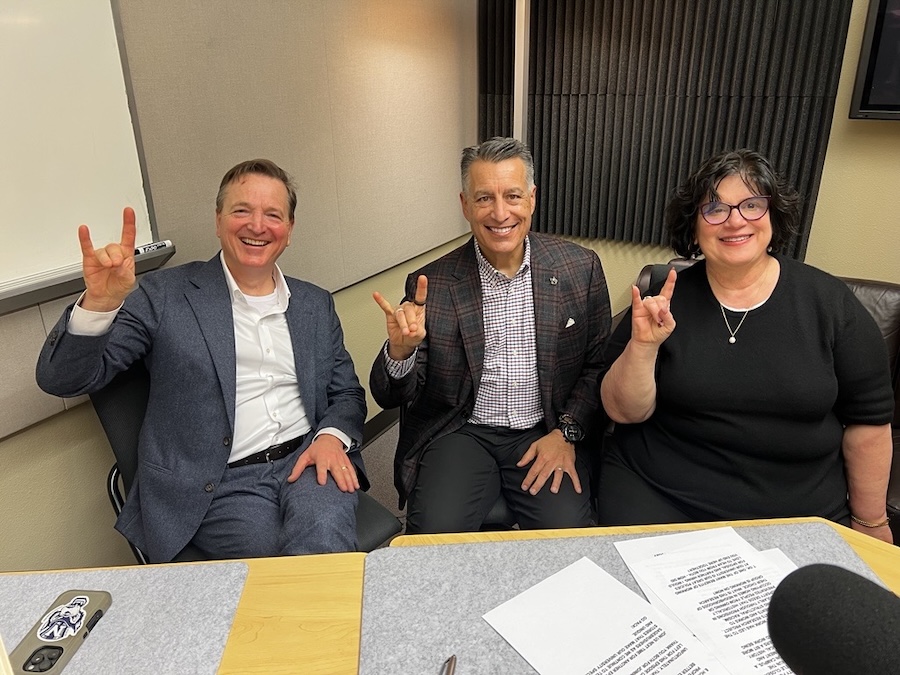
In this episode of Sagebrushers, University of Nevada, Reno, President Brian Sandoval speaks with Dr. Linda Curcio-Nagy, associate professor of history, and Dr. Chris von Nagy, teaching associate professor of history and head of the University's Shared History Program.
Curcio-Nagy discusses her research on the cultural and religious history of colonial Mexico. She also shares her teaching strategies that bring history to life, including classroom games and a student documentary project.
von Nagy details his anthropological and archaeological work across Mesoamerica, from Olmec sites in Tabasco to cave art in Guerrero. von Nagy also highlights the 60-year-old Shared History Program and the importance of oral history.
Curcio-Nagy and von Nagy also expand on the upcoming summer mini-course to Mexico City, which will immerse students in museums and cultural sites while exploring how history is presented throughout Mexico.
Sagebrushers is available on Spotify, Apple Podcasts and other major podcast platforms, with new episodes every month.

Sagebrushers season 5 episode 1: College of Liberal Arts History Department
In this episode, University of Nevada, Reno President Brian Sandoval speaks with Dr. Linda Curcio-Nagy, an associate professor of history, and Dr. Chris von Nagy, a teaching associate professor of history.
President Brian Sandoval: Welcome back, Wolf Pack Family to season five of Sagebrushers. I'm your host, Brian Sandoval, a proud graduate and the president of the University of Nevada. Each episode of Sagebrushers, which by the way was our University's first nickname,we take a closer look at the people, history and future of our University. We have an exciting lineup of guests,this season from all around campus, so let's get started. Today, we are recording in the @One podcast studio of the Mathewson-IGT Knowledge Center. We have a special treat as we have two guests, each of them inspiring students about the people, history and cultures of our world. And they just so happen to be married to each other. Here with us is Dr. Linda Curcio-Nagy, associate professor of history, and Dr. Chris von Nagy, teaching associate professor of history and head of the University's Shared History Program. So, thank you both for being on today.
Linda Curcio-Nagy: It’s great.
Christopher von Nagy: Thank you.
Curcio-Nagy: It’s an honor to be here. This is fun.
Sandoval: Yeah, we're going to have a great, great program. So, Linda, let's start with you. Your research focuses on the cultural and religious history of colonial Mexico. Can you tell us more about that?
Curcio-Nagy: Well, my interest in colonial Mexico actually began in fourth grade when I first learned about the Aztec, or actually the Mexica, which is their real name. Then I became interested over time in how Native American civilizations’ specifically, the Mexica dealt with the arrival of the Spanish and what happened after that arrival. I became very interested in then what happens to Mexican colonial culture with the arrival of African enslaved people and also Asians to create a really vibrant sort of spontaneous culture in the 16th and 17th century.
And so I became very interested, for example, in the recent book, the book that I just finished, about how the Catholic Church attempted to teach the concept of sin to various groups who had never had a concept like that and how that would play out in daily life. So what average people, whether they were Indigenous or African or Asian, how they felt about this idea of sin and how it affected marriage or ideas about divorce, which of course the Catholic Church was opposed to but average people were not. And also, what constituted scandal as people negotiated these different sort of moral patterns and then how they dealt with the idea of death and remorse and the various ideas about the afterlife.
Sandoval: So where do you go to learn about that? About those Indigenous cultures?
Curcio-Nagy: Well, actually, because I'm a cultural historian and religious historian, by its nature, it has to be very interdisciplinary. So, I'm looking at a wide variety of sources, religious texts, inquisition cases, diaries, letters. I also look at plays that were performed, for example, in Native American communities in Nawat that talk about sin and remorse and the devil or the Virgin Mary. So it's really, I'd say for this, the book that I just finished, I looked at probably over a thousand different items. It took nine years of research.
Sandoval: Oh my, what an accomplishment.
Curcio-Nagy: Well, thank you.
Sandoval: Where do you have to travel to, to find these documents?
Curcio-Nagy: To one of the best places in the world, which is Mexico City, to the Biblioteca Nacional, the National Library. And also there are lots of different archives, but the best one, and probably the most organized in Latin America is the Mexico's National Archive.
Sandoval: That's incredible. We could keep going, but I want to go to Chris. And Chris, you were practicing anthropological archaeologist, and your work has allowed you to travel to sites throughout Mesoamerica. Can you tell us a little bit more about what you've explored?
von Nagy: Sure. Let me start with, like Linda, I got interested in the past of the Americas really early as a kid. My dad was an avocational historian. I was always exposed to it. And I grew up in L.A. where there's lots of iconography on schools of the feathered serpent Quetzalcoatl. And you're growing up and like, "What's all this about? " Because I didn't grow up in a Latino household. My father was Hungarian. My mother was German Scot from Ohio. I got really interested in it. And then as an undergrad, began to get much more interested in it and decided to focus my studies on Mesoamerica.
I mean, I almost flipped the coin because I could have gone to the Andes too because the Andes are fascinating with the Inca as well. And I had the privilege of teaching courses on that as well. But in Mesoamerica, I started doing research as a graduate student in Yucatan and the first site I worked at was called Ek Balam. It's sort of halfway between Merida and Cancún near Valladolid. Fascinating site, if you look it up now on the internet, you can see these fabulous excavations that Mexican archeologists have done more recently that have exposed these beautiful, beautiful sculptures that we stood over when we were doing the initial mapping of the site.
But from there, I went on and I did work in Guatemala in the Highlands in some very early sites and was able to—I had the privilege to help out some other scholars in Zacatecas in the northwest of Mexico. But my own research is focused primarily on the Olmec and the Olmec are—it's both a period and an archeological culture. They're the group that were the first to develop cities. They were instrumental in developing writing along with the Maya, full writing like we write where you could write an entire book if you wanted to. Actually, the Maya wrote books. They're very long texts, in later Omex script called the Michoacán script. So, I've had the privilege to work in the Mexican state of Tabasco, which is kind of a mirror image of Mississippi.
It's very deltaic and lowland. There were lots of towns and villages along old waterways. And one of Mexico's earliest cities, a place called La Venta is located there on the western side of the state. And my colleagues and I have worked at a site that's just outside of it. It's kind of like a suburban part of La Venta that happened to have a lot of evidence of elite activities, parties, festivals, feasting, some evidence for early writing of the period as well too. That dates to around the fifth century BCE, just when Mesoamerica is developing writing. It's a really fascinating period of time because this is when Mesoamericans invent the calendar, they invent history, they invent writing, they invent kingship, they invent urbanism. With urbanism comes all the problems of how do you manage a city? How do you run a city? Then they had to figure all that out.
By the end of that first millennium B.C.E., we have some of the biggest cities that we'll ever see in the new world, Teotihuacan. Spent a number of years working there. More recently, I've been working in Guerrero. It's also an Olmec-period focused project. There's a site in mid-highlands of Guerrero just outside of a city called Chilapa de Álvarez, which is the old religious seat of the archbishop. It was actually also the edge of the Aztec Empire. There's still a Montezuma family there. It was such a critical military border for the Aztecs that the Montezuma family, the ruling family in Tenochtitlan sent a cousin to this city, Chilapa, which is its original name. And they just actually lived down the street from where I was with some UNR graduate students living. But we've been working at a site that's adjacent to a Nawat speaking community called Acatlan, The Place of the Reed, that has some very early political and religious ... It would be mural art if it were on a building. It's actually on a cave, so technically it's rock art, but it's this massive, massive early town. So it's a Guerrero counterpart in early urbanism and kingly imagery, ritual imagery that we see also elsewhere in Mesoamerica happening in that millennium. And that's been a really cool project because the Olmec and the Gulf Coast did a lot of their work that we have in sculptural stone.
So, they have these massive boulders that at La Venta were hauled about 60, 80 kilometers, partially along the coast to get there. And they were carved into basically giant thrones. And then in the front of these, there's this cave and in the La Venta figures, our versions, there's usually an elite male sitting there often with a baby. There's imagery of verdant vegetation. In Guerrero, we have exactly the same thing except it's painted on a cave wall and the cave that you have represented in stone is actually a Grotto. We have this figure that's dressed as a bird, a caracara, which is a raptor dancing on top of this throne, which is painted on this cliff wall nine meters above the cave floor. So, there's a lot of comparative work we've been doing and looking into that really fascinating period of time. And as I mentioned earlier, there's a little bit of writing there too, but it's actually a little bit later. There happens to be a date on the wall. Mesoamericans had multiple calendars, so they like to put historical dates all over the place on buildings, on caves, and artifacts. Yeah.
Sandoval: That's incredible. And again, we could keep going, but I'm going to go back to Linda. Linda, you've won many teaching excellence awards, helping to make history really come alive for students. Can you share some of your strategies with us?
Curcio-Nagy: I see how you researched that. There are a couple of approaches I guess I could talk about. One would be that, first of all, I personally think that history is just a fabulous topic. It's fascinating and it should be fun. It's fun to be a historian. It's fun to work in archives and libraries and be a detective and just find all this really cool stuff. But in terms of teaching, I really want to convey that to my students, that it is fun. History is fun and it's fun to be in my class. And as far as strategies go, I've actually done a lot of serious thinking about this, and I've taken a lot of workshops on how to design effective assignments and how to get people to participate in class, also experimented with my students. So for the last two years, I've been creating games for the classroom, and now my latest idea is we're all going to make a documentary.
Sandoval: That sounds amazing. Speaking of amazing, together you're working on a summer mini course this year to Mexico City. You'll be taking students to some of the finest art museums in the world. Linda and Chris, can you tell us more about that? And maybe I'll be joining you on this.
Curcio-Nagy: Oh, you should. You definitely should, President Sandoval.
Sandoval: It will up my GPA, maybe. Yeah.
Curcio-Nagy: Well, Mexico City is home to, I think, the largest number of museums in Latin America. Some of them are small and not well known, but some of them are right up there with the Louvrefor example, the National Museum of Anthropology. And we have a vibrant museum studies program here at UNR, and it seems a perfect idea that the two Mexicanists in the history department would take students to visit those museums. And obviously, Chris will be talking about how those museums are created and how exhibits are created. I will just be talking about, I don't know, but I got to be there. I just got to be there. Every summer for a long time. I've gone to the National Museum of Anthropology and every year there are different items on display, but there's nothing like the five rooms that are dedicated to the Mexica. And sometimes I get teary-eyed, even though I've been there so many times. So got to share that with students.
von Nagy: I'll just add that Mexico City and more generally Mexico, but Mexico City in particular is a center for museum work and art and architecture. And it's not something that a lot of times our students are familiar with. There's not just the Museum of Anthropology. There are multiple art museums you mentioned. There aremuseums for children. There are other political museums on the history of elections in Mexico. It's a fascinating place to just go do museological work to see how people in another country think about their museums and represent themselves. The National Museum of Anthropology that Linda mentioned, it was built very much part of the 20th century reimagining of Mexican national identity. So, you'll have a lot of school kids to go there, just like we have school kids that go to Colonial Williamsburg and the Smithsonian, and they learn about U.S, national identity. Who we are as a nation. The Museum of Anthropology is central for that in Mexico as well too. But I have to say there are lots of fabulous, fabulous regional museums and then archeological sites that are maintained. Mexico has, its Department of Education actually has a section, the Institute for Anthropology and History, and they run a lot of the museums and the archeological sites and actually engage in a lot of really cutting edge research as well. So, it's just a great place. It's close by. Mexico City is a safe place to go. It has fabulous architecture to be seen. You can go see the Templo Mayor, the Aztec temple that's excavated. Right next to it is the National Cathedral, which is—I think they've removed the scaffolding on the inside of this. They were working on and tipping it up a little bit because it was sinking down on one side. They had this little plum bob in it for years as they righted it back up. So it's really just a fascinating place to go. Plus, the food is fabulous.
Sandoval: That it is.
von Nagy: Right?
Sandoval: So let's move a little closer to home. Chris, you have a shared history project here.
von Nagy: Yeah.
Sandoval: Talk a little bit about that.
von Nagy: The Shared History Program. So I have to say that the shared history has been around in a way for 60 years because we actually are the old oral history program that existed at the University of Nevada since the early 1960s, about 1963. And most of that early materials actually shout out to special collections in this building there. So you can go listen to those old oral history interviews and there were some films that were produced too. In the early aughts or the mid-aughts, it became the shared history program. We amplified it a little bit.
So, we do oral histories still. It's very important to our core mission. We also added museum studies and public history. The primary idea is that we have a lot of people who love history and want to study history. The reality is there are not that many history professor jobs on the market. And just like other departments, we have to train people for the contemporary job market. And that means working as public historians, which could be anything from being a professional witness for court trials. We have some friends in Washington, D.C., and, the husband, he made a career of that. Doing research and then being a professional witness, there are a lot of cases that involve deep historical issues that need to be analyzed by professionals. There are plenty of historians who work at various levels of government, whether it's local, or state or federal park service historians. There's a Forest Service chief historian, there are CIA historians.
There's stuff we can't read for a while, but so there are a lot of opportunities for our historians, and we want to train them to be in those positions. Public history, the idea behind it is not just museums and presenting history to the public, that's part of it. Doing podcasts and digital media, that's all part of it. But also simply taking history and making it intelligible to policymakers. What happened in the past? What worked, what didn't work, why? So they can hopefully make better policy decisions in the future. Those are a lot of the reasons for why we have a shared history program. And we have graduate students involved in it. Undergraduates take public history classes, museum studies classes, oral history classes and we're still active in collecting oral histories.
Sandoval: So, Linda, we're running short on time. I'm going to give you the last word. It's amazing that the two of you have ended up at our amazing university together. How did that happen?
Curcio-Nagy: Well, we met in a graduate class at Tulane in anthropology class. We have the same interests in anthropology and history. We had a lot in common when we met. And then I went on the market first, and I came here and just had the best campus visit known to human history. I had so much fun, and I got home; the phone rang. Literally, I walked in the door, offered me the job, and I said, “Yes!” I came for the job in the history department. Chris came with me at that time. We're not going to say how long I've been here, right? We all agree? Alright. But at that time, there wasn't really a spousal hiring policy, so we had to wait a little bit. Then Chris, because of all his anthropological and archeological experience, was hired in the shared history position.
And so, my office is above his. One day I dropped a book and he came up.
Sandoval: As it is at home too.
Curcio-Nagy: He came up the stairs and he's like, "Are you alive up here?” Yea, so.
Sandoval: Well, that’s an incredible story and unfortunately, we’re out of time. But for the listeners, I'm sure they've got the same impression and we've only scratched the surface here, but Indiana Jones has nothing on you, each of you. And we're really blessed to have you here. And this trip that you're taking the students on this summer and the research that you do not only impacts obviously our students in this campus but impacts the globe. And so, we're grateful. And that is the very purpose of this Sagebrushers podcast is to be able to tell these stories. But again, unfortunately, that's all the time we have left for this episode of Sagebrushers. Thank you both for joining us today.
Curcio-Nagy: Thank you.
von Nagy: Thank you.
Curcio-Nagy: It’s a pleasure.
Sandoval: So, join us next time for another episode of Sagebrushers as we continue to tell the stories that make our University special and unique. And as always, go Pack!


