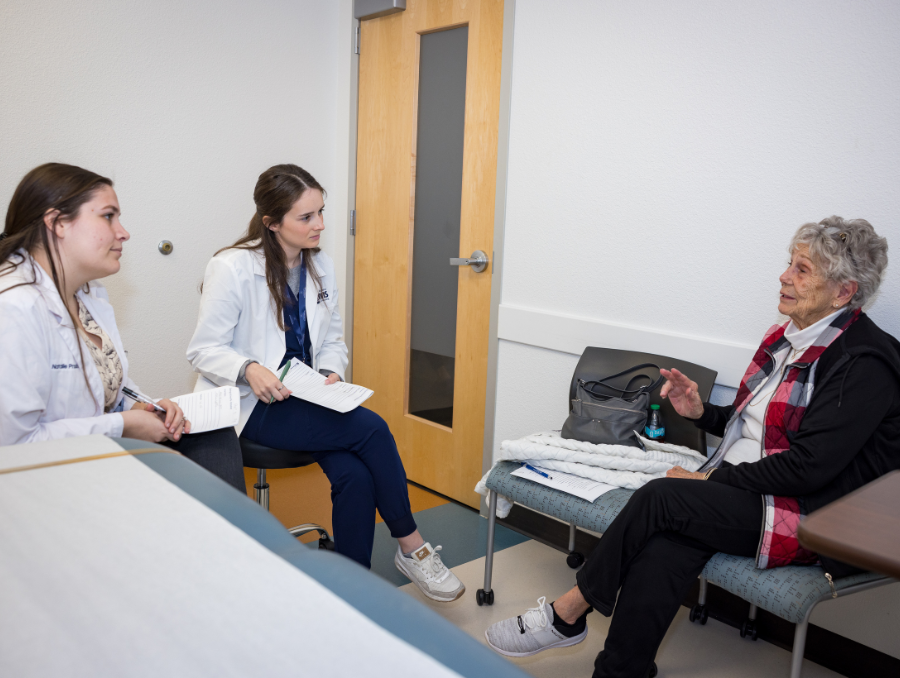
A collaboration with the Orvis School of Nursing, Physician Assistant Studies Program, School of Social Work, Sanford Center for Aging and Osher Lifelong Learning Institute (OLLI) at University of Nevada, Reno offered a half-day experiential learning program for current health care students by pairing them with older adult volunteers for an individual elder assessment. Each assessment lasted 20 to 30 minutes and rather than providing a script, each older adult volunteer spoke from their personal experiences as the students engaged and interacted together, utilizing the 4Ms framework.
“I truly enjoyed participating in this project,” said Sarah Britt, an older adult volunteer for the training event and OLLI member. “I am sure most of the students aren’t used to, or comfortable with, connecting with my generation. They may or may not have grandparents in their lives but probably don’t have conversations with them about their health care.”
Using the 4Ms framework helped students focus on what Matters most to the patient, Medications, Mentation (or mind) and Mobility, all key factors when working with older adults. This framework ensures that health care providers consider the full spectrum of an older adult’s needs as individuals, rather than making assumptions based on age.
“As a future social worker, partaking in an experience like this is incredibly important, especially if you have an interest in working in geriatrics,” said Kiera Escalante, a master’s student studying social work graduating in May 2026. “Not only is it important to be able to provide a quality care to a patient, but it is also crucial to recognize that our patients are people first. Each professional is part of that care team for a reason, but it is important for all of us to remember that the patient is leading the team, and it is my job to help advocate for their needs especially if their voice isn't being heard.”
Each student earned a Certificate in Interprofessional Geriatrics Care by completing recorded content about the 4Ms and participating in the patient simulation on April 17.
“I hope students discover that health is defined by the individual, not solely by clinical metrics,” said Megan Pratt, D.N.P, APRN, associate professor at the Orvis School of Nursing. “This activity challenges students to ask the right questions and listen carefully in order to understand what matters most to each patient. Through the insights shared by our patient volunteers, students begin to recognize their own assumptions and appreciate the value of curiosity, humility and teamwork.”
In total, 65 students from many different disciplines joined 12 older adult volunteers, a combination of OLLI members and community members.
“The event showed me firsthand how different disciplines can apply the 4Ms framework to provide more holistic, patient-centered care for older adults,” said Alyssa Shestack, public health senior, pre-physician assistant and a Sanford Center for Aging volunteer. “Witnessing patients become more open and engaged when asked what matters to them was an impactful reminder that healthcare is not just about treatment, but also about genuine human connection.”
In addition to providing valuable education for future health care professionals, this was an opportunity to include older adults in shaping health care education. Using their real-life conditions provided beneficial first-hand experience for students.
“We don’t have enough providers trained in the care of older adults, so our hope is to have all health care professionals know more about caring for older adults,” said Patti Swager, M.Ed., director of the Nevada Geriatric Education Center at the Sanford Center for Aging. “Additionally, there is a lot of ageism in our culture so having students working with older adults directly can open their eyes to the diversity among older adults and see the individual.”


