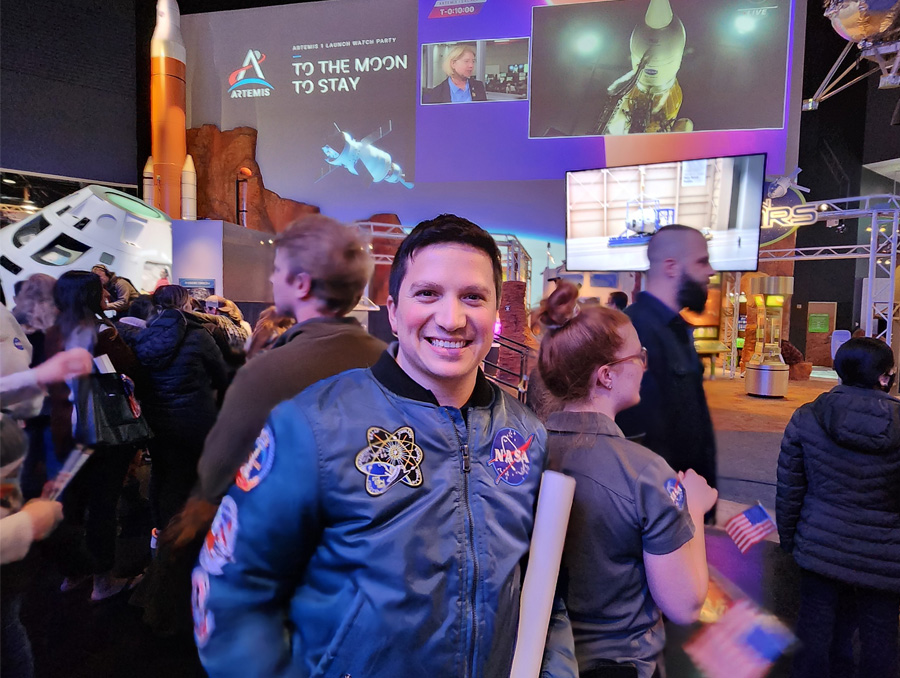
University of Nevada, Reno alumnus Manuel Retana ’18 (mechanical engineering) is helping send humans back to the moon — and making sure they get there safely.
As a project manager at NASA, Retana leads a team responsible for environmental control and life-support systems inside the Artemis II spacecraft. That includes something most people don’t immediately think about: fire suppression.
“I work on environmental control and life support systems. It sounds very fancy, but it’s really the HVAC of the spacecraft — controlling humidity, temperature and the whole atmosphere onboard,” he said. “My area of focus is fire suppression.”
In space, even a small fire can become catastrophic.
“In the event of a fire in orbit, astronauts obviously can’t just open a window,” Retana said. “That smoke has to go somewhere — it needs to be removed so people don’t suffocate. We design filters and masks for that. Essentially, we’re responsible for protecting the crew on their way to the moon.”
His work also includes developing critical tools like fire extinguishers and gas analyzers — sensors similar to carbon monoxide detectors in homes, built for the conditions of space.
The stakes are high, and Retana doesn’t shy away from that reality.
“If we sign off on something and we’re not doing it properly, you kill someone,” he said. “At the end of the day, as engineers, we’re protecting lives. And in this case, it’s the lives of the people going around the moon.”
From a first-generation college student to the moon
Long before contributing to one of the most closely watched space missions of our time, Retana was navigating a very different journey.
Born in the U.S., he spent his early years in Mexico with his mother’s family before moving to Las Vegas to finish high school. As a first-generation student, the path to college wasn’t always clear — but a visit to the Nevada campus changed everything.
“I visited through Upward Bound, and when I got to campus, I fell in love,” he said.
For Retana, it wasn’t just the right academic fit. The University was a perfect launch pad, offering a high-quality education that made pursuing engineering financially attainable.
“Attending the University was the best decision I’ve ever made in my life,” he said.
At the time, the University didn’t offer aerospace engineering; those undergraduate and graduate degree programs were launched in 2025, so Retana chose mechanical engineering as a practical pathway toward his goal.
He made the most of every opportunity — studying abroad in England through USAC, securing internships at NASA, completing research through the TRIO McNair Scholars Program, and staying open to wherever these experiences could take him.
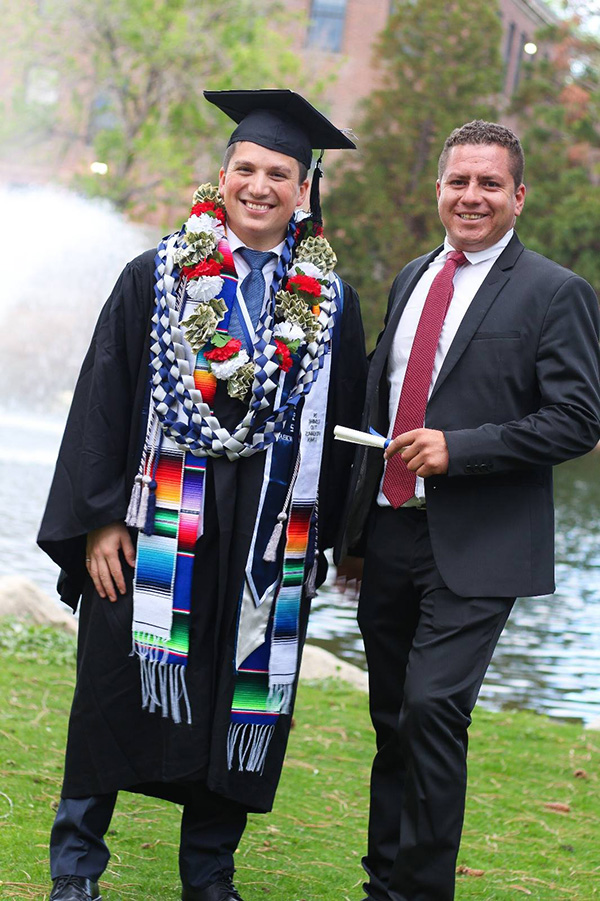
That momentum culminated in 2018, when Retana received the University’s La Promesa Award, honoring a graduating student who has made a significant impact on the community and is bound for graduate study.
That mindset, he explains, made all the difference — actively creating his own path.
“I’m passionate about going to the moon. It’s something humanity has worked toward for decades,” he said. “But I also want to show that we, as Hispanics, can play a big part in it. This is the closest I’ve been in my career to making a real impact — helping astronauts survive. I’m grateful for the opportunity, and I want others to see that we can be part of this.”
Retana carried his sense of identity beyond the classroom. Throughout high school, he played in mariachi bands, and when he arrived on campus and realized there wasn’t one, he created it. “I thought, ‘I’m not going to miss out on that,’” he said. He went on to found Lobos de Plata — “silver wolves” — a student-led mariachi group that remains active at the University today.
Retana credits many of his faculty mentors for helping him succeed. “The University has top-level researchers and engineers,” he said. “They wrote letters for me. They helped me apply for fellowships. Countless people helped me.”
By graduation, Retana had secured a position at NASA. He has since earned a master’s degree in aeronautics and astronautics from Stanford and completed doctoral coursework at the University of Texas at Austin.
From inspiring students in a classroom to protecting astronauts in space, Retana’s journey is a reminder that mentorship and opportunity can travel far — sometimes all the way to the moon.
To help first-generation students reach new heights, please consider a gift to First in the Pack.


