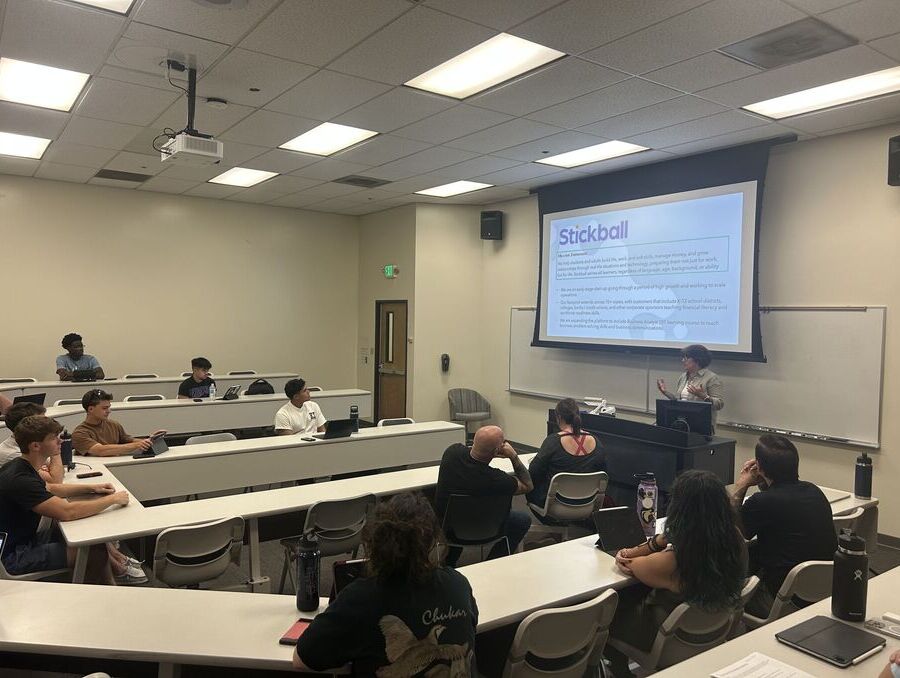
For the first time this semester, the University of Nevada, Reno College of Business introduced a service-learning section within Management 321, a course traditionally focused on business communication. This pilot section offers students the opportunity to apply business communication strategies in real-world settings while partnering with community organizations across the region.
The service-learning section integrates core business communication theory with hands-on experience. Students collaborate with local nonprofits and campus partners to address organizational needs while strengthening their professional writing, speaking and interpersonal skills.
Management instructor Samantha Bickert introduced the service-learning component based on her own experience working with nonprofit organizations and community-based learning.
“I decided to include a service-learning section because community engagement shaped my own education,” Bickert said. “As an undergraduate, I volunteered with nonprofit organizations, and one of those experiences became my capstone internship. Later, as a graduate student at the University of Wisconsin, Milwaukee, I saw how powerful service-learning can be when students connect coursework to real community needs.”
Students in the class are paired with organizations including High Fives Foundation, Skiing is Believing, Stickball, Karma Box Project and the Career & Corporate Outreach Center. Each student completes 15 hours of service throughout the semester, contributing to more than 300 total hours dedicated to supporting local and campus-based initiatives.
As part of the course, students develop a written professional proposal outlining organizational needs, recommended solutions and anticipated outcomes. They also deliver a persuasive, business-style presentation to their community partner and complete mid-semester and end-of-semester reflections to critically assess their growth, contributions and professional readiness.
For student Tito Bayewumi, who partnered with Stickball, the experience highlighted the importance of clear communication and collaboration.
“Learning how to coordinate meetings and make sure that everyone is on the same page was something I found myself doing a lot this semester,” Bayewumi said. “It showed me how important proper communication is and helped me understand what startup businesses really need.”
Community partners say the collaboration has been mutually beneficial. Meghan Ochs of Skiing is Believing shared that students balanced independent and collaborative tasks while learning through real-time feedback.
“They are learning related to the goals of the course and are also helping with much-needed work tied to our mission,” Ochs said. “Addressing communication challenges together has been valuable for everyone involved.”
At the High Fives Foundation, student support arrived during one of the organization’s busiest times of year. Maddie Low noted that the additional help made an immediate difference.
“With so many of us on the road, their support in the office has been instrumental in keeping things running smoothly,” Low said. “The positive energy and reliability they’ve brought to the team already make such a difference.”


