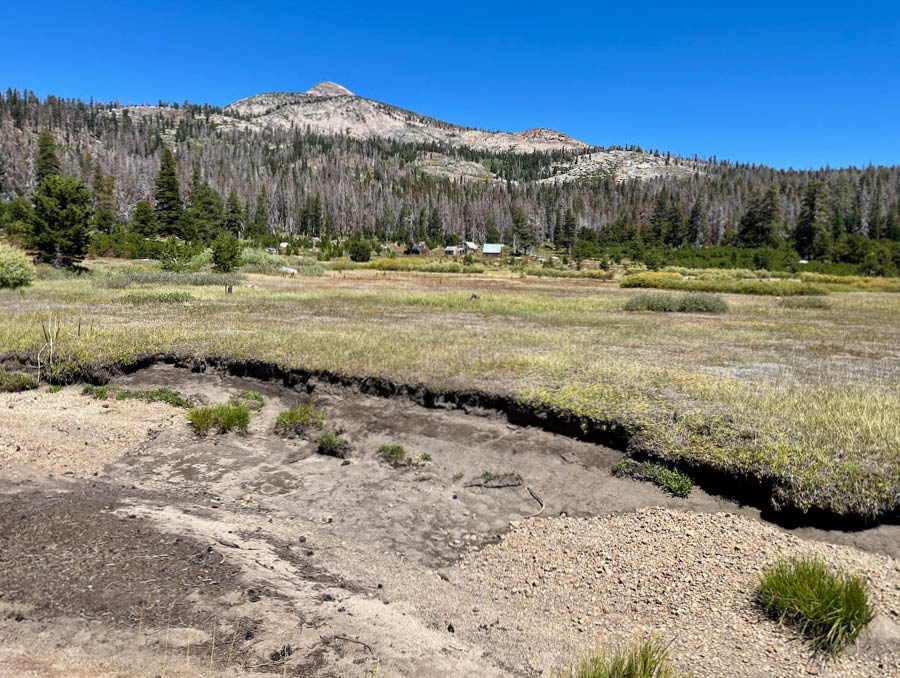

When most people think of solutions to environmental degradation, meadows are not usually the first thing that comes to mind. But research by Ben Sullivan, a soil ecologist in the University of Nevada, Reno’s College of Agriculture, Biotechnology & Natural Resources, has brought new attention to the power of meadows in defending the environment, restoring watersheds and supporting ecosystems. His work may offer an opportunity to address the pressing climate issues we face today.
“I love all meadows, no matter what meadow I happen to be standing in, regardless of condition or location or surroundings” said Sullivan, who also conducts research as part of the University’s Experiment Station “Their magic lies not only in their thriving flora and fauna, but in their significance to protecting surrounding ecosystems and the people who rely on them.”
Below, Sullivan, director of the Nevada Soil Ecology Lab and faculty at the Tahoe Institute for Global Sustainability, answers questions about meadows, their role in ecosystems and why they matter to the climate.
What are meadow ecosystems and are there different types of meadow ecosystems?
Meadow ecosystems are hard to define, but broadly they are locations dominated by herbaceous, grassy plants that have or could have water near the soil’s surface for at least part of the year. There are many different types of meadows. They vary depending on what types of plants live there, how much water they get, and how long the soil stays wet for. There can be steep meadows on hillsides and flat meadows in valley bottoms. Most people don’t know that many of our urban areas were once meadows. Reno, Washoe Valley, and parts of Carson City and Truckee were once meadows. South Lake Tahoe has lots of meadows throughout it, and many of them have been impacted by development.
Notably, meadows have been and still are incredibly important to our local Indigenous groups, who have been advocating for their protection for years – long before we even started researching meadows ourselves.
Why are meadows important as an ecosystem and what factors influence their ecology?
Meadows provide food, water, and habitat for animals of all kinds, and that food and shelter is important in dry mountain environments, like we have in the Lake Tahoe Basin. Meadows provide cool, clean water downstream by retaining water below ground and filtering solids that would otherwise wash downstream. They have soils with lots of organic matter, as much as the carbon and nutrient-rich material like mulch or compost that we often add to our home gardens. This organic-rich soil makes meadow plants tremendously productive if there is enough water.
Meadow plants can be so productive that one acre of meadow can store as much carbon in a year as one acre of tropical rainforest, and unlike in the rainforest, most of this carbon ends up below ground, in the soil. The thing that most influences meadow ecology is the hydrology because plants and soil follow water. If there is water, plants are productive, and the soils gain organic matter. Unfortunately, if management actions have resulted in drying and draining of a meadow, the meadow’s productivity suffers, storing less carbon and affecting the health of both the meadow and downstream ecosystems.
You and the Nevada Soil Ecology Lab have worked in meadows across the Sierra Nevada for more than a decade. What have you found?
We have learned that meadows can gain or lose huge amounts of carbon in soil organic matter depending on how much water a meadow gets. Meadows are wildly productive even compared to Sierra Nevada forests: one acre of meadows can gain as much carbon in a year as six acres of surrounding forest. We have learned that restoration of historically degraded meadows can improve meadow soil organic matter in just a few years, which is an exciting finding as we work to discover ways to continue to protect the environment for years to come.
What can we do to help conserve and restore our meadow ecosystems?
Support our regional water and meadow restoration organizations! The Lake Tahoe region is fortunate to have great folks doing the work of identifying meadows that need help and finding the resources to get the work done. The California Tahoe Conservancy, American Rivers, South Yuba River Citizens League, Truckee River Watershed Council and Plumas Corp are examples of these organizations. Many take donations or hold fundraisers and have opportunities to do hands-on volunteering to restore meadows. This work results in meaningful changes for our montane ecosystems. These organizations work with us to learn the science behind how meadows function and how management can make them healthier.


