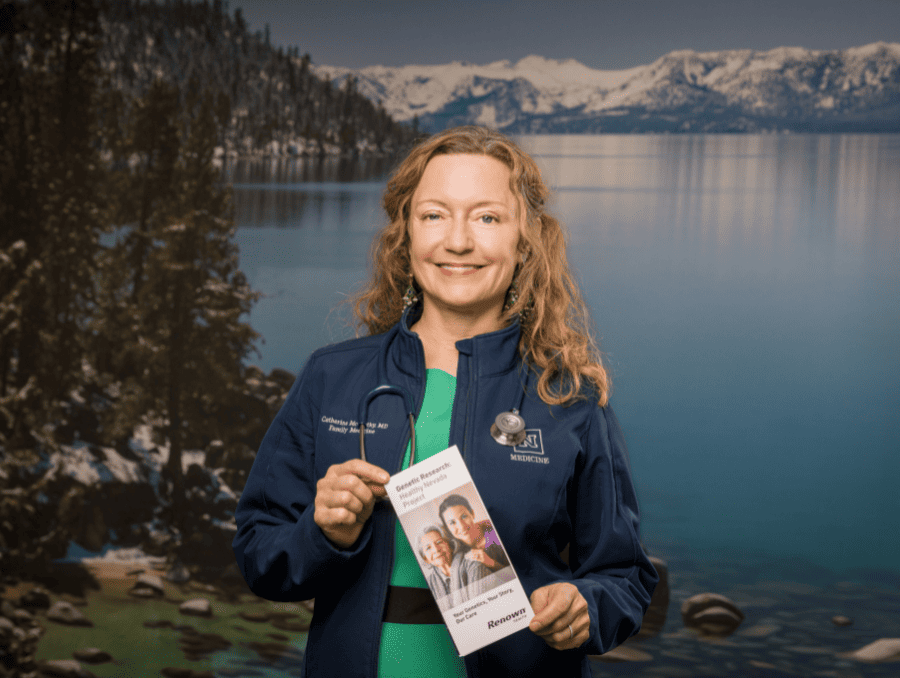
The Healthy Nevada Project provides free genetic testing in the region so individuals can make informed and proactive decisions about their health care. In 2016, Renown Health and the Desert Research Institute (DRI) launched the project to collect data that would become a roadmap to health determinants. So far, the project has enrolled more than 65,000 participants, with still more opportunities for individuals to enroll in the program.
“It is important to note this shows risk and not certainty,” said Catherine McCarthy, M.D., professor of family and community medicine at the University of Nevada, Reno School of Medicine (UNR Med). “The results from the genetic testing can identify an increased risk of cancer even if the individual did not know they were at risk. This provides an earlier preventive strategy that affects the family.”
Getting tested
The Healthy Nevada Project is free and available to anyone 18 and older. The genetic testing is focused on early detection, of the CDC Tier 1 conditions: hereditary breast and ovarian cancer syndrome, (including cancers of the prostate, pancreas, male breast and melanoma) Lynch syndrome (indicating risk for cancers of the colon, uterus, pancreas, prostate, ovary, kidney and more), and familial hypercholesterolemia (indicating risk for high cholesterol early heart disease and stroke).
“It is always heartbreaking to get positive genetic screening results after a cancer is diagnosed, knowing that it might have been prevented or detected much sooner,” said McCarthy. “Knowing risk enables proactive health care, increased screenings, surveillance and prevention.”
After signing up for the free genetic testing, a patient will receive a phone call with the results and a message in MyChart, a secure application where patients can access their electronic medical record. Depending on results, the patient may be referred to a licensed genetic counselor who will help explain the risks and prepare a personalized prevention plan.
“Our program is about universal screening, not just family history, so our research has published the importance of screening all comers, not just identifying those at risk,” said McCarthy. “Anyone interested in participating may speak to their provider or enroll online at healthynv.org.”
The results identify an increased risk of cancer or heart disease but do not equate to a diagnosis. Using the results, a more proactive approach to health care is suggested.
“Regardless of positive or negative results, we see all patients choosing a preventive approach to their health care plans,” said McCarthy. “Prevention is in the wheelhouse of family medicine and with these results, families tend to focus on a more proactive health care plan.”
Cascade screening is available for families if an individual receives a positive CDC Tier 1 result for an increased risk of cancer or heart disease. This helps families create a comprehensive view of the genetic markers that could dictate future medical issues.
Medical training
“I tell my students and residents that genetic testing is another piece of the clinical puzzle to integrate into a preventive strategy,” said McCarthy.
Students begin to learn genomic medicine in their first year at UNR Med, using a patient’s genetic information to guide clinical care. Throughout the curriculum, students learn and interpret how to establish risk, how to speak to patients, and how to use the data for a community understanding of cancer risks in a region. With the Student Outreach Clinic, a student-led clinic available to uninsured and underinsured individuals across northern Nevada, medical students learn what part of the full clinical picture is.
“Personalized medicine is becoming part of routine clinical care,” said McCarthy. “It is a shift to a preventive model where the patient and the medical team do not wait for the disease to develop. Instead, they intervene early, leading to better health outcomes.”
Academically, the Healthy Nevada Project is collecting vast information to contribute to clinical research, which will lead to innovation and improved health care outcomes for Nevadans.
“Genetic testing helps personalize preventive care,” said McCarthy. “That is the direction we are headed in with medicine.”


