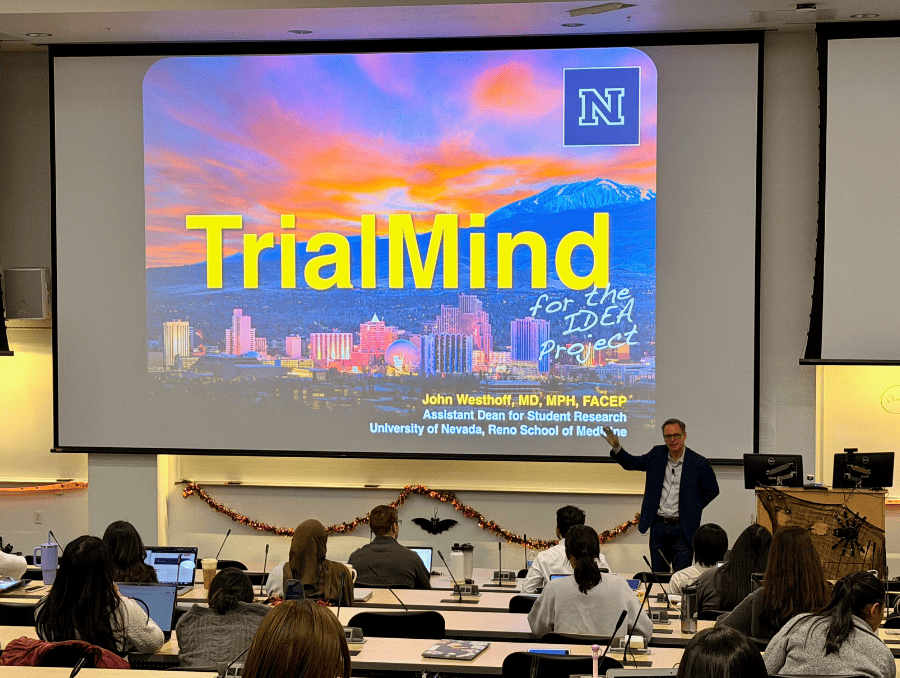
John Westhoff, M.D., MPH, associate professor at the University of Nevada, Reno School of Medicine (UNR Med) and assistant dean of Student Research, created the Independent Data Exploration and Analysis (IDEA) Project, a required research class for first-year medical students at UNR Med, to teach future doctors how evidence is generated and evaluated. The yearlong curriculum incorporates artificial intelligence (AI) tools, giving students a hands-on way to engage more deeply with real-world health data.
When the project first launched, Westhoff’s students used ChatGPT and Claude, but the class has since transitioned to TrialMind, a platform tailored specifically to students’ needs. TrialMind’s literature review function finds, screens and synthesizes studies, while the data science tools assist with coding, statistical analysis and modeling.
Developed by Keiji AI, TrialMind supports literature review, trial design and data analytics, allowing students to learn coding and data extraction skills for research purposes. Its partner organizations include Mass General Brigham, Beth Israel Lahey Health, Regeneron Pharmaceuticals, and Guardant Health. Originally built for clinical researchers and industry teams, UNR Med is the first medical school to integrate it directly into its curriculum.
Within this framework, TrialMind serves less as a shortcut and more as an AI research mentor. While it can streamline time-intensive tasks such as literature review, it also allows students to describe a study design in plain language and translate those ideas into executable statistical code. By not requiring mastery of statistical software, the platform lowers technical barriers while still requiring students to define relevant outcomes, formulate valid scientific questions, and interpret original results. The emphasis is on reasoning, not technical know-how.
“We realized several years ago that our students needed a stronger foundation in how clinical research actually happens,” said Westhoff. “That’s not because we want them to become researchers. We know most won’t pursue research as a career. But every physician has to be able to read the scientific literature and draw the right conclusions. If they can’t recognize weak methodology or understand how study design shapes conclusions, they can’t practice evidence-based medicine responsibly.”
Each cohort spends a full year in the program, with students divided into 18 groups of four. There are different steps and milestones, but students are ultimately have the freedom to tinker and explore, using TrialMind to develop their own individual case studies. The IDEA Project has completed its third year since launching in 2023.
“The experience was formative in shaping my professional trajectory,” said Joseph Tran, an M.D./Ph.D. student in the Ph.D. phase of his training who participated in the IDEA project before TrialMind was introduced. “It showed me that meaningful, publishable research can emerge from asking the right questions and applying accessible, well-defined research methods,” he said. “Through this process, I have been developing the skill of identifying clinically meaningful and policy-relevant questions.”
Students in the IDEA Project have published research on topics such as:
- “Trends and disparities in firearm-related mortality among U.S. children and young adults, 1999-2020” – one of the original IDEA Project teams, a group of just three students from the first cohort.
- “Geographical trends in cerebrovascular disease mortality in the United States, 1999-2020” – The same team had its work accepted for presentation at the American Heart Association’s International Stroke Conference, and their abstract was published in the journal Stroke.
- “Adults 65 years and older not immune to the opioid epidemic” – The team earned an invitation to present at the American Society of Anesthesiologists’ national meeting.
Tran contributed to all three published projects.
“When students see that they can move from a question they develop to a defensible analysis, it builds confidence and interest,” Westhoff said. “Some discover that they want to pursue research more seriously. But even for those who don’t, the experience changes how they read a paper, how they evaluate evidence, and how they think about data.”
Before joining UNR Med, Tran graduated from Stanford University with a degree in computer science, gaining hands-on experience with statistical software such as Python and R. His long-term goal is to integrate emerging technologies into medicine.
“In the context of the IDEA project, one of the most exciting developments is using large language models to lower the barrier to statistical and computational analysis,” said Tran. “Users can spend less time on low-level implementation details and focus on the important things directly impacting patient care.”


