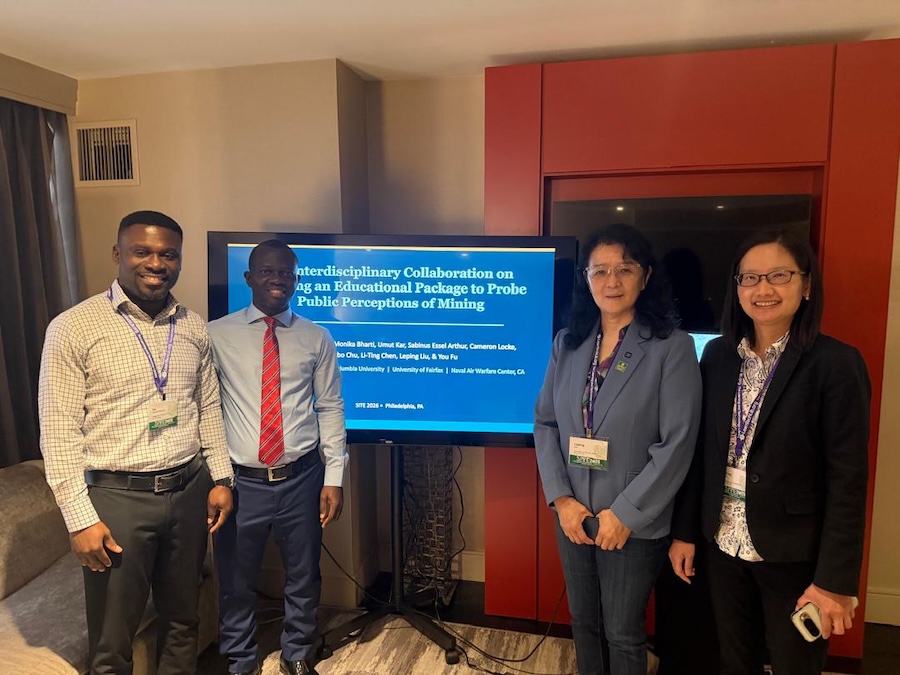
Every year, the professors and students of instructional design & educational statistics at the University of Nevada, Reno present their research at the Society for Information Technology and Teacher Education (SITE) conference. This year, they made 12 presentations at SITE 2026, including participation in two panel discussion sessions, four full paper presentations, one brief paper presentation, four roundtable discussions and one best practices presentation. SITE has held its conference since 1990 and represents individual teacher educators and affiliated organizations of teacher educators in all disciplines.
Akio Abe, M.Ed., is a second-year doctoral student who made three presentations. This was Abe’s second time attending the conference. And as a co-chair of Special Interest Group (SIG) English Education, Abe is responsible for coordinating reviews and decisions for conference proposals, engaging with SIG members throughout the year and hosting the SIG meeting at SITE.
“Serving as a co-chair has been a valuable opportunity to learn how an academic conference is organized from within, not just as a participant,” said Abe. “Through the review process, I have also become more aware of key points in writing papers and proposals. I believe this experience will have a positive impact on my future career.”
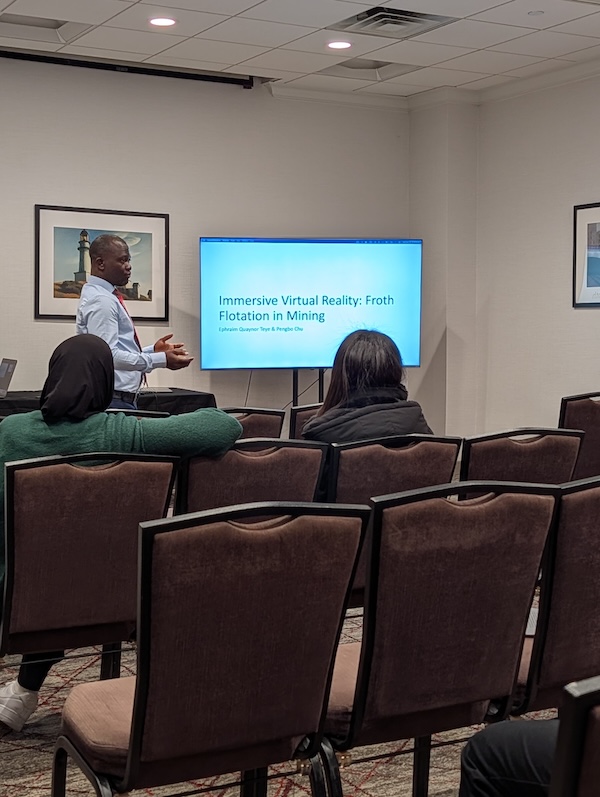
Ephraim Teye M.S., M.Phil., a third-year doctoral student from the same program, made three presentations and engaged the audience as a panelist of “Modern Technology to Enhance Multiple Means of Learning: Customized GenAI, Immersive Virtual Reality, and AI-Generated Videos.” One of his research projects was funded by the University of Nevada, Reno Foundation, in which he and his colleagues developed an educational package, aiming to provide accurate information about mining and mining education to the public. As a panelist, he also shared the design process for the froth flotation immersive virtual reality (IVR) project, funded by the National Science Foundation (Award ID: 2202640). The IVR was designed and developed to improve student outcomes in learning the complex process of froth flotation.
“Attending this conference has deepened my understanding of how instructional design and emerging technologies intersect to address educational challenges,” said Teye. “I hope to leverage this exposure to strengthen my research agenda in IT education, build collaborative networks with international scholars and continue developing instructional solutions that make complex subject matter more accessible to diverse learners.”
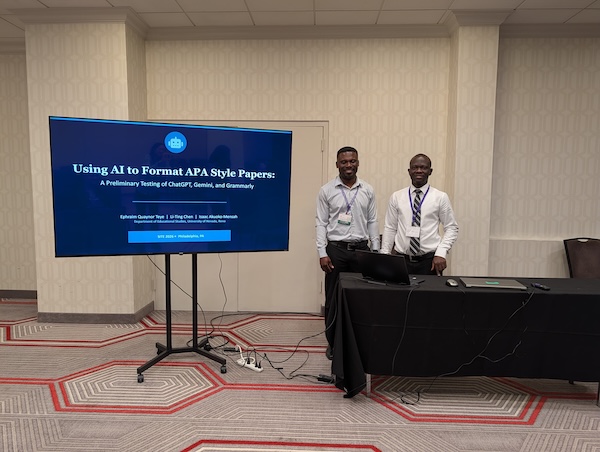
Isaac Akuoko-Mensah, M.S., a second-year doctoral student, gave two presentations and served as a panelist on the “Modern Technology to Enhance Multiple Means of Learning: Customized GenAI, Immersive Virtual Reality, and AI-Generated Videos” panel. Akuoko-Mensah has worked with multiple professors to create an AI chatbot for different purposes. His full paper presentation examined the capabilities of three generative AIs (Gemini, Grammarly and ChatGPT) to answer American Psychological Association (APA) questions. The paper concludes that while AI tools like Grammarly, Gemini and ChatGPT can assist with basic APA formatting, such as margins, fonts and title page setup, none of them achieved a perfect score, and they performed weakest in the areas where students struggle most (in-text citations and reference lists).
“Presenting at SITE 2026 gave me the opportunity to share findings that are directly relevant to how students and educators use AI tools today,” said Akuoko-Mensah. “Our study shows that generative AI can be a helpful starting point for APA formatting, but it is not a substitute for learning the guidelines in the publication manual. I hope this work encourages educators to guide students on using AI responsibly as a supplement, not a replacement, for developing their academic writing skills.”
Priscillar Banda McMillan, BA.Ed., MPH, MBA, a first-year doctoral student in information technology in education who joined the program this spring, served as a virtual panelist of "Modern Technology to Enhance Multiple Means of Learning: Customized GenAI, Immersive Virtual Reality, and AI-Generated Videos." Drawing on over twelve years of professional experience with UNICEF and international organizations, McMillan shared her research on the application of AI-generated videos within a universal design for learning (UDL) framework to support diverse learner populations.
Mabel Sedano, M.Ed., is an elementary school teacher and first-year doctoral student. She shared her study on using podcasts and Microsoft Teams to help her students in taking the English language exam. Her strategy has effectively increased the number of English language learners to pass the district-required language test. She is dedicated to sharing her experience with other school teachers.
“Technology integration in education is here to stay and continues to grow,” said Sedano. “It is important that we stay informed and updated on developments in the field of educational technology. SITE 2026 provided an amazing opportunity to share my work, learn from other educators and be part of a community dedicated to advancing technology in education.”
Adebola Adesina (received her Ph.D. in May 2025) and Cong Zou (M.S., current doctoral student) were virtual panelists for “Project Management (PM) in Instructional Design,” where Adebola emphasized the influential principles that impact the success of PM, and Cong introduced her experiences of multiple-project management. They both emphasized that “PM is one of the most desired qualities for the workforce and employers in the field of instructional design.”
Phillip Tretheway, M.Ed., current doctoral student, co-authored their best practice in “Initial Step to Assess the Use of AI in Learning” which discussed a dynamic assessment model. They pointed out that “dynamic assessment is part of AI-integrated learning, based on the dynamic features of AI tools and applications.”
“SITE conference is one of the largest conferences in the field of instructional design and educational technology,” said Li-Ting Chen, Ph.D., associate professor of Quantitative Methods and Learning Sciences, program coordinator of Instructional Design & Educational Statistics, and co-chair of Research & Evaluation SIG – SITE. “Our faculty members created course assignments that enable students to further develop their coursework into journal articles or conference presentations. Participating in SITE’s annual conference allows students to showcase the knowledge and skills they acquire from the program and to connect with international scholars with similar interests.”
“Our doctoral students demonstrated at SITE their abilities to learn/apply new knowledge, skills and technologies independently or collaboratively by themselves – which is one of the key qualities that our Ph.D. program in information technology in education prepares students to achieve,” said Leping Liu, Ph.D., professor of Information Technology and Statistics, the graduate program coordinator, and a long-time contributor for SITE.


