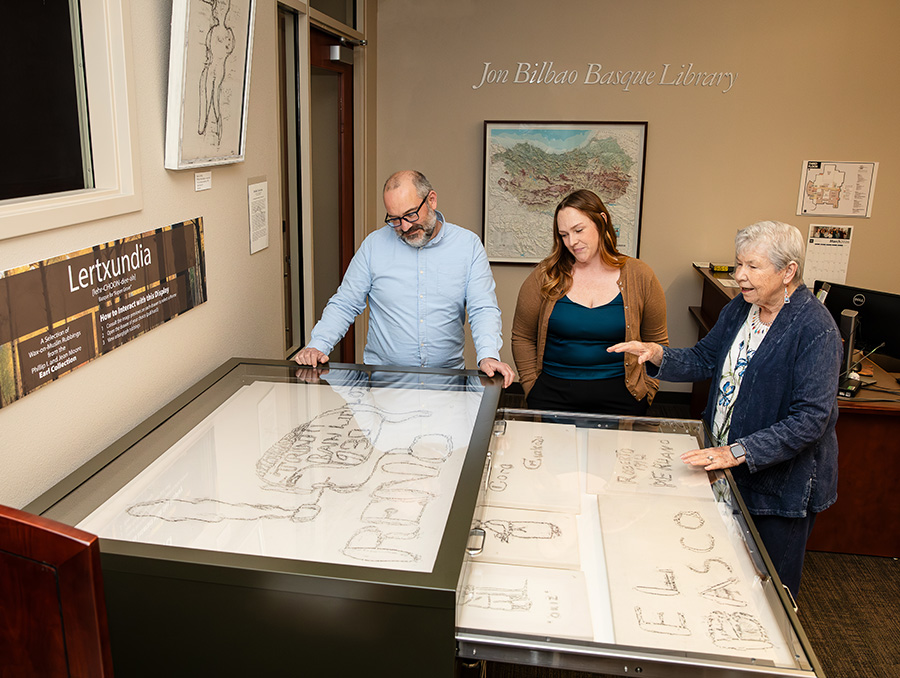
Lertxundia is defined as “A group of,” or “a grove of aspen trees” in Euskara, the Basque language. Lertxundia is also home to a unique type of cultural art, Basque arborglyphs. Artistic rubbings of these arborglyphs are now one of the latest additions to the permanent collection of the Jon Bilbao Basque Library. In 2022, University Libraries donor Jean Earl selected the Library to be the home of her and her husband’s personal collection of original Basque arborglyph rubbings, The Earl Collection.
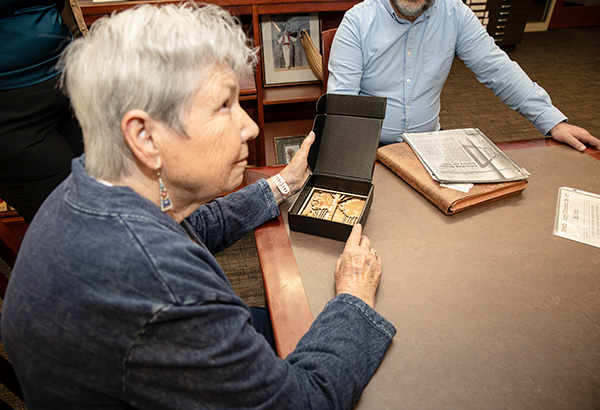
Earl recently visited the Basque Library located on the third floor of the Mathewson-IGT Knowledge Center to see the collection on display. The rubbings are hung in frames on the wall and are also on display inside a large-scale, 12-drawer filing-cabinet-type display case. This donor-funded equipment is much more than a piece of furniture. Lertxundia offers Library visitors an opportunity to go beyond viewing these arborglyph rubbings on a wall or within a storage system, and incorporates visual aids that invite those who are curious to come in and experience this interactive, tactile and visual, display of Basque tree carvings.
Known as “The Mountain Picassos,” this is one of the Basque Library’s newest collections, showcasing 130 arborglyphs that were etched into aspen trees by generations of Basque sheepherders throughout the mountains of the American West. These distinctive figures - along with names, dates, and sayings - were carved by Basque sheepherders starting in the late 19th century until the 1980s. Unique to the area, the Basque tree carvings are beautiful examples of human artistic creativity, even in the most humble of material circumstances, and serve as a historical and cultural record of the Basque sheepherder experience.
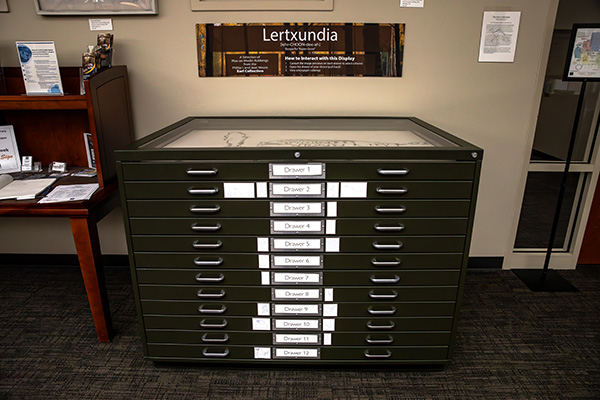
Students, faculty, staff, researchers and community members with an interest in Basque history and culture are welcome to visit the Library during regular business hours to experience and see this uniquely Nevada collection up close.
“It was important to me to donate this collection to a place that would be able to appreciate the arborglyphs for their cultural and artistic significance, and to preserve and display them,” she said. “It was essential they be shared. Because of that, I knew the Basque Library would be the perfect home for them. As I age, I came to realize I didn’t want them to end up in the trash. If you don’t know what they are, you may not understand the deep cultural significance they hold to the men who herded sheep and to Basque history.”
Of the arborglyphs donated, Earl said approximately 85-90 percent of the glyphs featured in the collection no longer exist in nature.
Because of the expertise found within the Basque Library, it is important to note that the Library plays a key role in the Arborglyph Collaborative, a tri-state academic partnership geared towards documenting and sharing Basque arborglyphs.
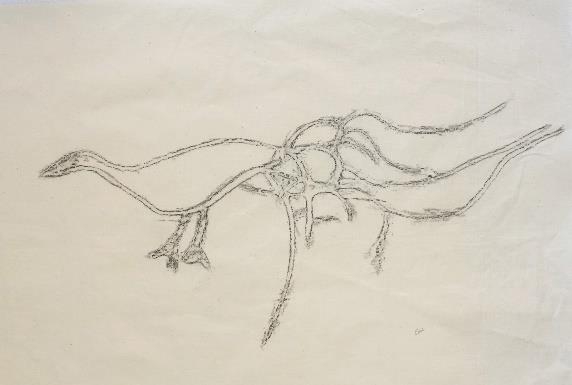
“This art is ephemeral,” she said. “Hopefully, with the collection in the Basque Library the arborglyphs will remain intact for generations to come. I wanted to preserve this art, but it’s really about helping to preserve Basque culture in the United States.”
She said, “Arborglyphs are the art of boredom. Imagine these young men coming to America for the first time, not speaking any English, and then they are given anywhere from 100-500 sheep, a dog, a donkey and a rifle and told, ‘up the mountain you go’ for months and months at a time.
“Surely the fresh, white bark of the aspens were calling to be carved into,” she said. “The carvings were multi-purpose. They were part art, part communication method and part documentation and record keeping. The herder used a knife or nail to carve the image on the tree, similar to a pen and ink drawing. The tree would later play a role in maintaining and modifying while healing the wound.”
What started out as a family activity turned into a conservation effort
For more than half a century, Jean and her husband Phillip used clues from old maps, letters and books to hunt for and document the distinctive figures carved into aspen trees found in the high-country meadows of the Great Basin.
Earl said she was inspired to adventure and find these carvings after seeing an arborglyph exhibit in the Church Fine Arts building on campus in the early 1970s. She also said she loved the artistic nature of the arborglyphs, and that she has always loved and been interested in ethnic art of any kind.
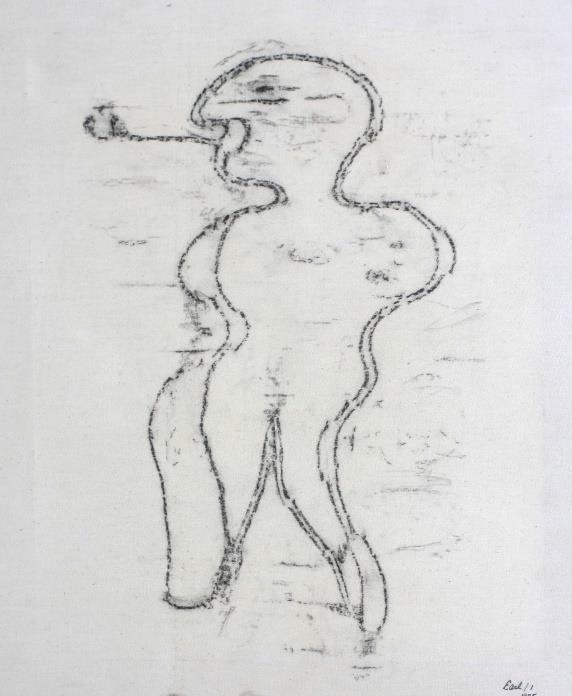
“Back then, we were a young family and didn’t have a lot of money,” she said. “We’d load up ‘Betsy,’ our old Toyota truck, with the kids, grandma and the dog and we’d go hunt for arborglyphs. We knew we needed a meadow, aspens and water, so the first time we went out we stopped in a place that met the criteria for what we needed, and we ended up finding three arborglyphs in the grove of aspen trees.”
The ‘Man with a Pipe,’ her favorite image, was one of them. This was in 1975.
Earl said at this time, they were just photographing what they found, beginning to appreciate the artistic and cultural significance of the images.
“No digital documenting was available at this point,” she said. “At first, we just wanted to find them and see them. Then, when we started returning to the same spots, we noticed some of the arborglyphs were gone or in very poor shape because the trees were dying. When we thought about this, we felt we needed to come up with a way to preserve these images in a permanent format.”
Typically, an aspen tree has an 80-90-year life span.
Trial, error, crayons and Polaroids
Once they decided they wanted to permanently capture the arborglyphs she and her husband were finding, they had to do some trial-and-error testing to figure out how to transfer images to a permanent medium and what materials to use.
“Some of the images are quite large and wrap around the tree. When I thought about capturing them, I felt paper would be too thin to preserve it, and I knew it would tear if I tried to wrap it around the tree. Then I had the idea to use muslin fabric.”
Muslin is a lightweight, breathable, and soft plain-weave fabric made from cotton.
Earl said they knew they could wrap and stretch muslin around the tree. She said she also liked the idea of using it because it would give a neutral background to the transfer of the arborglyph.
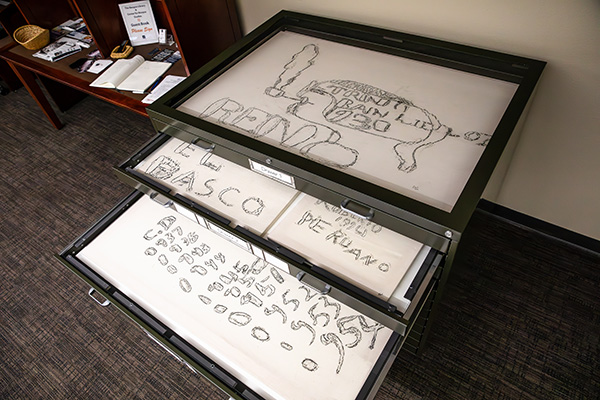
To capture the arborglyph on the tree and transfer it to the muslin, the Earls experimented with different types of crayons.
“I thought to use charcoal, but worried it would smear a lot and not give a true representation of the art,” she said. “Then I tried a keno crayon. That didn’t work either. It was red and left too many smudges. Finally, I thought I’d try rubbing wax but I could not find black in Reno at the time, only umber.
“As I was searching for the right type of crayon to use, I connected with a friend of mine who was visiting England. This friend found what I needed during their trip and brought back several black rubbing wax crayons for me to use.”
Earl said the black rubbing wax was the perfect crayon they needed to capture the arborglyphs. It allowed transfer of the carving’s raised scar, preserving a close-to-exact replica of what had been carved into the tree onto the muslin. However, it wasn’t a perfect system at the start.
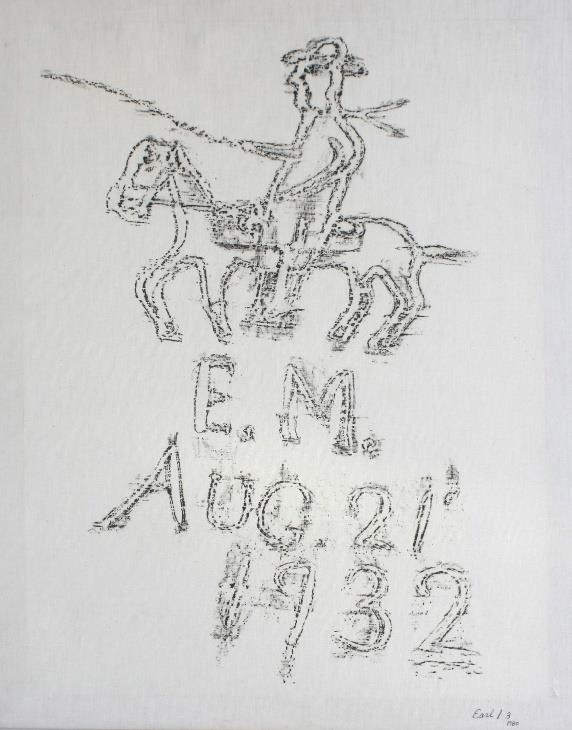
Earl said the first time she tried to capture the “Man on a Horse” she missed his kerchief. Because of this, they began taking Polaroid pictures to use as a reference, to help plan how to capture the image, making sure she didn’t leave anything out. She said then, using the Polaroid as a guide, they would stretch the muslin around the tree and work with the black rubbing wax crayon to document and preserve the arborglyphs.
“The quality of the final rubbing is determined by the tightness of the fabric, the smoothness of the bark, how deeply the carving is incised, and the sure and steady hand of the artist,” Earl said. “We borrowed this technique from the practice of brass rubbing. As a result, I evolved a special process for capturing on muslin the essence of a carving on the curved surface of aspen bark.”
Most of the rubbings in the collection come from four main galleries in areas flanking Lake Tahoe. Three of the galleries are on land under the stewardship of the U.S. Forest Service: Genoa Peak, Pole Creek and Treasure Mountain. The fourth gallery, Glenshire, is on private property with no current public access and no formal stewardship.
Importance of preservation
It was critical to Jean that their collection of arborglyph rubbings be given a permanent home.
“Never in my wildest dreams would I have envisioned this when we started this project,” she said. “Not many people saw any significance to what we were doing, but over time, it was proven that collecting these images had value. It amazes me that what we started doing as a family outing has turned into something as amazing as it has. When I reflect on this, I am happy, but it is not what I was seeking when we started capturing the arborglyph rubbings. I just liked the way they looked!”
In 2011 Jean and her husband published a book, “Basque Aspen Art of the Sierra Nevada,” offering readers a unique look at the little-known aspect of immigrant culture in California and Nevada during the first half of the twentieth century. The years 1920 to 1950 represented the high point of the sheep industry in the western U.S. The mountain meadows of the Sierra Nevada were an important source of summer forage, and Basque sheepherders, many recently arrived from the Pyrenees, were primarily responsible for tending the flocks.
In 2016 the collection was featured in a two-year traveling exhibit titled “The Mountain Picassos: Basque Arborglyphs of the Great Basin,” which was part of the Nevada Arts Council’s Nevada Touring Initiative – Traveling Exhibition Program, and was funded by the National Endowment for the Arts and the Nevada State Legislature.
Jean Moore Earl is now retired from the field of Nursing. She enjoys reading mysteries, traveling, working in the yard and flowers, and working on family genealogy. She is originally from south Appalachia, Virginia, and settled in Nevada after meeting her husband when she was making her way to Alaska as a young woman.
“Well,” she said, “I never made it to Alaska! I wound up finding a home in Nevada.”


