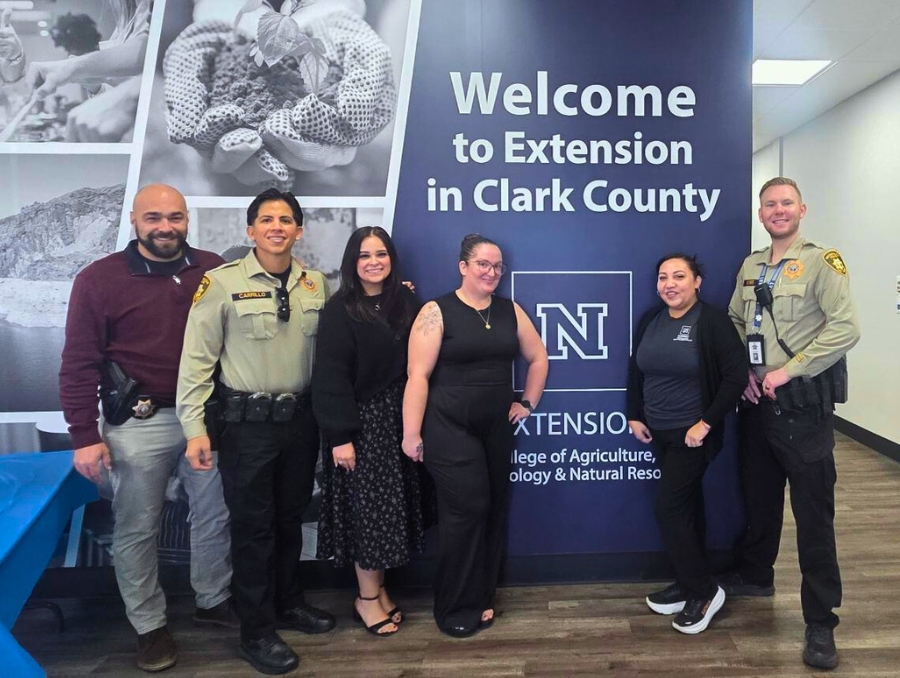
The College of Education & Human Development and the College of Agriculture, Biotechnology & Natural Resources’ Extension unit have been awarded an approximately $87,000 grant from the State of Nevada Office of the Attorney General to support a new trauma-informed training initiative for law enforcement and legal professionals across the state.
Co-PI’s Pamela B. Payne, Ph.D., CFLE, CA, associate professor of Human Development & Family Science, Extension and interdisciplinary social psychology; and Elizabeth Ornelas, Extension lead coordinator for domestic violence and recovery programs, received funding through the Services-Training-Officers-Prosecutors (STOP) and Sexual Assault Services Provider (SASP) grant program for calendar year 2026.
The grant will support the development and delivery of a four-module training series, “Exposure to Action Series: Trauma-Informed Practices Across Systems.” Designed for professionals working at the intersection of public safety, legal systems and victim services, the training will focus on building knowledge and skills that promote survivor-centered, trauma-informed responses across systems.
“Survivors interact with law enforcement and the legal system at some of the most vulnerable moments of their lives, and how those systems respond can significantly impact healing, safety and trust," Ornelas said.
The training series will be offered from May through December 2026 and will provide continuing education units (CEUs) and continuing legal education (CLEs) for registered participants. The curriculum is intended to help professionals better recognize the impacts of trauma, reduce re-traumatization and strengthen cross-system collaboration when responding to individuals affected by violence.
Trauma-informed training helps professionals understand how exposure to trauma, such as violence or abuse, affects an individual’s behavior, decision-making and interactions with systems of authority. Rather than asking, “What’s wrong with this person?” trauma-informed approaches emphasize asking, “What has this person experienced?” The goal is to improve safety, trust and communication while reducing the risk of re-traumatization during investigations, legal proceedings and service delivery.
The project builds on the work of Extension’s Hope for Family Resilience, an program that supports individuals, families and communities impacted by trauma, violence and adversity through education, prevention and capacity-building efforts. The program has its roots in programming that began more than 20 years ago when Extension collaborated with law enforcement in Churchill County to create the Heart & Sheild Program to improve response to domestic violence incidents.
“We are excited to expand our training offerings through this award to include not only our 40-hour Domestic Violence Advocate Trainings (40-hour H.A.T.) but this new Law Enforcement and Legal Personnel-based training series that will be accessible virtually in 2026,” Payne explained.
By partnering with justice and legal systems, the team aims to translate research-based trauma-informed practices into real-world applications that improve outcomes for both professionals and the communities they serve.
“We are honored to provide this training at a time when trauma-informed responses are not just needed, but essential across Nevada,” Ornelas said. “By making this training accessible statewide, we are strengthening the capacity of professionals to respond with compassion, skill and coordination. This will ultimately improve outcomes not only for survivors, but for the communities and systems that we serve.”
Funding from the STOP and SASP grant programs is administered by the Nevada Office of the Attorney General and is intended to strengthen statewide responses to sexual assault, domestic violence and related forms of harm through training, collaboration and system-level improvements.
“We are grateful to receive this support from the Attorney General’s Office as it recognizes not only the importance of ongoing training for law enforcement and legal personnel, but the role of the University of Nevada, Reno in providing high-quality training supported by academic research to support communities across the state of Nevada,” Payne remarked.
For more information about the training series or the Hope for Family Resilience, email hopeteam@unr.edu.


