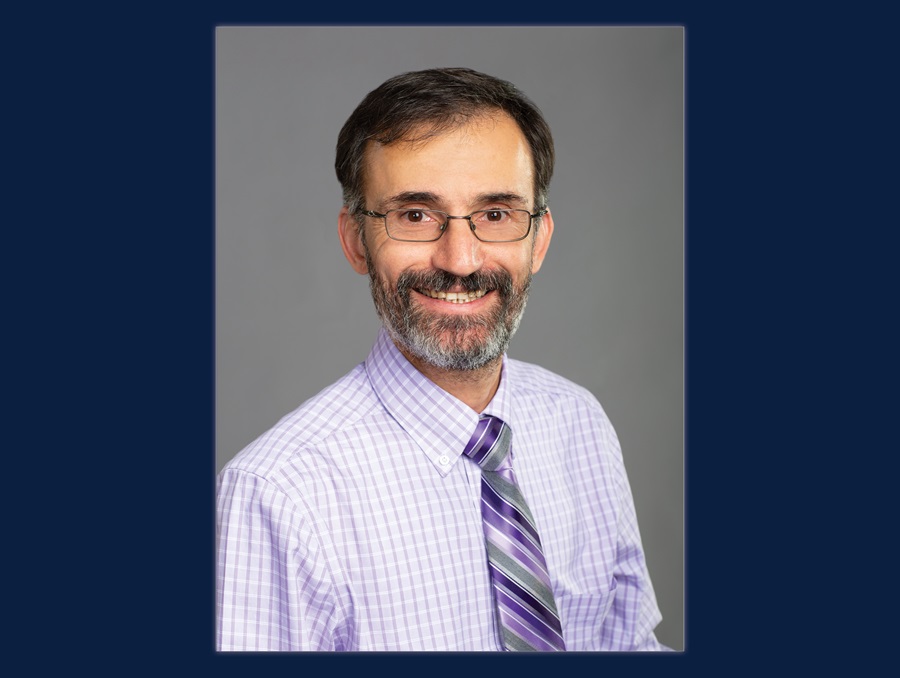
On April 22 and 23, astronauts on the International Space Station will be testing their vision for neuroocular damage with a system designed by Computer Science & Engineering Professor Alireza Tavakkoli.
Four astronauts will use Tavakkoli’s equipment — a vision test taken with a virtual reality headset — to gather data that will help scientists better understand a relatively new phenomenon called Spaceflight Associated Neuroocular Syndrome (SANS).
Since 2000, humans have spent extended periods of time on the space station, where gravity is very weak. By 2009, NASA began noticing changes in the eyes of those astronauts.
“There are changes in the optic disc and in the optic nerve, which connects the eyes to the brain,” Tavakkoli said. “Also, there are changes that are physically happening to the shape of the retina. Over time, these changes could impact vision.”
On Earth, ophthalmologists would examine someone experiencing those symptoms with specialized equipment, but those machines are too bulky to launch into space, Tavakkoli said. He is testing equipment that is lighter and simpler that could gather eye data in space, providing clues on what causes SANS and possibly how to avoid it.
“This phase of the study is primarily for feasibility,” Tavakkoli said. “You want to see if this thing actually works in space, if it's measuring things that it's supposed to be measuring, and if those measurements are consistent. We’re also collecting medical data, too.”
Tavakkoli said the next phase of the study would be to get approval from NASA to link his data with NASA’s astronaut medical database and compare datasets for eye changes before and after flight.
Results from this research align with NASA’s Artemis project, the goal of which is to establish a long-term presence on the moon and Mars. Tavakkoli said it could also help people here on planet Earth who live in remote areas lacking access to specialized medical equipment.
Tavakkoli’s equipment was on the Cygnus XL cargo spacecraft launched April 11 from Cape Canaveral, Florida, to resupply the space station. The resupply capsule reached the space station on April 13, Tavakkoli said. He plans to observe the first tests on April 22 and 23, which will happen around 1 a.m. Pacific Standard Time, from his home. Additional testing has been scheduled for June 18-19, Aug. 28 and Nov. 2. Four astronauts will complete the tests, which each last about 30 minutes. A second round of testing will follow.
Tavakkoli’s project was funded with a $100,000 NASA EPSCOR research award granted in 2023.


