At 6:29 p.m. on Monday, April 13, 2026, a magnitude 5.7 earthquake was recorded by the Nevada Seismological Laboratory, striking southeast of Lahontan Reservoir in the Dead Camel Mountains. While no large-scale emergency unfolded across Northern Nevada, the event set the stage for a powerful learning experience the following day.
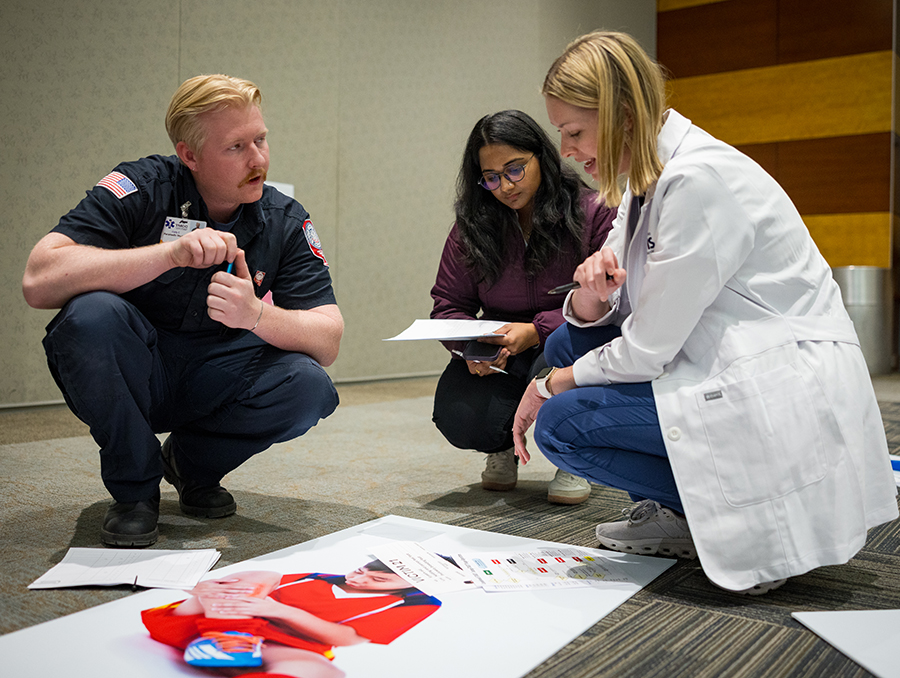
On Tuesday, April 14, more than 150 students gathered inside the Joe Crowley Student Union Theater at the University of Nevada, Reno for Interprofessional Care 2026 — a large-scale disaster preparedness exercise designed to simulate the aftermath of a catastrophic 6.9-magnitude earthquake that resulted in a mass-casualty incident.
“Our preparation for this exercise takes more than nine months, so it was somewhat serendipitous that we experienced an actual seismic event in the state the day before,” Amanda Windes, manager of organizational resilience, said.
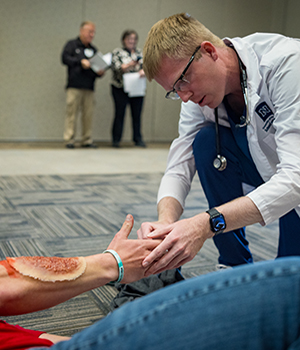 A medical student assesses a simulated patient during the disaster response exercise.
Bringing together students from the University’s School of Medicine, School of Public Health and Orvis School of Nursing, along with participants from the Paramedic Program at Truckee Meadows Community College, the exercise emphasized collaboration across disciplines in a high-pressure, real-world scenario.
“They’re learning alongside students from different programs and even another institution, while experiencing emergency response in action,” said Jim Bellamy, Ph.D., MPH, CNMT, clinical professor and undergraduate program director at the School of Public Health. “It also exposes them to a side of public health and health care we hope is never needed but know is essential. And just as important, it gives them the chance to build connections with community partners they may work with in the future.”
Throughout the afternoon, students stepped into critical roles, working through simulated triage, coordinating patient care and navigating complex decision-making processes using the Hospital Incident Command System. The exercise blended both functional and tabletop components, challenging participants to think quickly, communicate clearly and adapt as new developments unfolded.
“The exercise gives our students a valuable opportunity to learn from professionals who are doing this work every day,” Windes said. “Instead of only reading about it in a textbook, they’re able to see what these situations actually look like and gain a better understanding of what they may face in real-world scenarios throughout our community.”
Participants were tasked with managing limited resources, prioritizing patient needs and coordinating across teams — all essential elements of effective disaster response. The experience provided a firsthand look at the realities of emergency management and the importance of seamless collaboration between health care professionals.
“It’s expected that a patient surge would occur in a health care setting, so students are working through triage scenarios where they suddenly have more patients than available resources,” Jennifer Delaney, organizational resilience training and exercise coordinator, said. “This challenges them to think critically about how to prioritize and categorize care.”
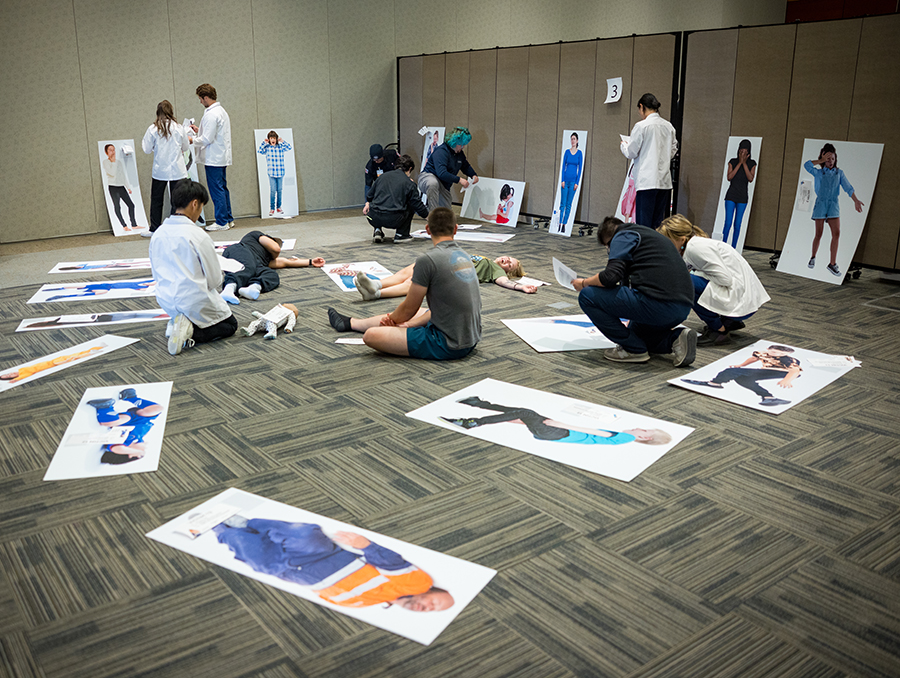 Students across disciplines collaborate during a simulated disaster response, stepping into critical roles to triage patients, coordinate care and navigate complex decision-making using the Hospital Incident Command System.
Interprofessional Care 2026 is part of an ongoing effort to prepare the next generation of health care providers for the complexities of real-world crises. By simulating large-scale emergencies, students gain valuable insight into coordinated care, leadership and the systems that support community resilience in times of disaster.
“I think the most important part is learning how to triage patients — how to prioritize who needs care first based on the urgency of their condition and how quickly they need to be treated,” Arnold Wu, a first-year medical student, said.
The exercise was designed and coordinated by University Organizational Resilience – Northern Command in collaboration with a wide range of campus and community partners:
- University of Nevada, Reno - Orvis School of Nursing, School of Public Health, School of Medicine, Office of Statewide Initiatives
- Truckee Meadows Community College – Emergency Medical Services Program
- Regional Emergency Medical Services Authority (REMSA)
- Northern Nevada Public Health
- Washoe County School District
- Revive Health Senior Care Management
- Alpine Skilled Nursing and Rehab Center
- Northern Nevada Health System
- Saint Mary’s Regional Medical Center
- Renown Regional Medical Center
- Eureka County Emergency Medical Services
- Veterans Affairs Sierra Nevada Health Care System
- Washoe County Emergency Management
- American Red Cross
- Shoshone-Paiute Tribe
- Reno-Tahoe Airport Authority
- Nevada Office of Emergency Management
- Regional Transportation Commission of Washoe County
As disasters continue to challenge communities, exercises like this ensure that future health care professionals are not only clinically prepared, but also equipped to lead, collaborate and respond when it matters most.


