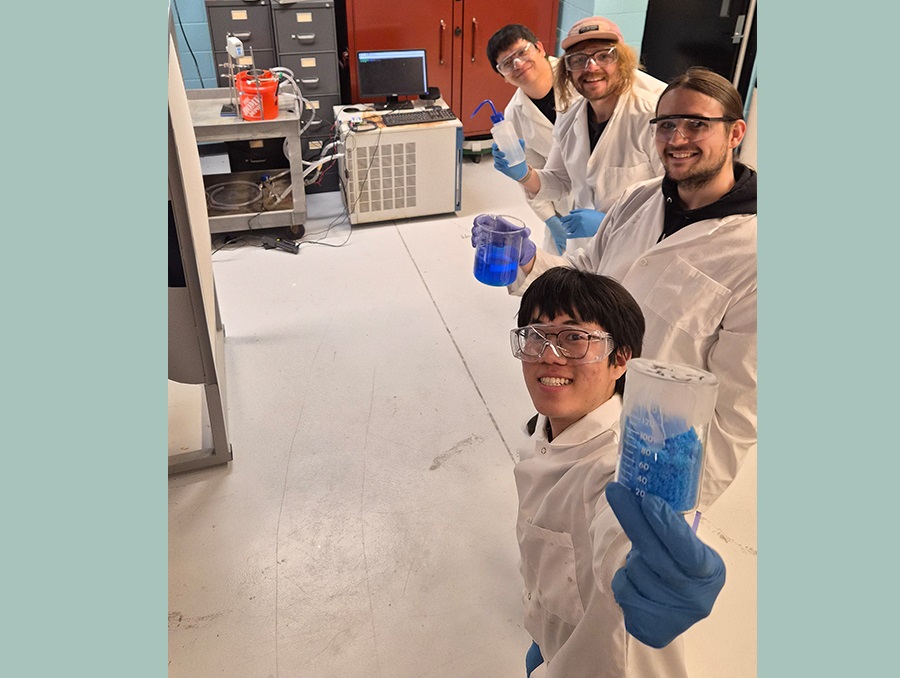
A chemical engineering project demonstrating crystallization – a process used to extract lithium and other critical minerals from liquid solutions – is among the engineering design projects to be showcased at Innovation Day on May 1.
“The hope for our project is that it will ... give future students the knowledge required to operate this process in industry,” senior Bryce Campo, who is studying engineering, said.
Campo and fellow students Corban King, Josiah Guyer and Austin Rorex compose one of 99 student teams presenting projects at Innovation Day. All of the projects will be on display from noon to 2 p.m. in three Engineering buildings: William Pennington Engineering Building, Harry Reid Engineering Laboratory and the Davidson Math and Science Center. All the projects are available for preview now on the Innovation Day website.
Twenty teams will be vying for cash prizes in the Capstone Design Project Competition, which takes place during the event. A 14-member panel of tech industry representatives will judge the teams in two categories: Engineering Design and Impact. Event attendees also can vote for their favorite project in the People’s Choice category, an online contest.
“Innovation Day is when our seniors showcase their capstone design projects, projects they’ve been working on during the past school year,” Nevada Engineering Dean Tom Weller said. “We encourage everyone to come out and see what the next crop of Nevada Engineers are working on.”
‘Make a crystallizer lab’
Crystallization is used extensively in many mining applications to extract metal from ore, explained Chemical & Materials Engineering Professor Charles Coronella. It’s also used in the production of fine chemicals in the pharmaceutical industry.
“That's about as far away from metal production as you can get, but it conveys the importance of crystallization in the process industries,” Coronella said. “Chemical engineering students learn about the theory of crystallization, but as far as I know, none in the U.S. get hands-on practice with it.”
So he proposed a senior capstone project that would create that hands-on opportunity.
Students Campo, King, Guyer and Rorex took up the tightly framed challenge.
“This particular (assignment) was to ‘build a crystallizer,’” Campo said. “Make a crystallizer lab.”
The team created a small lab system for cooling crystallization, one of several crystallization methods. Using copper sulfate – although other compounds could be used – the team has proven its system by creating several blue crystals of different hues.
“We could go on for hours about the trial and error we had as a group in developing the design and experimentation for the process,” Campo said.
The process involves dissolving copper sulfate in water at a temperature of around 70 to 80 degrees Celsius so it's completely dissolved. Then, the solution is slowly cooled to around 20 degrees Celsius. Because water holds significantly less copper sulfate at lower temperatures, the solution becomes supersaturated. At that point, the excess copper sulfate can no longer remain dissolved and has the potential to leave the solution as a solid crystal.
But crystal formation is not automatic and must be carefully encouraged.
“We have to coax it out of the solution,” King said. “And that’s what students (using this system in the future) will be studying – what the best way to get this crystal out of the solution is.”
There are different ways to do that, King said, such as spinning the solution or adding an anti-solvent. The team has focused on the cooling rates, which Coronella says influence the crystal size, which can have a significant impact on the way that the crystals are processed downstream.
Nevada Tech Hub support and industry collaboration
Coronella plans to augment the lab system his students created with an optical probe that will “watch” the generation of crystals as it happens in the system’s reactor in real time. This upgrade is supported with funding from the Nevada Tech Hub, a University of Nevada, Reno-led coalition of government, industry, education and nonprofit organizations to develop the state’s lithium economy.
“It will offer students an opportunity to get hands-on experience with state-of-the-art instrumentation in crystallization,” Coronella said. “With this probe, we might be able to do useful work for industries trying to develop crystallizers for their own operations.”


