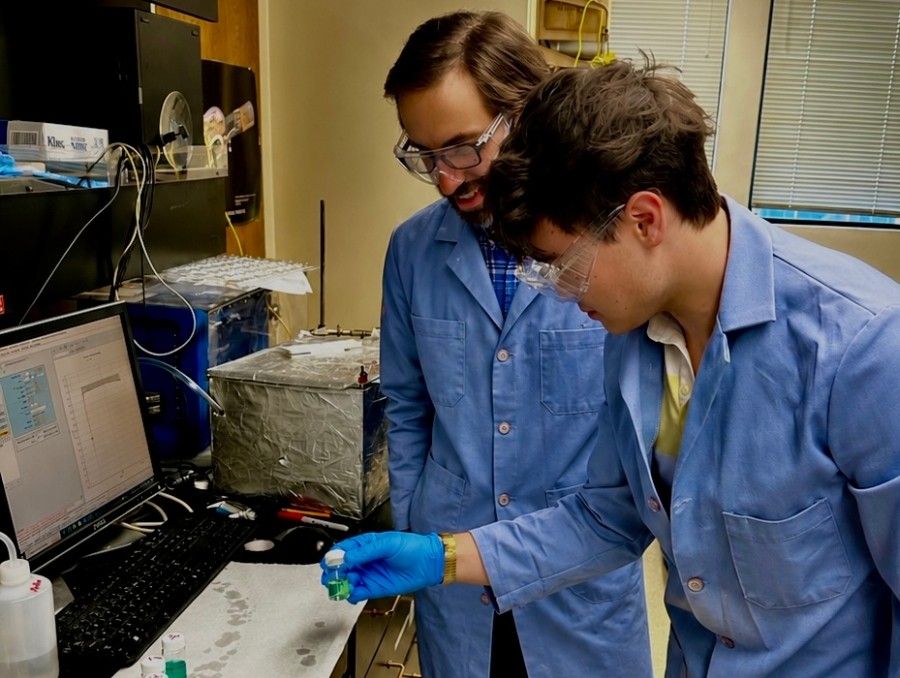
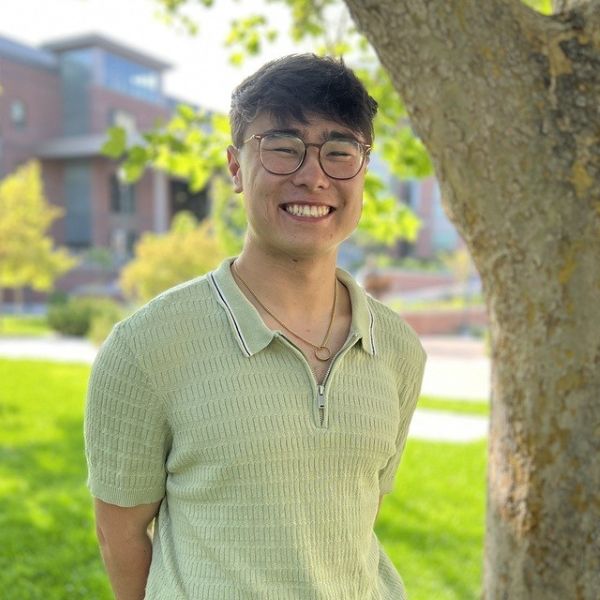
In this first-person narrative, Matthew Shaver – an undergraduate researcher at the University of Nevada, Reno, pursuing dual degrees in professional chemistry and secondary education – discusses his experience being an undergraduate researcher and how that impacted his development as a student. His research focuses on catalyst design and light-responsive materials for energy-related applications. He plans to pursue a doctoral degree in chemistry after completing his undergraduate studies.
A thousand years have rolled by,
with me just sitting here.
I’ve seen the rolling plains transform into forests, where birds would sing.
A hundred years have slipped by,
with me just sitting here.
I’ve seen the lush groves of trees scarred by paths, a widening wound.
Ten years have rushed by,
with me just sitting here.
I’ve seen the paths muddied by human steps until these lands fell silent, birds gone with fear.
- Mattthew Shaver
I wrote this poem after reflecting on the ways that we are often silent witnesses to the changes that happen around us, without even understanding their consequences. We call home to landscapes that have been molded by the gentle hands of time. Yet, looking back, we have impacted the world at an unprecedented pace. Objects made by our hands have been carried away by the winds, waters and ecosystems of our world, resulting in a fingerprint that can never be removed. Even in the most distant corners of Earth, traces of our presence can be found. As an undergraduate researcher in chemistry, I believe that we hold so much potential and power in our hands, from creating efficient energy solutions to curing deadly diseases. With this power, the way we pursue research is something that we must consider.
As a curious lover of chemistry, it is only natural that I want to introduce a fascinating strain of molecules under the classification of per- and polyfluoroalkyl substances (PFAS). This group of chemicals is also known as “forever chemicals” due to their incredible stability from their carbon-fluorine bonds, one of the strongest in organic chemistry. PFAS were made to be extremely resistant against water, grease and heat. With these spectacular properties, you can find these molecules used in almost all areas of life, from the non-stick pots and pans we cook with, to the development of some of the life-saving medical devices we rely upon. The discovery of these molecules is truly amazing. However, the lack of ethics in prioritizing corporate profits instead of public safety has led to large adverse effects on people and animals. Scientific research and discovery are never going to be separate from responsibility.
This conviction is what led me to pursue undergraduate research. Through the support of the McNair Scholars Program and my work in the Barile group, I have had the opportunity to witness firsthand how chemistry research can address many of the world’s most pressing challenges. At the same time, McNair introduced me to a world that I had only known from a distance: graduate school. Through seminars, graduate program visits, Graduate Record Examination preparations, research training and guidance through graduate application processes, I began to more clearly see the road to a doctorate. We are not alone in this world, and this holds ever true when it comes to the journey into graduate school.
"Research does not mean having every answer, but being willing to ask questions, seek answers and keep learning."
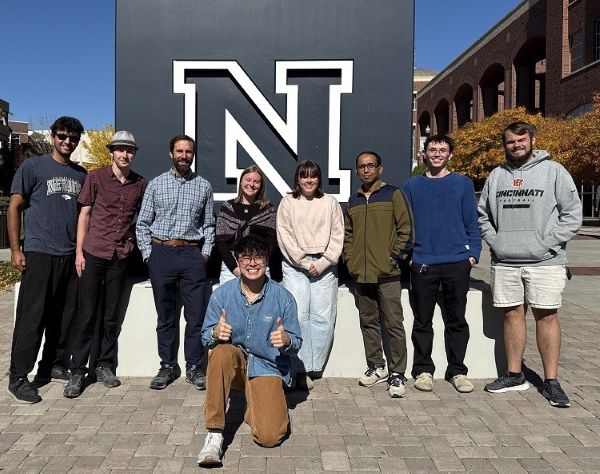
Over our six-week Summer Research Internship, I became close with the 10 students in my cohort. Traveling together to the University of California, Berkeley and Lawrence Livermore National Laboratory, attending a national McNair Research Conference, and working alongside one another during the summer nurtured moments where we could learn from each other as much as from our mentors. I was continually inspired by the resilience and determination of my peers, many of whom had to navigate familial and financial burdens. Being a part of first-generation TRIO Scholars programs has given me the chance to meet the wonderful students and mentors that have helped me flower into the person I am. Under the guidance of Jarell Green and Heather Williams, I have gained so much confidence that the journey towards a doctorate is attainable.
As an undergraduate researcher in Professor Christopher Barile’s laboratory, I have been given such an unimaginable opportunity and freedom to pursue more research than my curious heart could even hold. Joining the Barile group during my first week of college immersed me in a depth of knowledge I had never experienced. As I attended group meetings, it felt as though I was pulled from the kids’ table and given a seat with the adults. Although intimidated, I learned quickly that research does not mean having every answer, but being willing to ask questions, seek answers and keep learning. Working closely with and under the mentorship of Dr. Barile has truly been one of my favorite parts of my undergraduate experience. So much of what I have learned and accomplished is a direct result of his guidance and willingness to invest in my growth. With his support, I recently submitted my first-author paper, “An Azobenzene-modified Pt Catalyst for Tunable Selectivity in Electrocatalytic Oxygen Reduction,” in a peer-reviewed journal. Leading a project has allowed me to experience just how fulfilling the exploration of new frontiers of research is.
Now, my experience with research has not always been filled with endless days of euphoric discovery. Often, I have left lab wondering if I had even accomplished anything. There were many days that I spent replicating past results to no avail or experimenting with new procedures that seem to be designed solely to spite me. In these moments, feelings that I was unqualified and overextending myself arose. What helped me the most was to sit down and reflect on ways I could change my approach. Often, that means being adaptable and willing to explore the vast literature. I would also say that curiosity and genuine interest in your research goes a long way. I am fortunate to say that I love the research that I do, so coming into lab is never a problem; leaving usually is.
My advice to anyone who is even the least bit intrigued by research is to just dive in. There are so many amazing opportunities and resources that we have access to at the University that can be accessed by a short email. Looking back at the emails I sent during the start of my freshman year is almost comedic, but they got my foot into the doorways that I have since stepped through. I would also say that research is going to be filled with so many failures that you may start to wonder if there is even a point to any of them, but failures have been some of my best teachers.
Article written by Matthew Shaver and edited by Undergraduate Research Advisor Ki'Mani Wormwood.


