When Luciana Borges came to the University of Nevada, Reno from Brazil, she brought a question that would shape her doctoral work: why strong public health evidence does not always lead to real-world change.
Now, as she prepares to graduate this spring, her latest research offers part of the answer, showing how tobacco industry messaging can shift how people understand risk, even in places where traditional advertising is restricted.
In a recent study examining tobacco industry corporate social responsibility messaging in Brazil, Borges and her colleagues found that even brief exposure to positive corporate narratives can make people view cigarettes as less harmful, highlighting a gap in how public health policies address indirect forms of marketing.
The study, published in the journal Cadernos de Saúde Pública/Reports in Public Health, was supported through funding from the Institute for Global Tobacco Control at the Johns Hopkins Bloomberg School of Public Health and carried out by an international team of researchers from the University of Nevada, Reno, Brazil’s Oswaldo Cruz Foundation and the institute.
At the University’s School of Public Health, Borges’ work reflects a broader focus on understanding how industries influence health behaviors, policies and public perception, research that connects global findings to public health challenges in the United States.
Understanding the influence of corporate messaging
At the center of Borges’ research is a simple but critical question: if a tobacco company presents itself as ethical, community-minded or environmentally responsible, does that change how people perceive its products?
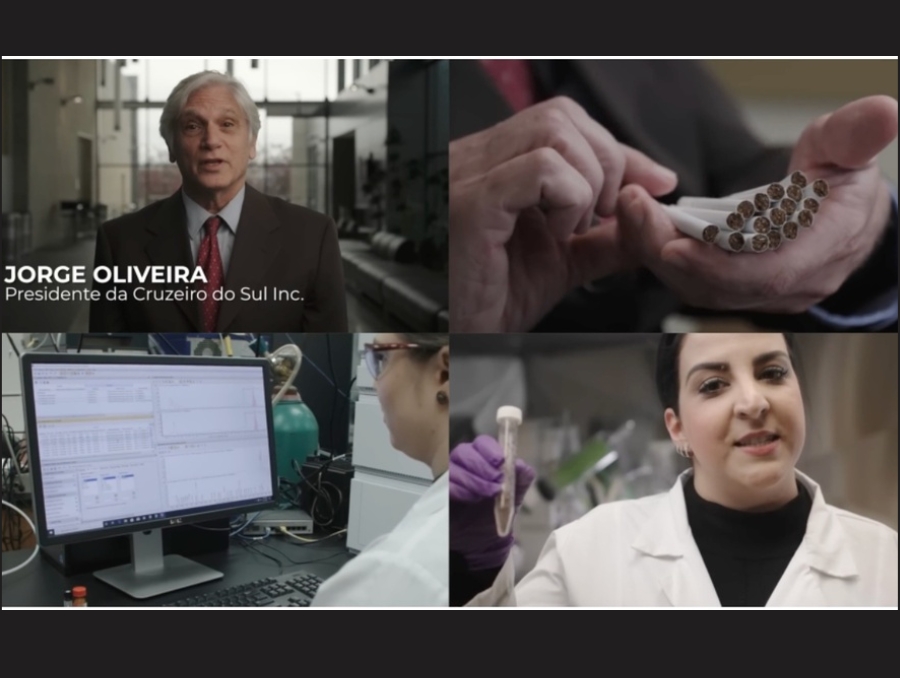
To answer that, researchers conducted a large-scale study in Brazil, where tobacco advertising is restricted but corporate social responsibility messaging remains visible. Participants were shown two short videos for the control condition and experimental condition designed to mirror real-world corporate messaging and were asked about their perceptions before and after viewing.
Even a brief, three-minute exposure led participants to view the company more favorably and, in some cases, to believe its cigarettes were less harmful than those of other brands.
“We found that even a very brief exposure made a difference,” Borges said. “That shift in perception matters, because once people begin to see a company more positively or its products as less harmful, it can open the door to broader influence over time.”
Why global research matters locally
While the study focused on Brazil, its implications extend well beyond one country.
Tobacco companies operate globally, and so do their communication strategies. Messaging that shapes perception in one region can inform how similar approaches appear elsewhere, including in the United States.
“This is not just about Brazil,” Borges said. “It is about how industries shape narratives, and how those narratives influence the way people understand harm.”
At Nevada, that global perspective is central to how researchers approach public health challenges, particularly in areas tied to the commercial determinants of health.
“When study participants learned about our fake cigarette company’s environmentally friendly business practices and support for family farms and local communities, they were more likely to believe its cigarettes were less harmful, which is untrue,” said Jennifer Pearson, Ph.D., MPH, associate professor in the School of Public Health. “This is important because it suggests that public-facing company communications that aren’t regulated as ‘advertising’ can still affect things like harm perceptions, which we know increase the risk that people will use the products. This is essentially ‘sneaky’ advertising.”
Pearson, the study’s principal investigator, also mentored Borges throughout the research process.
A gap in policy and regulation
The findings also point to a challenge for policymakers.
Countries like Brazil have made significant progress in restricting direct tobacco advertising. But Borges’ research suggests that corporate social responsibility messaging can function as a form of indirect promotion, shaping public perception without explicitly marketing a product.
“Our findings suggest that corporate social responsibility should not be treated as harmless communication,” Borges said. “If it changes how people understand risk, then it becomes part of the public health conversation around regulation.”
This has implications for how tobacco control policies are designed, particularly if the goal is to reduce the appeal and normalization of harmful products.
“This research is critical in understanding how health-harming industries like the tobacco industry manipulate consumer perceptions about their products,” said Eric Crosbie, Ph.D., M.A., associate professor in the School of Public Health and Borges’ advisor. “Tobacco companies use these corporate social responsibility programs to repair their credibility as good corporate citizens when in reality it is another one of their deceptive tactics to undermine tobacco control policies worldwide.”
From research to real-world impact
“Luciana’s research has global implications that not only contribute to scientific advancements but have significant policy implications,” said Crosbie. “As she prepares to defend her dissertation, she has really become a global leading researcher on understanding the barriers and facilitators to adopting tobacco standardized packaging policies. These policies help smokers understand the effects of smoking through graphic images and help prevent youth from beginning to smoke.”
“What drew me to public health was the integrative perspective,” Borges said. “It helped me see how law, policy, politics and population health are constantly interacting, and how that ultimately affects people’s lives.”
Borges dissertation is organized around three linked studies that move from the global evidence base to Brazil’s legislative process. The first, already published in Tocacco Control, systematically reviews global barriers and facilitators to adopting tobacco standardized packaging, identifying how legal threats, economic framing, industry opposition and political coordination shape policy outcomes.
The second study examines Brazil’s congressional process, tracing where and how those barriers became consequential as standardized packaging moved through committees, constitutional review and legislative gatekeeping. The third study analyzes the competing coalitions behind the policy debate, showing how public health actors, government institutions, tobacco industry allies and trade-oriented legislators used beliefs, resources and procedural strategies to influence whether the policy advanced, stalled or was redesigned.
“Public health gave me the lens that connected those areas,” she said. “It helped me see how systems, institutions and communication all shape health outcomes.”
From Brazil to Nevada
As a Fulbright Scholar, Luciana Borges came to the University of Nevada, Reno with a clear goal: to bring together the different parts of her academic background into a more complete understanding of public health.
Before arriving at Nevada, Borges studied law, political science, international relations and global health, building a foundation in how policy and institutions shape decision-making. Public health, she said, was where those pieces finally came together.

“What drew me to public health was the integrative perspective,” Borges said. “It helped me see how law, policy, politics and population health are constantly interacting, and how that ultimately affects people’s lives.”
Her Fulbright experience expanded that perspective, pushing her to think across countries, systems and disciplines.
“Fulbright helped me understand that the questions I brought from Brazil were part of something much larger,” she said.
At Nevada, that perspective shaped how Borges sees her responsibility as a researcher. “Not just to produce knowledge,” she said, “but to make that knowledge useful to communities, advocates and decision-makers.”
Defining experiences at Nevada
As she prepares to defend her dissertation this week, Borges is completing her Ph.D. in Public Health with a specialization in social and behavioral health, a program that prepares students for research careers in academia, policy and leadership while focusing on improving health equity and addressing complex public health challenges. Through close faculty mentorship, the program also provides hands-on experience in research, publication and grant writing.
Borges said her experience at Nevada was shaped by the connection between research, teaching and real-world impact. Working with Pearson provided early hands-on research experience that helped shape her focus on tobacco control and related public health issues.
“That experience helped me grow as a researcher and expand how I think about tobacco control,” Borges said.
She also credits Crosbie with helping expand her work through global collaborations, including partnerships with researchers at the Johns Hopkins Bloomberg School of Public Health and other international tobacco control networks.
“That showed me that public health research can be rigorous while still being connected to policy and practice,” she said.
As the lead instructor for PBH 211, Borges also worked closely with students to help them turn real-world concerns into research questions.
“Public health begins with the issues people see in their own lives and communities,” she said.
Looking ahead
As she prepares to graduate, Borges hopes her work will help strengthen the connection between research and action.
“It is not enough to know what works,” she said. “We also need to understand what allows that evidence to become action.”
That includes building stronger connections between research and policy, improving how evidence is communicated and ensuring that public health solutions are designed with real-world conditions in mind.
For Borges, the goal is clear: research that does not just stay on paper, but helps shape policies, systems and decisions that improve health in communities around the world.
“Public health begins with the issues people see in their own lives and communities,” she said.


