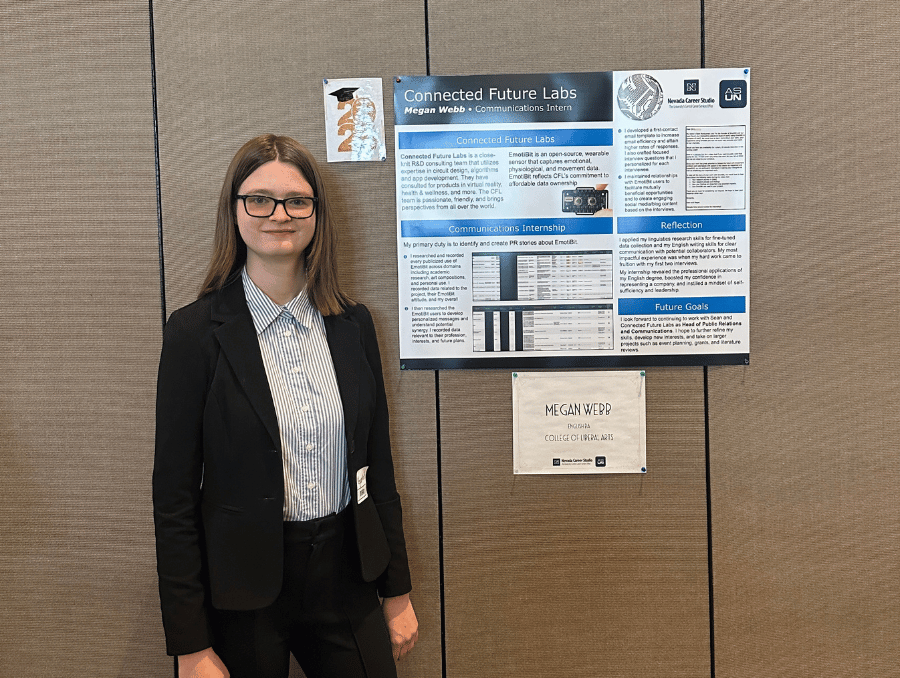
Megan Webb exemplifies the power of leveraging university and college resources to maximize both academic and professional growth. An English language and linguistics major with a minor in business analytics, Webb graduated in Spring 2025 as an Honors College baccalaureate. Her successful time at the University was filled with the challenges of graduating in three years. Yet through a College of Liberal Arts student newsletter, she discovered a way to maximize a “two-for-one” opportunity: earning course credit while gaining valuable work experience to strengthen her resume, an expectation increasingly common even for entry-level positions. This was made possible through the University’s Pack Internship Grant Program, which ultimately paved the way for her post-graduation career.
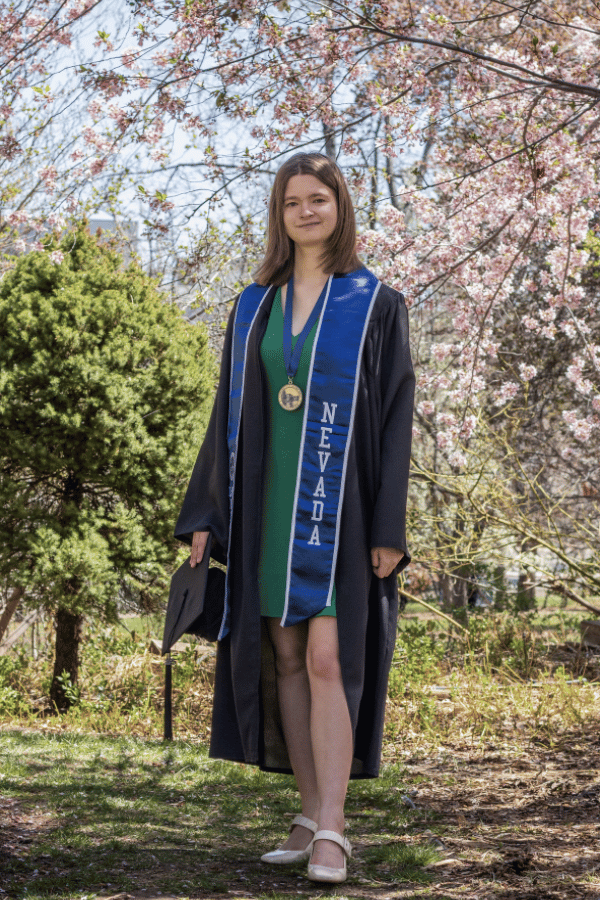 Webb encourages students to consider interdisciplinary studies, as they not only broaden skills but also build confidence after graduation.
Although her focus was on liberal arts and business, Webb had always been drawn to STEM communications. Drawing on her experiences as a University of Nevada, Reno Writing & Speaking Center consultant and an undergraduate researcher in the University’s Department of Computer Science & Engineering, she recognized the fulfillment of interdisciplinary work. Eager to further develop her cross-college skills and explore lingering interests, Webb sought an internship in computer science or another STEM field, knowing it would challenge her and position her for a career that blends analytical expertise with the soft skills cultivated through her liberal arts education. Connected Future Labs emerged as a natural fit, offering opportunities to engage in innovative research and cutting-edge projects.
Through the Pack Internship Grant Program, Webb accepted a communications internship with Connected Future Labs, focusing on promoting brand and product, EmotiBit, an open-source biosensor module used by academics, artists and DIY enthusiasts. Her work included compiling an extensive list of EmotiBit user success stories from the past four years and producing blog posts highlighting the most inspiring examples. The project was particularly rewarding: her research skills allowed her to become an expert on the product, identify and address challenges in consumer engagement data and witness firsthand the broader impact of her work on the community of users and researchers.
Webb attributes much of her success to her liberal arts education. Class projects strengthened her confidence in public speaking and taught her to set realistic, empathetic goals. Conducting literature reviews and independent linguistics research sharpened her ability to analyze complex information, a skill she applied when evaluating over 80 EmotiBit-related publications. Honors College courses and capstone projects trained her to break large tasks into manageable components and develop organized systems, ensuring her work extended beyond the internship. Her minor in business analytics provided insight into applying research findings and capturing nuanced details about user experiences, while reflective writing assignments enhanced her metacognitive skills, allowing her to critically assess her choices and operate independently.
For students hesitant to pursue roles in STEM-based companies, perhaps due to their degree title, Webb offers practical guidance. She emphasizes the value of the application and interview process in clarifying career goals to a hiring committee, demonstrating critical thinking and fostering creativity; skills strengthened by her liberal arts education.
STEM internships, even for students pursuing other disciplines, offer valuable perspectives and opportunities for professional growth. Internships allow students to explore different ways of thinking, develop versatile skills and gain experiences that go beyond the boundaries of a single major. This makes it important to challenge the norm by applying for opportunities that are genuinely of interest to an individual rather than limiting themselves to what seems “logical” on paper.
Following curiosity can open doors to unexpected insights and shape a fulfilling career.
Webb also encourages leveraging resources such as the University of Nevada, Reno’s Writing & Speaking Center and the Nevada Career Studio for guidance on resumes, cover letters and interviews.
Now serving as head of science communications for Connected Future Labs, Webb credits her liberal arts education with preparing her to thrive in a global society. She acknowledges the full-circle effect of committing to her Pack Internship Grant Program during her undergraduate studies. By fostering critical thinking, exposing her to diverse perspectives and nurturing confidence in lifelong learning, her overall experience at the University and the College of Liberal Arts has helped serve as a launchpad for her post-graduate career.


