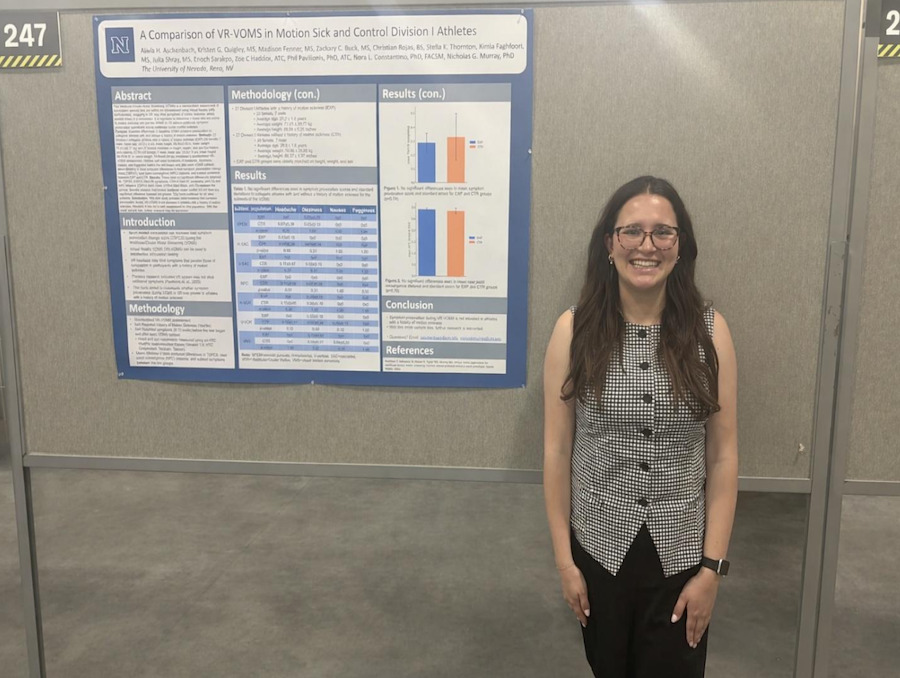
For Alivia Aschenbach, an honors student double-majoring in psychology and Spanish, undergraduate research has provided opportunities to turn an interest in healthcare into meaningful work that is improving the lives of students across Nevada.
A native of Dayton, Nevada, and graduate of Carson High School, Aschenbach chose the University of Nevada, Reno, because she wanted to stay in Northern Nevada while pursuing the academic challenges and close-knit community offered by the Honors College.
"I was looking for classes with academic rigor," Aschenbach said. "I also liked being a part of a community of like-minded individuals."
That combination of academic challenge and connection helped shape her undergraduate experience. An honors psychology course with Professor Dean Hinitz inspired her to continue studying psychology, while her high school Seal of Biliteracy gave her the confidence to pursue Spanish to further strengthen her ability to serve people from diverse backgrounds throughout her future career.
Today, Aschenbach works in the University's Neuromechanics Laboratory, directed by Dr. Nicholas Murray, where researchers study concussions and their biomechanical effects while helping evaluate concussion patients from the community. The laboratory's research seeks to improve concussion evaluation and recovery methods, including educating patients and families about evidence-based approaches that support recovery.
Her interest in concussion research began before she arrived at the University. As a Sports Medicine Career and Technical Education student at Carson High School, Aschenbach saw firsthand the gaps in Nevada's Return to Learn protocols, which help students successfully transition back to the classroom following a concussion, when fellow Honors College student Stella Thornton experienced a traumatic brain injury. Because of this, Thornton helped raise awareness of the challenges students face after concussion injuries and the need for stronger support systems in Nevada schools.
Drawing on her sports medicine classes, Aschenbach assisted Thornton with pilot concussion testing efforts at her high school and later testified about her experiences during legislative discussions surrounding Thornton's Senate Bill 80, landmark legislation that strengthened concussion management standards for Nevada students. Through this work, she met Murray, a connection that ultimately led her to undergraduate research opportunities at the University.
For Aschenbach, the path from student advocate to undergraduate researcher demonstrates how the Honors College and the University of Nevada, Reno help students transform issues they care about into meaningful research and real-world impact. Through faculty mentorship, hands-on research experiences, and support for conference travel, students have opportunities to take their work beyond the classroom and contribute to solutions that benefit Nevada communities.
Aschenbach has received the Honors College Research Travel Grant two years in a row, allowing her to present her research twice at the American College of Sports Medicine (ACSM)’s Annual Conference. There, she gained valuable experience sharing her work with experts in the field.
"As an undergraduate, these experiences are important because research is reviewed and questioned by field experts," she said. "It allows me to become more confident in public speaking and learn how to grow as a researcher."
The ACSM conference also exposed her to emerging research in sports medicine, including topics related to women's health, psychological factors in injury recovery, and concussion management. Just as importantly, it allowed her to connect with other early-career researchers who share her passion for improving concussion care. She is currently working toward publishing her 2025 research abstract.
Aschenbach encourages other students to seek out research opportunities and experiences that connect them with people who share their interests. "I would recommend that others try to do research or attend a conference in order to meet people who share similar goals and interests," she said. "It is very exciting to meet people who are working toward learning the same thing as you."
In addition to receiving support through the Honors College Research Travel Grant program, Aschenbach's conference travel was also supported by the Office of Undergraduate Research and the School of Public Health through a Student Development Award.
Students interested in pursuing undergraduate research, academic enrichment, and experiential learning opportunities through the Honors College can learn more and apply through the University of Nevada, Reno Honors College.


