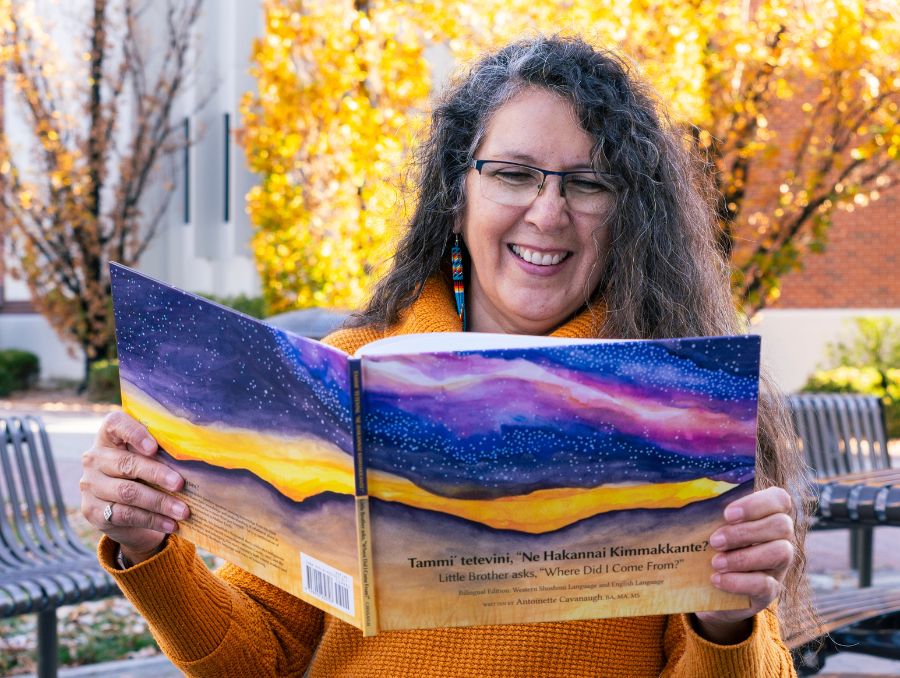
Antoinette Cavanaugh, a Human Development and Family Science doctoral student, will celebrate the release of her first book, Tammi’ (Little Brother), at a launch event on Tuesday, Dec. 2, 2025, from 5:30 to 8:30 p.m. in the Wells Fargo Auditorium at the Mathewson-IGT Knowledge Center. The event will include a discussion, reading, signing and reception.
Cavanaugh was born and raised on the Duck Valley Indian Reservation, home of the Shoshone-Paiute Tribes. She began her career as a teacher and, after earning her master’s degree in Educational Leadership and Higher Education, served as Nevada’s first Native American public school superintendent. She said one lesson stayed with her throughout her career, “Educational institutions must serve all students. Every learner deserves to be seen, supported and provided opportunities to engage in meaningful learning experiences.”
Cavanaugh was accepted into the GAIN Scholars Program, where she decided to earn her doctorate in Human Development & Family Science (HDFS) after realizing how closely it aligned with her research on Native American student persistence, family processes and cultural socialization. She continues to work with Native communities through the University’s Tribal Students Program as a mentor to University undergraduate students.
The idea for her book Tammi’ grew out of a course project in her HDFS 638: Children and Families in a Multiethnic Society course. As she reviewed the literature on Native American families, she recognized gaps in Western Shoshone cultural practices. A story she had carried with her resurfaced, and she decided to write it.
“I began writing the story from memory,” Cavanaugh said. “Then I decided that the Shoshoni language needed to be incorporated to better convey Shoshone Ways of Knowing, as language is closely tied to cultural practice and family and cultural nuances.”
She and her husband, Norman, worked closely to ensure accuracy in the Shoshoni text, referencing the Western Shoshoni Grammar (Crum & Dayley, 1993) and discussing meanings word by word.
“When it got to be too much, we took breaks and honored our result by acknowledging that we were doing meaningful work. Over time, validating the Shoshoni writing came faster and easier. We agreed that spending time with Shoshoni translation, writing and teasing out levels of meaning, increased each of our levels of literacy.” Cavanaugh remarks.
The story follows a young boy, Tammi’, who asks, “Ne Hakkanai Kimmakkante?” or “Where did I come from?” Cavanaugh said the narrative highlights “The role of extended family, the importance of seeking knowledge from elders and the cultural practices grounded in land-based practices and understanding one’s place and relationship in the natural world.”
The illustrator, from a Shoshone/Paiute family, created watercolor images grounded in community knowledge and lived experience. “The illustrations provide an accurate and culturally grounded portrayal of Western Shoshone socialization practices, while the narrative itself reflects core dimensions of family, identity, and cultural continuity,” Cavanaugh explains.
She hopes the book helps normalize Native-authored stories in libraries and classrooms. “Storying is the collective research of our ancestors,” she said. “When gifted a story, it is our responsibility to share it so that our Ways of Knowing are preserved and continued.” The book is also available to be purchased on her website.
Cavanaugh embodies The Wolf Pack Way, by uplifting her community and inspiring others to learn from and honor the Shoshoni language, culture and storytelling.


